6.1.2(d) - Continuous and discontinuous variation
Variation means differences between individuals. In this lesson, the focus is not every cause of variation, but the genetic reason why some characteristics form a smooth range while others fall into clear categories. The genetic explanation depends on how many genes influence the characteristic and how their effects combine.
Spot The Pattern
A phenotype is the observable characteristic of an organism, produced by its genotype and any environmental influence on expression. When you look at variation in a population, the first useful question is: does the phenotype form a range, or does it fall into separate categories?
Continuous Variation
Continuous variation is variation in which individuals show a range of phenotype values with many intermediates between the extremes.
Height is a common example. In a large group of people, there are not just "short" and "tall" categories; there are many possible heights between the smallest and largest values.
Discontinuous Variation
Discontinuous variation is variation in which individuals fall into distinct phenotype categories with no intermediates between the categories.
ABO blood group is a common example. A person is in one ABO blood group category rather than half way between two categories.
[DIAGRAM: gene_number_variation_patterns: Lesson 144: Genetic basis of continuous and discontinuous variation - diagram 01; asset_slug: 144_m06_1_2_genetic_basis_of_continuous_and_discontinuous_variation__diagram_01; recommended_method: drawn_biology; description: A deterministic 16:9 comparison diagram showing continuous variation as a smooth phenotype range produced by many genes with small additive effects, and discontinuous variation as distinct phenotype categories produced by one gene or a small number of genes.]
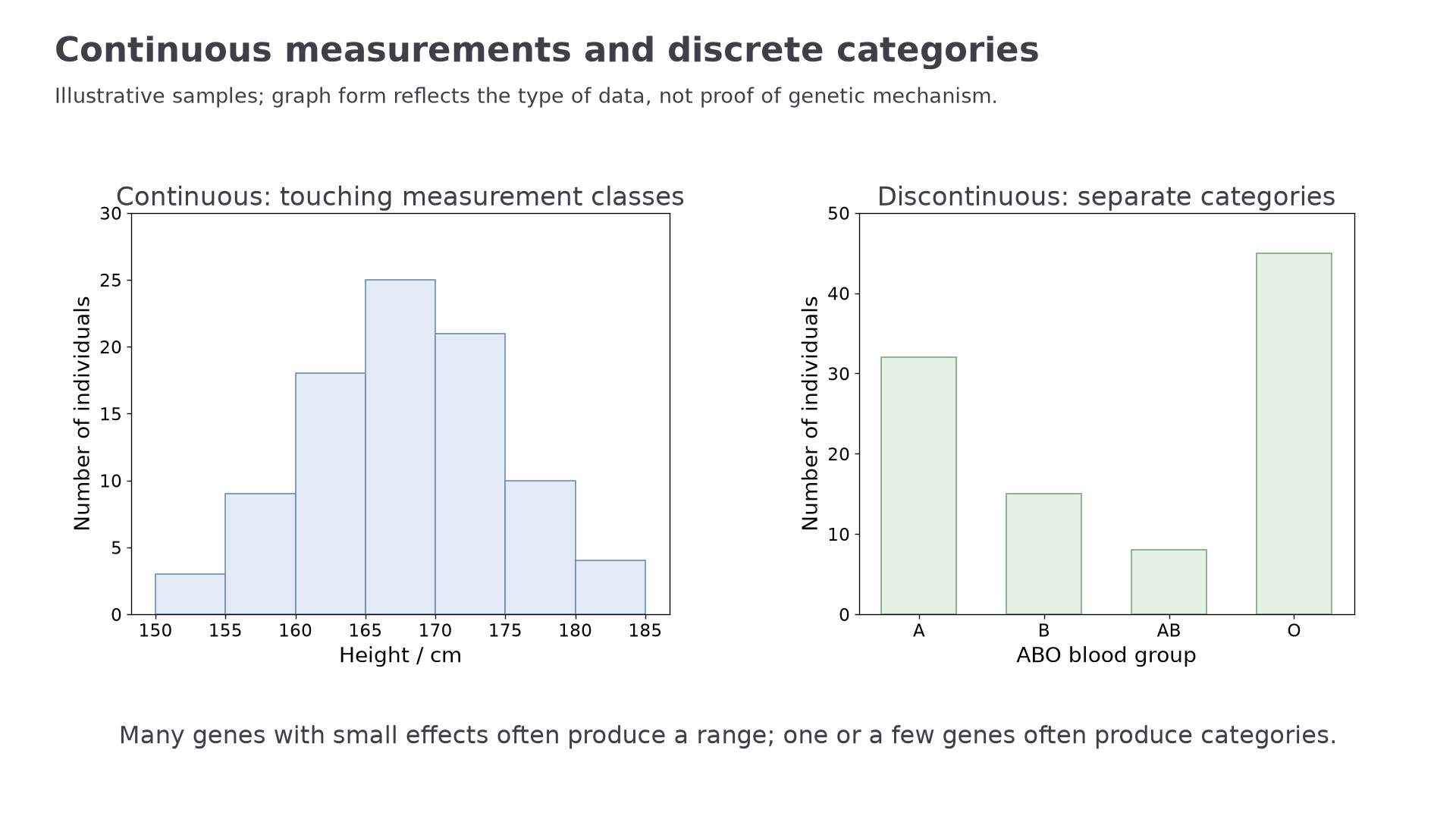
The diagram connects the observed distributions to their likely genetic basis. Continuous variation is usually influenced by many genes. Discontinuous variation is usually influenced by one gene or a small number of genes.
Many Genes Make Continuous Variation
Continuous variation has a polygenic genetic basis. The prefix poly- means many, so a polygenic characteristic is influenced by many genes.
Polygenic Characteristic
A polygenic characteristic is influenced by two or more genes; in continuous variation, many genes usually contribute to the phenotype.
Each gene may have alleles that make a small contribution to the phenotype. When many genes contribute, there are many possible combinations of alleles. Those combinations can produce many intermediate phenotype values, so the population forms a range rather than a few boxes.
Why many genes create a range
Imagine a simplified characteristic in which each contributing allele adds one small unit to the phenotype.
If one gene is involved, there are only a few possible totals.
If two genes are involved, there are more possible totals.
If many genes are involved, there are so many possible totals that the phenotype values can form a near-continuous range in a population.
This is why continuous variation often gives a smooth distribution, with many individuals near the middle and fewer individuals at the extremes.
The environment can also influence many continuous characteristics. For example, height has a genetic basis, but nutrition and health during growth can affect the final measured height. Therefore continuous variation is often polygenic and may also be influenced by environmental factors.
Continue this lesson.
You’re previewing NovaLearn without an account. Create a free account to read the rest.
Create free account