6.2.1(g)(i)-(ii) - Aseptic culturing and fermentation
Microorganisms are useful in biotechnology only if they can be grown safely, predictably and with little contamination. In this lesson you will learn how aseptic technique makes small-scale culturing reliable, how serial dilution and agar plates can estimate microbial density, and why industrial fermenters control conditions differently in batch and continuous processes.
Why Aseptic Culture Matters
A culture is a population of microorganisms grown in a suitable medium. The medium may be solid agar in a Petri dish or a liquid broth in a bottle or fermenter. The medium supplies nutrients, water, suitable ions and, where needed, a suitable pH so the microorganism can grow.
Aseptic Technique
Aseptic technique means using sterile equipment and careful handling to prevent unwanted microorganisms contaminating a culture, and to prevent the culture contaminating the environment.
The problem is that air, dust, skin, benches and unsterile equipment can all carry microorganisms. If a contaminant enters a plate or broth, it may grow faster than the intended microorganism, change the results, reduce product yield, or create a safety risk. Aseptic technique is therefore not just about tidiness; it protects the validity and safety of the culture.
An effective culture needs four linked decisions:
| Decision | Why it matters |
|---|---|
| Use a suitable microorganism | The strain must produce the required product or show the required response, and should be safe for the practical setting. |
| Use sterile equipment and medium | Sterilisation kills microorganisms before inoculation, so growth is more likely to come from the intended inoculum. |
| Use aseptic transfer | The culture is moved into agar or broth with minimal exposure to contaminants. |
| Control incubation conditions | Temperature, oxygen availability, pH and nutrient supply affect enzyme activity, respiration and growth rate. |
A useful way to think about it is this: sterile describes equipment or medium that has no living microorganisms; aseptic describes the technique used to keep it that way during handling.
When asked why aseptic technique is used, give both sides if the question allows it: it reduces contamination of the culture, and it reduces the chance that microorganisms escape into the environment.
Aseptic Transfer On Agar
Culturing on agar plates lets colonies grow on a solid surface. A colony is a visible group of microorganisms that usually grew from one original cell or small cluster of cells. A spread plate is useful when a small measured volume of diluted culture needs to be spread evenly over agar.
[DIAGRAM: aseptic_spread_plate_workflow: Lesson 160: Aseptic culturing and fermentation - diagram 01; asset_slug: 160_m06_2_1_aseptic_culturing_and_fermentation__diagram_01; recommended_method: drawn_biology; description: A deterministic 16:9 workflow showing a disinfected bench, Bunsen updraft, sterile agar plate, flamed inoculating loop or sterile spreader, brief lid opening, spread plate, inverted incubation, observation without opening and safe disposal.]
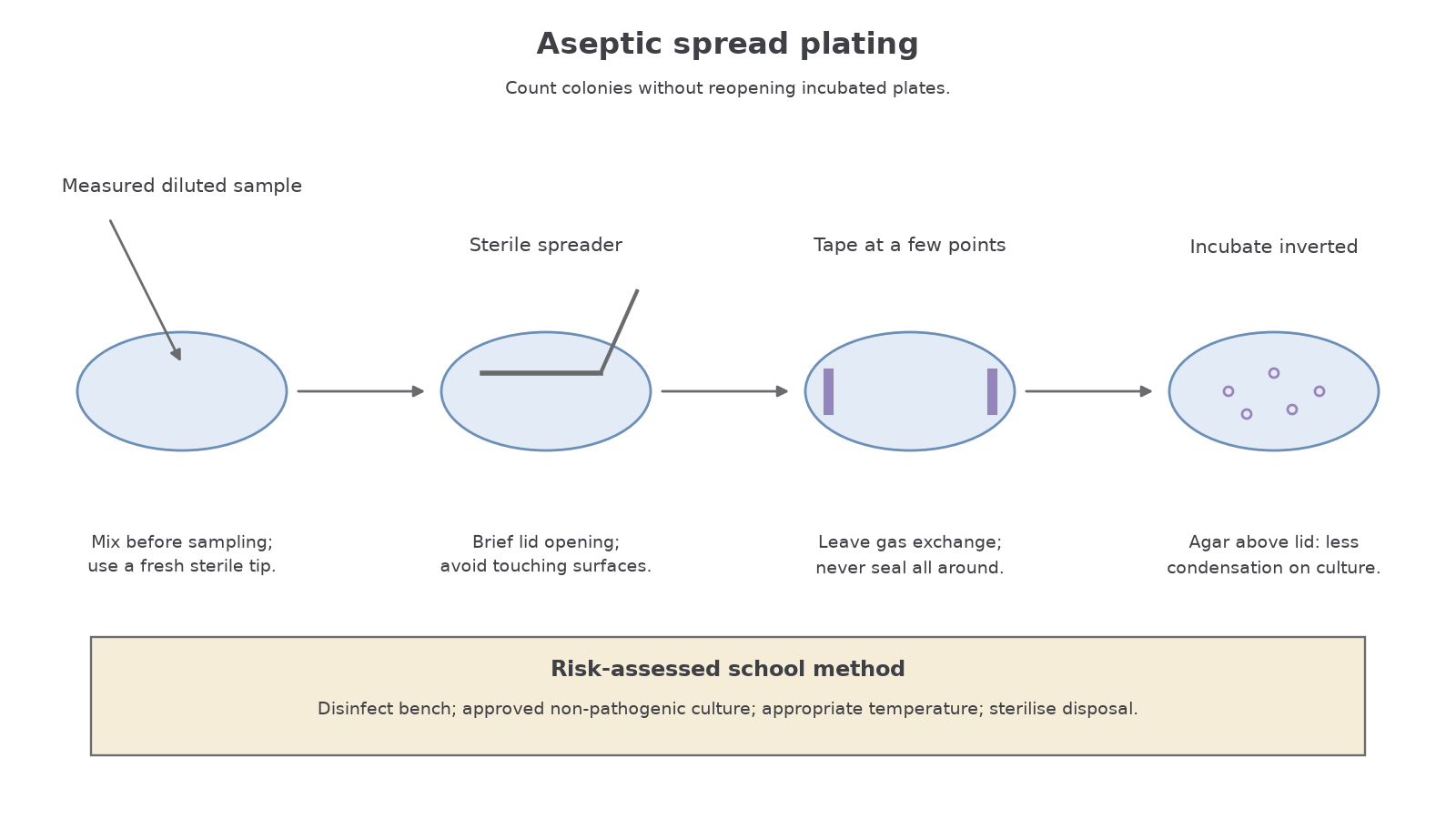
The exact apparatus can vary, but the reasoning behind the method is consistent.
- Disinfect the bench and arrange all equipment before starting, so plates and bottles are open for the shortest possible time.
- Use sterile agar, sterile pipettes or loops, and a culture from a suitable safe source.
- Work close to a Bunsen burner flame where this is part of the centre's risk-assessed method, because the warm air current helps reduce airborne contamination.
- Flame-sterilise a metal loop before and after transfer, then let it cool so it does not kill the inoculum.
- Open culture bottles and Petri dish lids only briefly; lift a Petri dish lid like a shield rather than removing it fully.
- Spread the inoculum evenly across the agar surface using a sterile spreader or loop.
- Secure the lid with tape at a few points, but do not seal it all the way round, so harmful anaerobic conditions are not encouraged.
- Incubate plates inverted, usually at a school-safe temperature such as room temperature or below 30 °C unless the approved method states otherwise.
- Observe without opening the plate, then sterilise or dispose of cultures safely according to the risk assessment.
Every aseptic step has a purpose: either keep unwanted microorganisms out, keep the intended culture in, or make the result valid enough to interpret.
Serial Dilution And Colony Counts
An undiluted broth culture may contain so many microorganisms that a spread plate becomes a continuous lawn of growth. That is not useful for counting. A serial dilution solves this by repeatedly diluting the culture by a known factor, then plating a measured volume from one or more dilutions.
Serial Dilution
A serial dilution is a stepwise dilution in which each tube is diluted by the same known factor, such as a tenfold dilution each time.
For a tenfold dilution series, 1 cm³ of culture could be added to 9 cm³ of sterile diluent. The first tube is then a dilution. Repeating the same step gives , , and so on. A sample from a diluted tube can then be spread onto agar.
When colonies are counted, the result is often reported as colony-forming units per cm³, or CFU cm⁻³. The wording is careful because one visible colony may have started from one cell, a pair of cells, or a small clump.
Original Microbial Density
Here, the dilution factor is the reciprocal of the dilution. For a dilution, the dilution factor is .
Estimating Microbial Density
A student spreads 0.1 cm³ from a dilution of a broth culture onto an agar plate. After incubation, the plate has 48 colonies.
The original broth culture is estimated to contain colony-forming units per cm³. This is an estimate, so the method should use repeats and a dilution that gives separate countable colonies.
A plate with too many colonies is unreliable because colonies overlap. A plate with very few colonies is also unreliable because random variation has a large effect. The best practical answer is not "use the most colonies"; it is "use a countable plate and repeat the procedure".
Mix the original sample and each dilution before transfer, and use a fresh sterile pipette tip for each step. Otherwise cells settling or carry-over from a concentrated tube can invalidate the calculated dilution. Plate several replicates from the same dilution and calculate a mean colony count; an uninoculated plate handled in the same way checks contamination.
Continue this lesson.
You’re previewing NovaLearn without an account. Create a free account to read the rest.
Create free account