6.3.2(c) - Conservation and preservation
Protecting nature is not one single idea. Sometimes humans protect biological resources by managing them carefully; sometimes the aim is to keep them away from human use or disturbance as far as possible. In this lesson, you will learn the difference between conservation and preservation, and how to justify conservation using economic, social and ethical reasons.
Biological Resources And The Decision Problem
A biological resource is any useful component of biodiversity. It may be a gene, a species, a population, a habitat, or a whole ecosystem process that humans depend on or value.
Biological Resource
A biological resource is a component of biodiversity, such as genes, species or ecosystems, that has actual or potential value to humans or to the functioning of living systems.
The word resource does not mean "only useful if sold". A resource can have direct economic value, such as fish, timber, fibres, medicines or crop genes. It can also have indirect value, such as pollination, soil formation, water purification, flood protection, or a stable habitat that supports many species.
This matters because biological resources can decline. A population may be overharvested. A habitat may be disturbed. A species with useful genes may become extinct before those genes are understood. Once genetic diversity, species or ecosystems are lost, they may be impossible to recover fully.
| Type of biological resource | Why it may need protection |
|---|---|
| genetic diversity | provides variation that may be useful for crop breeding, disease resistance or adaptation |
| species | may provide food, medicines, materials, pollination, cultural value or ecological interactions |
| habitats and ecosystems | maintain many species and provide services such as water purification and flood protection |
The decision problem is therefore not just "save nature or use nature". The biological question is how to protect resources so that biodiversity does not keep declining. The social question is how that protection affects people who depend on the land, water, species or ecosystem.
Conservation And Preservation
Conservation is managed protection. It aims to maintain biodiversity and biological resources, often while allowing controlled human use. Conservation may involve active management, monitoring, restrictions, restoration, education or regulation. The key idea is that use is managed so the resource is not depleted in the long term.
Conservation
Conservation is the active management and protection of biological resources so that biodiversity is maintained and resources remain available in the future.
Conservation does not mean "leave everything untouched". A conserved habitat may be grazed, fenced, monitored, replanted, surveyed or used by people under restrictions. Human intervention is often part of the approach.
Preservation has a different emphasis. It aims to protect organisms, habitats or landscapes from human use or disturbance. In preservation, the biological system is intended to remain as undisturbed as possible. There may still be human decisions, such as making an area legally protected, but the biological aim is not active resource use or management.
Preservation
Preservation is protection of a species, habitat or ecosystem from human use or disturbance, with the aim of leaving it largely undisturbed.
[DIAGRAM: conservation_preservation_contrast: Lesson 171: Conservation and preservation - diagram 01; asset_slug: 171_m06_3_2_conservation_and_preservation__diagram_01; recommended_method: drawn_biology; description: A three-column comparison showing conservation as managed protection and sustainable use, preservation as protection from use, and biological resources as the shared target of genes, species and ecosystems.]
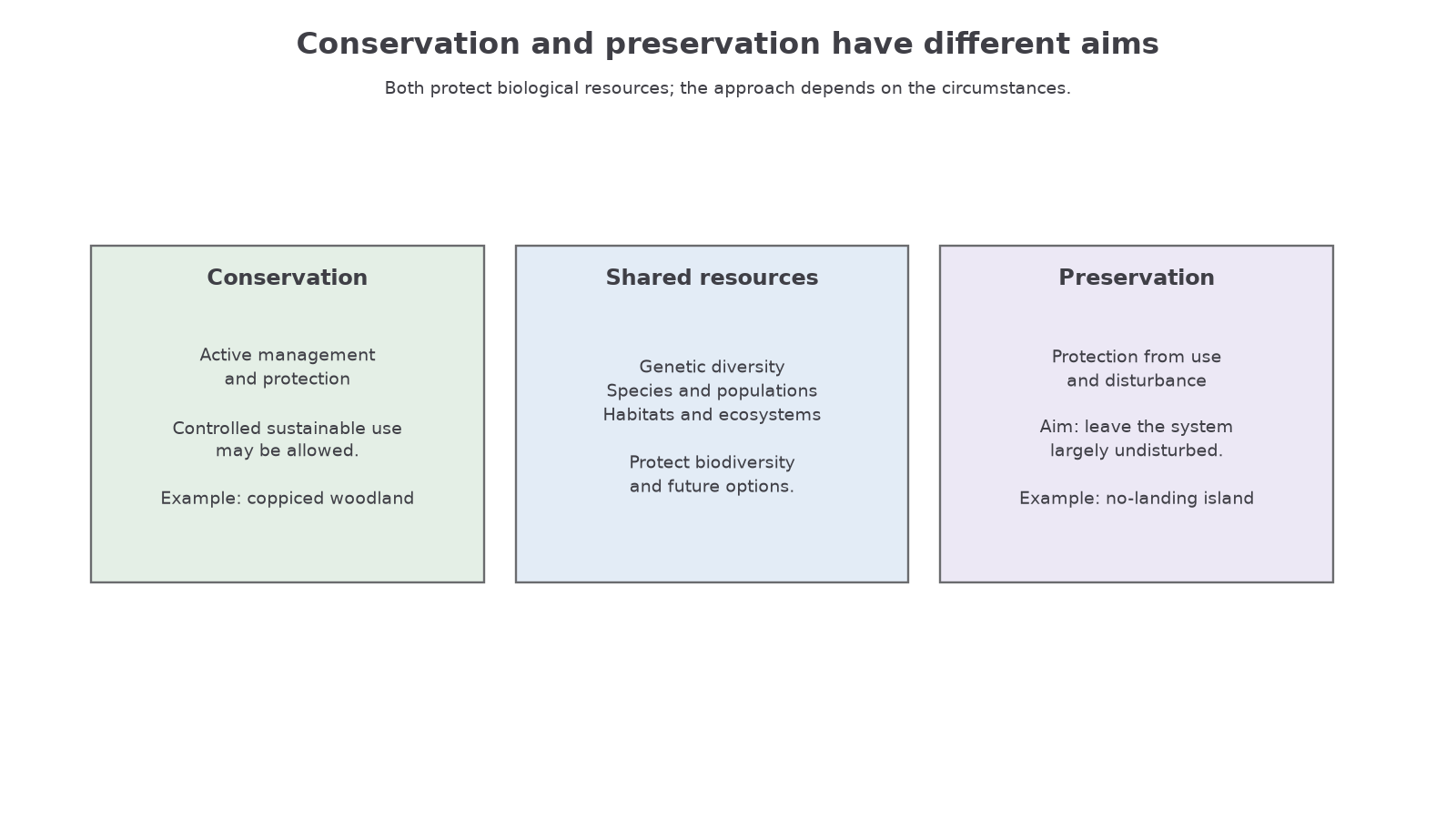
The common exam trap is to confuse two separate ideas:
| Question being asked | Correct distinction |
|---|---|
| Where is the organism protected? | in situ means in the natural habitat; ex situ means away from the natural habitat |
| What is the protection aim? | conservation means managed protection and possible sustainable use; preservation means protection from use or disturbance |
A preserved area is usually in the natural habitat because organisms are not removed from where they live. But that does not make preservation the same as in situ conservation. In situ conservation may involve human intervention; preservation aims to minimise that intervention.
Economic, Social And Ethical Reasons
There are economic, social and ethical reasons for conservation of biological resources. The reasons often overlap, but separating them helps you write precise answers.
Continue this lesson.
You’re previewing NovaLearn without an account. Create a free account to read the rest.
Create free account