E9.3 - Events without replacement (Extended)
After a red counter is taken out and kept, is another red counter more or less likely? E9.3 develops two-stage selections without replacement: update the collection on each branch, multiply the correct path probabilities and combine the paths that answer the question.
Changing probabilities
Without replacement, the selected object stays out. The second random choice comes from a smaller collection, and its colour counts depend on the first result.
Dependent selections
Selections are dependent when knowing one result changes a later probability. When one object is removed without replacement, the total number of objects falls by one and the count of its own category also falls by one.
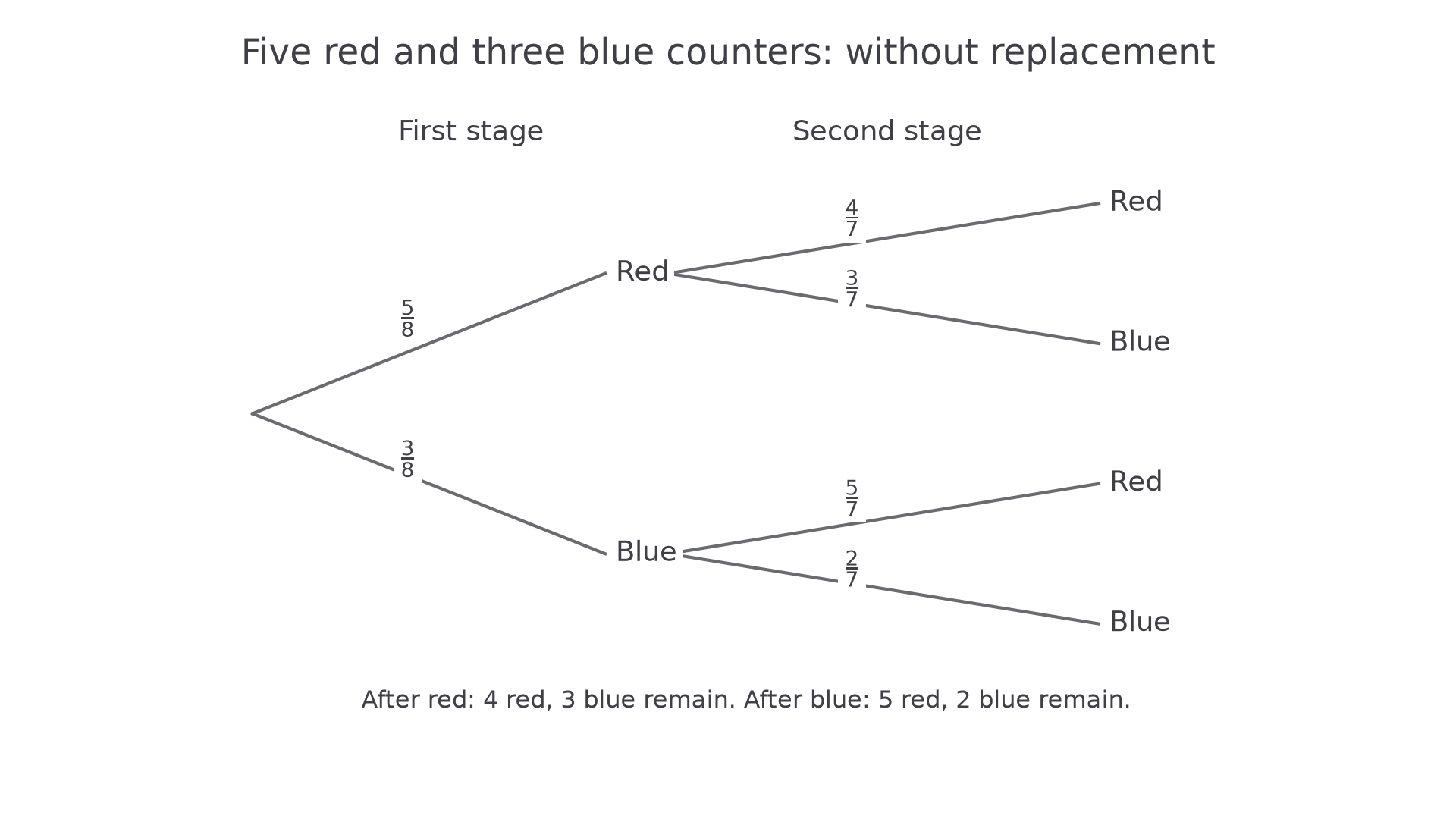
For 5 red and 3 blue counters, the first-draw denominator is 8. Every second-draw denominator is 7, but the second red numerator is 4 after red and 5 after blue.
[DIAGRAM: asset_name: Two draws without replacement; asset_slug: changing_tree; caption: Seven counters remain on both second stages, but the colour counts depend on the first draw.; description: A complete two-stage probability tree for five red and three blue counters drawn at random without replacement. First branches red and blue have probabilities five eighths and three eighths. After red the red and blue branches are four sevenths and three sevenths. After blue they are five sevenths and two sevenths. Stage headings distinguish first draw from second draw and outcomes appear at branch ends.]
Worked example 1: after a red counter
Question. A bag contains 5 red and 3 blue counters. A red counter is drawn and not replaced. State the probabilities of red and blue on the next random draw.
Plan. Remove one red counter, recount each colour and use the remaining total.
Answer. Red , blue .
Check. . The red chance falls from to , consistent with a red counter being removed.
Change only the first colour. The total still falls, but a different numerator changes.
Worked example 2: after a blue counter
Question. Instead, the first counter drawn from 5 red and 3 blue is blue and is not replaced. State the probabilities of red and blue on the next random draw.
Plan. Keep all five reds and remove one blue.
Answer. Red , blue .
Check. . The red chance is now greater than , since all the red counters remain in a smaller bag.
The same red numerator cannot be copied onto both second-stage branches. Each branch starts from its own remaining collection.
Watch out
After a red draw, changes the numerator but forgets the smaller total. After a blue draw, removes a red that is still present. Recount both quantities.
State the probabilities after the specified first result.
Dependent paths
Multiply along a path even when its stages are dependent. The second factor must be the probability after the first result on that path, rather than the original probability.
A path without replacement
Here is the first-result probability and is the second-result probability after that first result. Update the remaining collection before forming .
Not in the supplied formula list: learn it.
A count explains the product. With eight distinct physical counters, the first has eight choices and the second has seven, giving equally likely ordered physical-counter pairs. The same object cannot appear twice.
Worked example 3: the same colour twice
Question. Two counters are chosen at random without replacement from 5 red and 3 blue counters. Calculate .
Plan. Follow red then red, reducing the red count and total for the second factor.
Answer. .
Check. Choose one of five physical red counters first and one of the four other reds second. This gives favourable ordered pairs out of 56, agreeing with .
Continue this lesson.
You’re previewing NovaLearn without an account. Create a free account to read the rest.
Create free account