C6.3; E6.3 - Circle circumference and area
A circular table needs a strip around its edge and a cover over its top. Which measurement does each job require, and what changes if the diameter is doubled? This lesson develops circle circumference and area in C6.3 and E6.3, beginning with the radius needed in the supplied formulas.
Radius and diameter
The radius runs from the centre to the circumference. A diameter goes right across the circle through its centre, so it consists of two radii. A chord that misses the centre is not a diameter.
Radius and diameter
For a circle of radius and diameter ,
Every point on the circumference is the same distance from the centre.
Read the endpoints of a labelled segment before choosing a formula. A number printed inside a circle can label a full diameter; its position on the page does not automatically make it a radius.
[DIAGRAM: asset_name: Radius and diameter have different endpoints; asset_slug: radius_diameter; caption: A diameter passes through the centre and contains two radii.; description: A circle centred O has a horizontal diameter AB labelled fourteen centimetres, with O at its midpoint. A separate sloping radius OC is labelled r. Another chord DE above the centre misses O and is labelled chord, not diameter.]
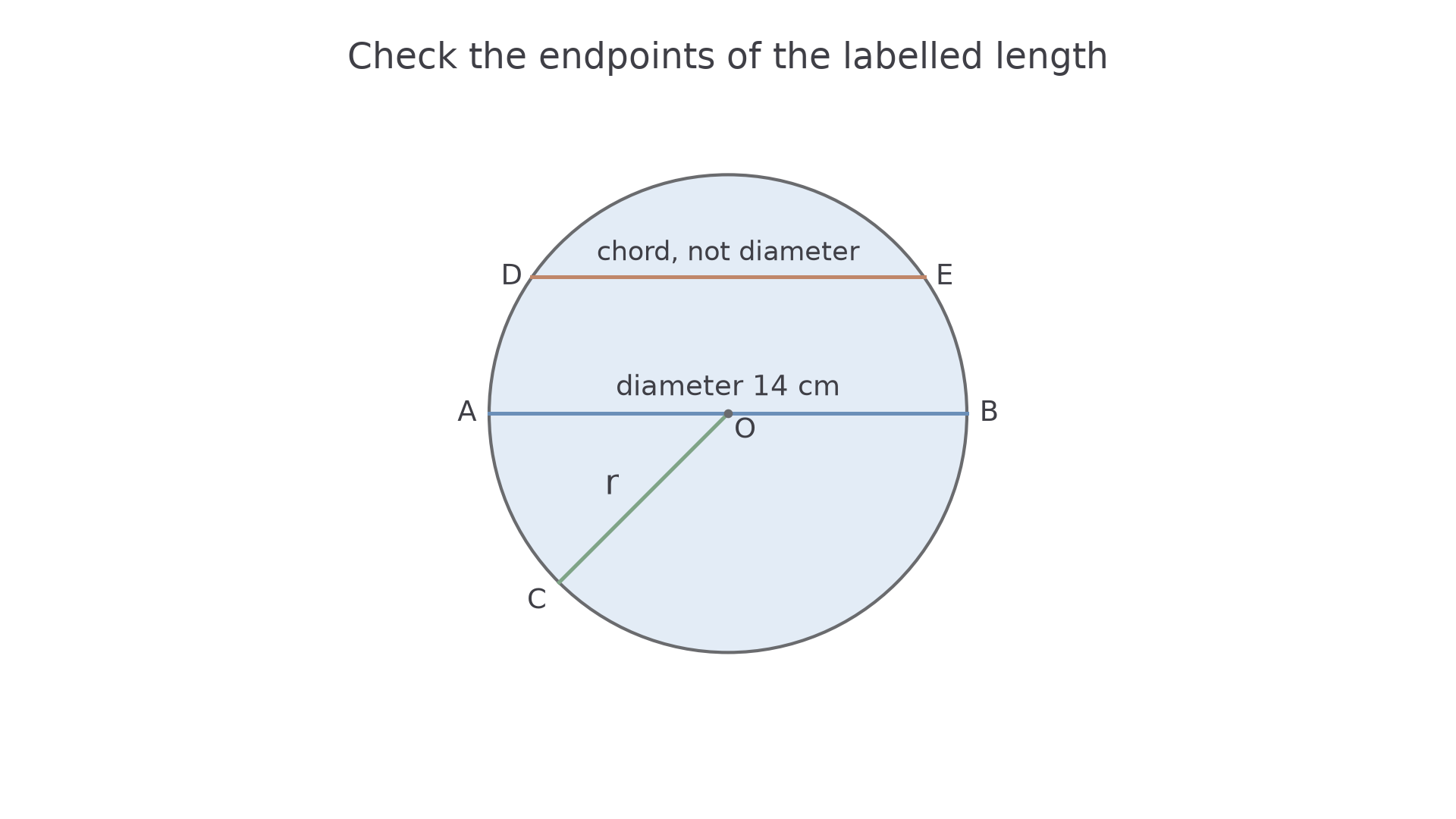
Worked example 1: radius from a diameter
Question. The circle above has diameter . Find its radius.
Plan. Halve the full width through the centre.
Answer. .
Check. Two radii placed end to end give , the stated diameter.
Now the centre-to-edge distance is supplied. Doubling, rather than halving, gives the full width.
Worked example 2: diameter from a radius
Question. A circular plate has radius . Find its diameter in millimetres.
Plan. Double the radius, then convert centimetres to millimetres.
Answer. .
Check. Half of 72 mm is 36 mm, or 3.6 cm, recovering the radius.
The value of a radius or diameter is a length, so it uses ordinary length units. Its square will appear when finding area.
Watch out
A chord is a diameter only when it passes through the centre. Do not halve an arbitrary chord to obtain the radius.
Decide what has been given before operating.
Circumference
The circumference is the perimeter of a circle. If circles of different sizes are measured accurately, circumference divided by diameter has the same value, . This constant is approximately 3.14159, so a circle's boundary is a little more than three diameters long.
Circle circumference
Here is the radius and the diameter. This formula is supplied on page 2 of Papers 1–4; required formulas are provided within questions on Papers 5 and 6.
Use the calculator's value in decimal calculations and retain working precision. An exact answer such as preserves the full value without rounding; give this form when the question asks for an answer in terms of .
Worked example 3: circumference from a radius
Question. A circle has radius . Calculate its circumference, giving your answer correct to three significant figures.
Plan. Substitute the radius into and round only the final result.
Answer. , correct to three significant figures.
Check. The diameter is 9.6 cm. Three diameters total 28.8 cm, so a circumference slightly above 30 cm is reasonable.
The next circle gives its diameter. Use directly, or halve first and use ; the two routes agree.
Continue this lesson.
You’re previewing NovaLearn without an account. Create a free account to read the rest.
Create free account