C1.9; E1.9 - Rounding and significant figures
A distance of 6740 metres can sensibly be described as about 7000 metres, but 6.740 metres cannot. Rounding keeps a chosen level of place value while preserving the number's scale. This lesson develops the place-value, decimal-place and significant-figure rounding required by C1.9 and E1.9.
Place-value rounding
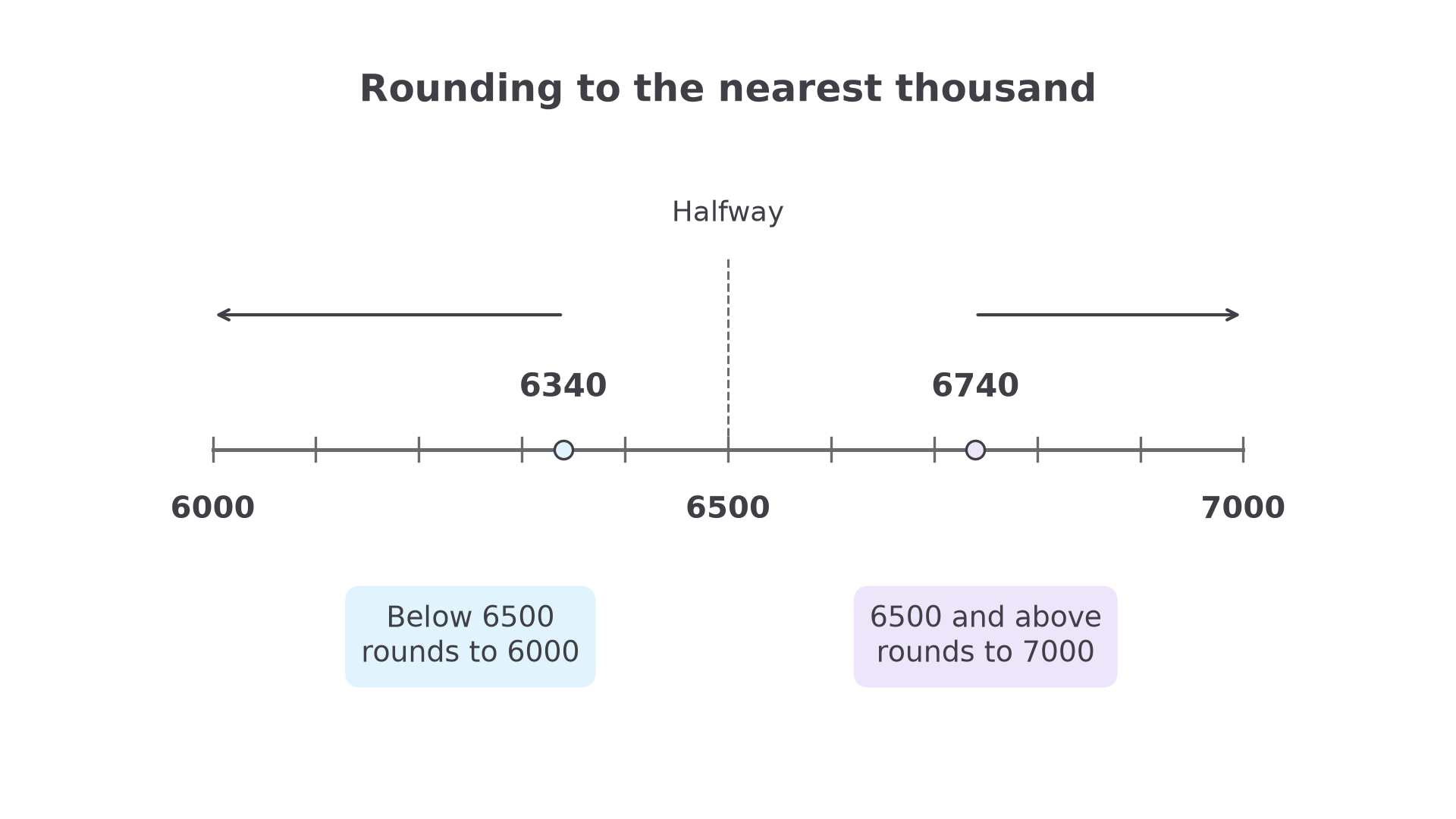
Rounding to the nearest thousand chooses the nearer multiple of 1000. For 6740, compare 6000 and 7000: the distances are 740 and 260, so 7000 is nearer.
Rounding to the nearest place
Rounding replaces a number by the nearest allowed value at the stated place. For positive numbers, if it lies exactly halfway, round to the larger allowed value.
The halfway point between 6000 and 7000 is 6500. The next digit after the thousands digit tells you which side of that midpoint the number lies on: 0–4 keeps the thousands digit; 5–9 increases it by one. Replace the lower whole-number places with zeros, rather than deleting them.
[DIAGRAM: asset_name: Rounding to the nearest thousand; asset_slug: nearest_thousand_line; caption: The midpoint 6500 separates numbers that round to 6000 from those that round to 7000.; description: An exact number line from 6000 to 7000 with midpoint 6500. The point 6340 lies left of the midpoint and rounds to 6000. The point 6740 lies right of the midpoint and rounds to 7000. Both endpoints, the midpoint and both values are labelled.]
Worked example 1: rounding up
Question. Write 6740 correct to the nearest thousand.
Plan. Compare the hundreds digit with 5, keeping the thousands place.
Answer. .
Check. The distance to 7000 is 260; the distance to 6000 is 740. The chosen multiple is closer.
Change only the hundreds digit. That moves the number across the midpoint, so the rounding direction changes.
Worked example 2: rounding down
Question. Write 6340 correct to the nearest thousand.
Plan. Inspect the hundreds digit, then replace the lower places with zeros.
Answer. .
Check. The distances are 340 to 6000 and 660 to 7000. The answer still has the same thousands scale as the original.
The same reasoning works for tens, hundreds or larger places. For example, to round to the nearest hundred, inspect the tens digit and replace the tens and units with zeros. For negative values, compare the distances to the neighbouring allowed values: is 0.26 from and 0.74 from , so it rounds to to the nearest whole number.
Watch out
to the nearest thousand is , not 6. The three zeros keep the 6 in the thousands column. At an exact positive midpoint, such as 6500, the nearest-thousand answer is 7000.
Identify the requested place before looking at the next digit.
Decimal places
Decimal places count digits after the decimal point, starting with tenths. To round to two decimal places, keep the hundredths place and inspect the thousandths digit.
Decimal places
The number of decimal places is the number of digits written after the decimal point. A zero counts as a written decimal place: 3.40 has two decimal places, while 3.4 has one.
Round directly from the original number. Rounding first to three decimal places and then to two can change a number close to a midpoint.
Worked example 3: preserving a final zero
Question. Write 5.304 correct to two decimal places.
Plan. Keep the hundredths digit and inspect the next digit.
Answer. .
Check. Its distances from 5.30 and 5.31 are 0.004 and 0.006. The final zero records the requested two decimal places.
The next number rounds up. Carrying can change more than the last retained digit, just as it does in whole-number addition.
Worked example 4: carrying across the decimal point
Question. Write 5.996 correct to two decimal places.
Plan. Compare the number with the two neighbouring hundredths, 5.99 and 6.00.
6.00 is nearer. Increasing the hundredths digit of 5.99 by one causes a carry through both 9s.
Answer. .
Check. The answer has exactly two decimal places and differs from the original by less than .
The zeros in 6.00 do not change its numerical value, but they communicate its stated accuracy.
Watch out
Do not truncate: 5.996 to two decimal places is 6.00, not 5.99. Do not remove required zeros: 6 and 6.00 have the same value but only one shows two decimal places.
Apply the rounding decision once, using the original value.
Significant figures
Significant figures count from the first non-zero digit, wherever the decimal point lies. In , the first significant digit is 4; the following 0, 7 and 2 are also significant. The leading zeros locate the number's scale but do not count.
Significant figures
Significant figures are counted from the first non-zero digit. Zeros between significant digits count, and zeros written after a decimal point at the end of a value can state accuracy. Thus 4.07 has three significant figures and 4.070 has four.
For a whole number such as 4070, an unlabelled final zero may be a place-value placeholder. State the requested accuracy explicitly, or use standard form when it is needed to make the significant-figure count clear.
Worked example 5: a small decimal
Question. Write 0.004072 correct to three significant figures.
Plan. Start counting at 4, keep the third significant digit and inspect the next one.
Answer. .
Check. The result lies between 0.004 and 0.005, as the original does. Counting from 4 gives exactly three significant figures.
Now move to a large number. The counting starts in the same way, but the discarded whole-number places must become zeros.
Worked example 6: a large whole number
Question. Write 48270 correct to three significant figures.
Plan. Keep 4, 8 and 2, then use the next digit to round.
Answer. to three significant figures, equivalently .
Check. The difference is 30, below half a hundred. The answer remains about 48 thousand, rather than becoming 483.
Compare the instructions carefully: to three decimal places is , while to three significant figures it is . They count from different starting points.
Watch out
Internal zeros count. has three significant figures, not two. Leading zeros do not count; deleting them would change the value.
Use the first non-zero digit as your starting point.
Quick Recap
- Name the place to keep, then inspect the next digit.
- Decimal places count after the decimal point; significant figures start at the first non-zero digit.
- Preserve zeros needed for place value or stated decimal accuracy.
- Round once from the original number, allowing carries when needed.
The opening 6740 metres rounds to 7000 metres to the nearest thousand; its scale remains thousands of metres.