E7.4 - Trigonometric equations (Extended)
A calculator gives when you reverse , but the sine graph reaches the same height twice in one turn. Where is the other solution? You will use graph symmetry, rearrangement and endpoint checks to find every solution between 0 and 360 degrees.
Multiple solutions
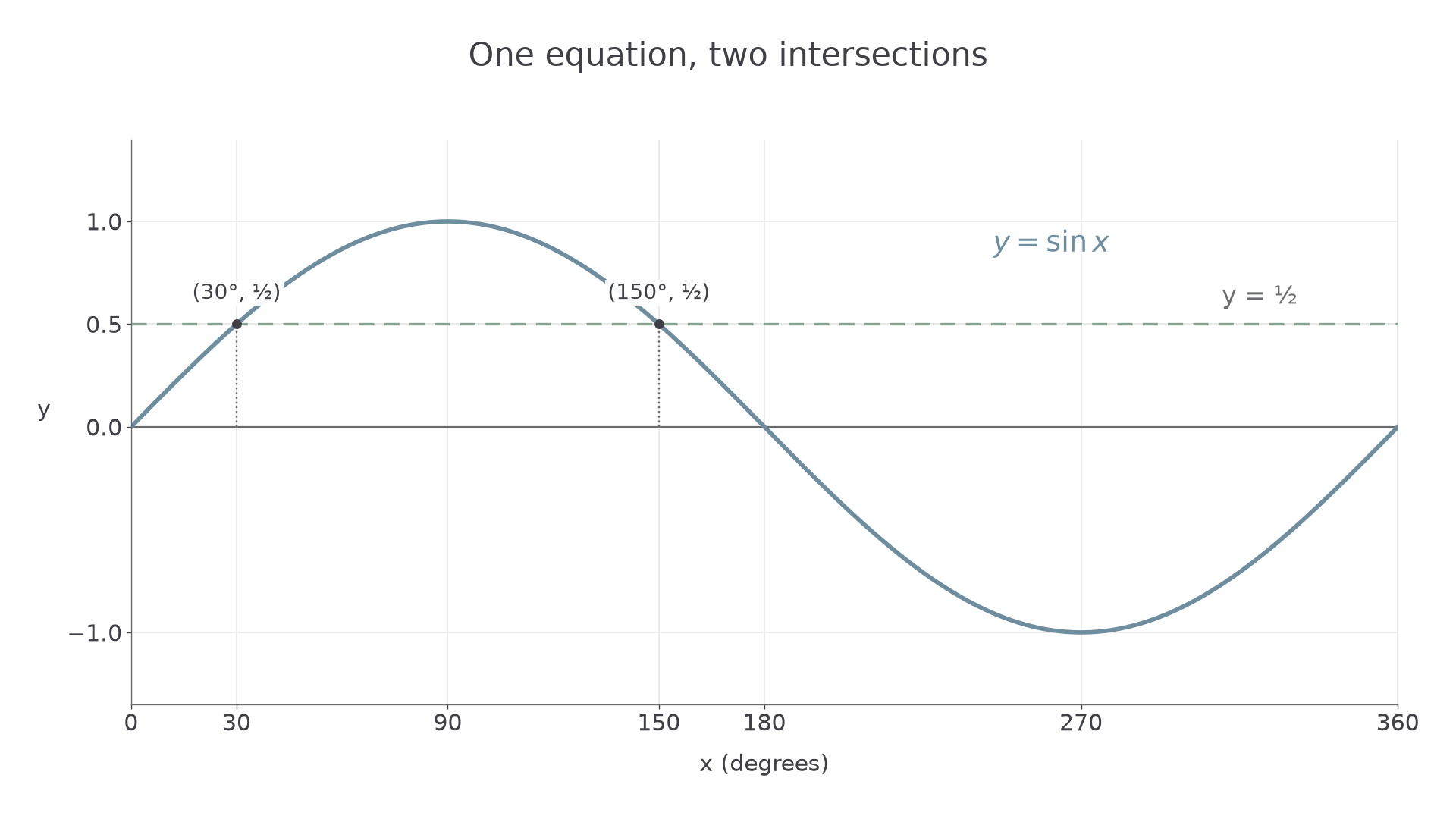
The equation asks where the sine graph meets the horizontal line . Each intersection supplies a solution. One inverse-trigonometric calculator value cannot, by itself, list them all. Use degree mode whenever you calculate angles here.
[DIAGRAM: asset_name: Two sine solutions in one turn; asset_slug: sine_equation_intersections; caption: The line meets the sine graph at both 30 and 150 degrees.; description: Exact sine curve on zero to 360 degrees with a dashed horizontal line at one half. The intersections at 30 and 150 degrees are marked, with guides to the horizontal axis. The negative half of the sine curve remains visible.]
Reference angle
A reference angle is the acute angle between the rotating arm and the horizontal axis. Its sine, cosine and tangent magnitudes match the corresponding acute values. The quadrant determines the signs.
Sine is positive above the horizontal axis, cosine is positive to the right, and tangent is positive when sine and cosine have the same sign. This gives the following candidates for an acute reference angle .
| Equation | Angles in one turn |
|---|---|
These rules are not in the supplied formula list. Use the graph or rotating-arm signs to reconstruct them. Values 0 and for sine/cosine lie on boundaries, so use the key graph points directly there.
Worked example 1: a positive sine
Question. Solve for .
Plan. Find the acute angle, then use sine's symmetry above the axis.
Sine is positive in the first two quadrants. In the other two, its values are negative, so there are no further solutions.
Answer. .
Check. Both points have height on the unit circle. The horizontal line meets the sine graph exactly twice, so the list is complete.
Keep the same target value but change sine to cosine. The symmetry now pairs angles either side of the horizontal axis.
Worked example 2: a positive cosine
Question. Solve for .
Plan. Use the acute angle, then reflect to the other right-hand quadrant.
Cosine is negative in the left-hand half-turn, which excludes the middle two quadrants.
Answer. .
Check. At 60 and 300 degrees, the horizontal coordinate is . The cosine curve crosses that height once on the way down and once on the way up.
For a calculator value such as , first find . The negative sine positions are and , giving and to one decimal place. Keep the unrounded reference angle until the end.
Watch out
means the calculator's inverse-sine operation, not . Its single displayed angle is a starting point; the graph supplies the other valid angles.
Use the negative sine positions with a different reference angle.
Rearranging
An equation may hide its trigonometric value inside ordinary arithmetic. Treat , or as one quantity while rearranging. Once it is isolated, choose every angle with the required sign.
Worked example 3: a negative cosine
Question. Solve for .
Plan. Isolate cosine, then find its negative positions using a 60 degree reference angle.
Answer. .
Check. Each cosine is , so the original left side is . Cosine is negative only in the middle half-turn, where the graph has two intersections at this height.
Continue this lesson.
You’re previewing NovaLearn without an account. Create a free account to read the rest.
Create free account