C1.1, C1.5, C1.6; E1.1, E1.5, E1.6 - Integers and place value
A temperature rises from below zero to above zero: how do you describe both the temperature and the change? Number types and place value in C1.1 and E1.1 help you read quantities accurately; ordering in C1.5 and E1.5 compares them; calculations in C1.6 and E1.6 tell you how they change.
Natural numbers and integers
A thermometer reading of is four degrees below zero. The minus sign gives its position relative to zero; the 4 gives its distance from zero. A reading of is four degrees above zero.
Natural numbers and integers
The natural numbers are , including zero. The integers are the whole numbers , including positive numbers, negative numbers and zero.
A positive number is greater than zero; a negative number is less than zero. Zero is neither positive nor negative. You may write a positive integer as or simply 7. Do not omit the minus sign from a negative integer: and 7 are different numbers.
| Number | Natural? | Integer? | Reason |
|---|---|---|---|
| Yes | Yes | A positive whole number | |
| Yes | Yes | Included in both lists | |
| No | Yes | A negative whole number | |
| No | No | Between consecutive whole numbers |
Decimals ending in zeros need care: , so it is an integer. The value decides the classification, rather than the way the number is written.
Key idea
Every natural number is an integer. Negative integers are the extra whole numbers below zero; zero belongs to both groups.
Use the boundary cases to check the definitions.
Place value
In 502, the 5 means five hundreds, while in 5002 it means five thousands. Each move one place to the left makes a digit's value ten times as large. Zero keeps a place open when no units of that size are needed.
Place value
A digit's place value is the value given by its position. Reading from the right, the places are units, tens, hundreds, thousands, ten thousands, hundred thousands, millions, ten millions, hundred millions, billions, and so on. One billion is : one thousand million.
Group figures in threes from the right. The groups count billions, millions, thousands and units. Each group has three positions, even when some contain zeros. For example, the groups in are 4 billion, 20 million, no thousands and 9 units. Spaces here separate groups; they are not decimal points.
Worked example 1: words to figures
Question. Write three billion, forty million and six in figures.
Plan. Put each quantity into its group, filling missing positions with zeros.
The thousands group is 000, not an omitted group.
Answer. .
Check. Reading its groups back gives 3 billion, 40 million, zero thousand and 6: the original words.
Now reverse the direction. Keep the group sizes, but say only the non-zero groups.
Worked example 2: figures to words
Question. Write in words.
Plan. Separate the four groups and read their values from left to right.
A leading zero within a group does not change that group's value: 005 is five, but still occupies all three places.
Answer. Seven billion, five million, thirty thousand and twelve.
Check. Rebuilding the number gives .
A quick scale check helps: a number of several billion has ten digits, whereas a number of several million has seven.
Watch out
“Two million and eight” is , not . Missing zero groups change the size of the number.
Check each group before writing the final number.
Ordering signed numbers
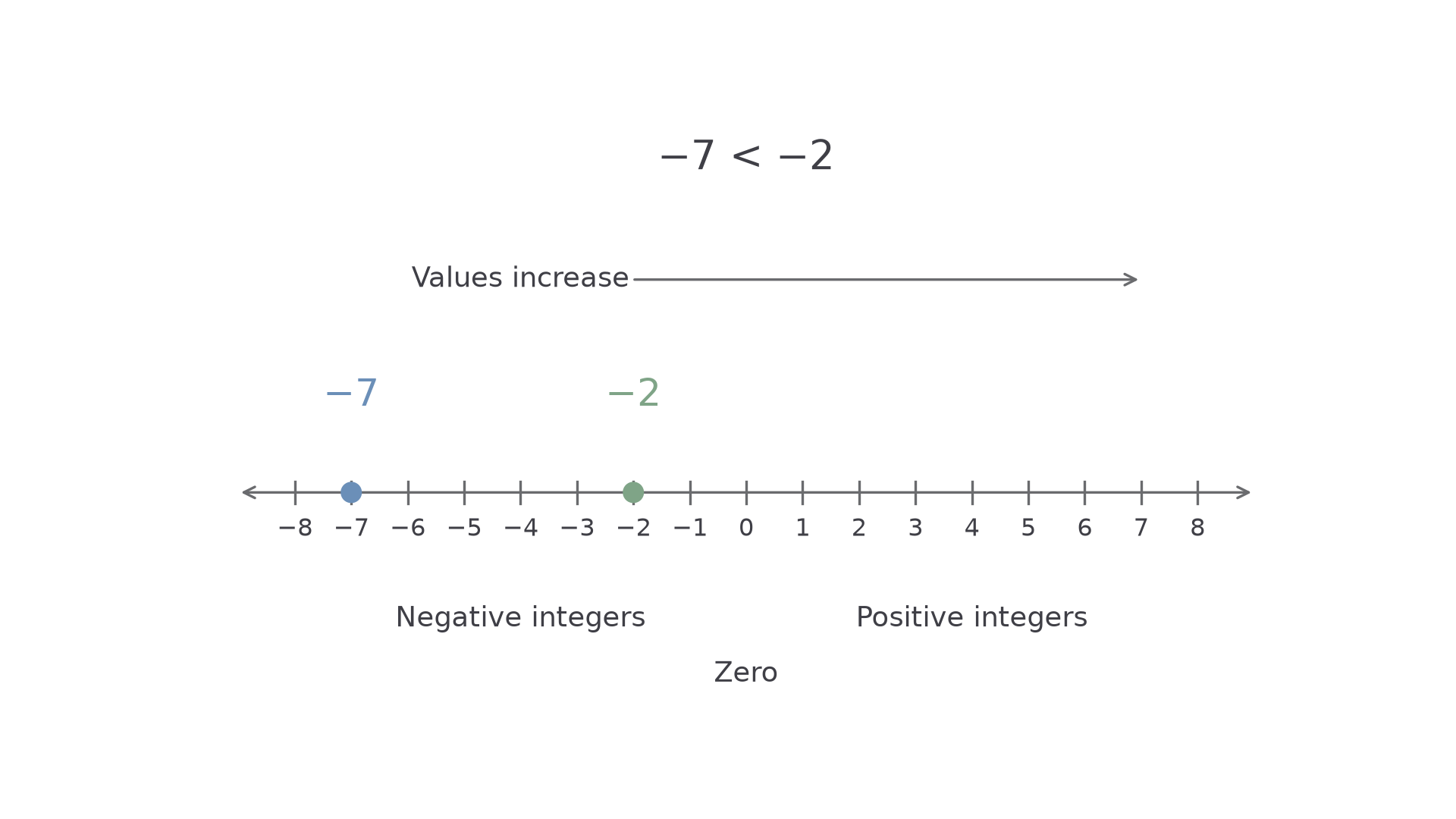
On a number line, values increase to the right. This settles a comparison that can feel backwards: is greater than , because it is farther right. In temperature terms, two degrees below zero is warmer than seven degrees below zero.
[DIAGRAM: asset_name: Signed integers on a number line; asset_slug: signed_integer_line; caption: Numbers increase to the right, so minus 2 is greater than minus 7.; description: A horizontal number line has evenly spaced integer ticks from minus eight to eight. Minus seven and minus two are marked and labelled. A right-pointing arrow above the axis is labelled values increase. Zero is labelled between negative and positive integers.]
Comparison symbols
means equal; means not equal; means less than; means greater than. The inclusive symbols and mean less than or equal to, and greater than or equal to. The open end faces the greater value.
A strict inequality excludes equality: does not allow 3. An inclusive inequality includes it: does allow 3. You can combine comparisons, as in .
Worked example 3: ordering a signed list
Question. Write in increasing order, using inequality signs.
Plan. Read their positions from left to right on a number line.
Answer. .
Check. Each step moves right. All five given values appear once.
The next comparison adds boundary conditions. Decide whether each endpoint is included before making the list.
Worked example 4: inclusive and strict bounds
Question. Write down all integers such that .
Plan. Include the lower endpoint and stop before the upper endpoint.
Answer. .
Check. The smallest value equals the inclusive bound. The largest is less than 2, and every integer between them is listed.
Equality and inequality say different things: is true, but is false.
Watch out
A larger distance from zero does not always mean a greater number. Although 9 is greater than 4, .
Use the two symbols to choose the endpoints carefully.
Changes across zero
A temperature is a position; a temperature change is a movement. A rise moves right on a number line and a fall moves left. Start at the initial temperature, then move through the stated number of degrees, crossing zero if necessary.
Signed change
For a temperature, . A rise has a positive change; a fall has a negative change. The change from an initial to a final value is .
Adding a negative has the same effect as subtracting the corresponding positive number: . Subtracting a negative reverses that negative movement, so . For instance, the rise from to 5 is degrees: six degrees to zero, then five more.
Worked example 5: a rise through zero
Question. A temperature is . It rises by . Find the final temperature.
Plan. Add 11 to the starting value, counting the movement to zero first.
Answer. .
Check. Reversing the rise gives , the starting temperature.
Now reverse the direction while keeping the size of the change. A fall requires subtraction, not addition.
Worked example 6: a fall through zero
Question. A temperature is . It falls by . Find the final temperature.
Plan. Subtract 11, using 5 degrees to reach zero and the remaining 6 to go below it.
Answer. .
Check. The distance travelled is degrees, and the final temperature is lower than the start.
This answers the opening problem: crossing zero joins the distances on either side. The sign tells you the final position, not how many degrees the temperature travelled.
Watch out
A fall of 11 from 5 is , not . Keep the initial value first. If you are asked for a change, state a rise or fall as well as its size.
Try the same movement with a different starting point and fall.
Quick Recap
- Natural numbers include zero. Integers also include negative whole numbers.
- Use three-digit groups to read millions and billions without losing zero places.
- Values increase to the right on a number line; inclusive inequalities allow equality.
- Add a rise and subtract a fall, keeping the starting value first.
A rise from below zero to above zero covers the distance to zero and then the distance beyond it.