C10.1, C10.3; E10.1, E10.3 - Classifying and tabulating data
A club records how many people attend and how long each person stays. Both records are numbers, but they describe different kinds of quantity. C10.3 and E10.3 distinguish these data types; C10.1 and E10.1 organise observations into frequency and two-way tables so patterns can be read without losing anyone from the count.
Discrete and continuous
Can a club have 18.4 people attending? It can have 18 or 19, but a fraction of a person is not a possible count. A visit, however, can last between 18 and 19 minutes, and between 18.4 and 18.5 minutes. The possible values, rather than the appearance of the written numbers, distinguish the types.
Discrete and continuous data
Discrete data take separate, distinct possible values, often counts. Continuous data are measurements that can take any value within an interval, subject to the precision of the measurement.
The number of messages received in an hour is discrete: 0, 1, 2 and so on. A parcel's mass is continuous, even when the balance records it to the nearest gram. Rounding a measurement does not turn the underlying mass into a count. Conversely, a discrete value need not be an integer: a scoring system allowing only 0, 0.5, 1, 1.5 and 2 points is still discrete because other values are unavailable.
Categorical data record labels, such as a person's chosen club activity. These are neither discrete numerical data nor continuous numerical data. Giving activities numerical codes does not make their labels measurements.
| Variable | Type | Why? |
|---|---|---|
| Number of seats in a room | Discrete | Separate whole-number counts |
| Height of a seat | Continuous | Measurements between other measurements are possible |
| Colour of a seat | Categorical | A label rather than a numerical quantity |
| Journey time rounded to minutes | Continuous underlying quantity | Greater measurement precision could reveal fractions of a minute |
Ask what was measured or counted before looking at the recorded precision.
Watch out
“Recorded as a whole number” does not mean “discrete”. A temperature recorded as 21 degrees is a rounded measurement. The number of thermometers is a count.
Use the variable itself to classify the next record.
Frequency tables
A long list is easier to understand when equal values are collected together. Each observation must enter exactly one row. A tally gives a running record while the frequency gives the completed count.
Frequency and tally
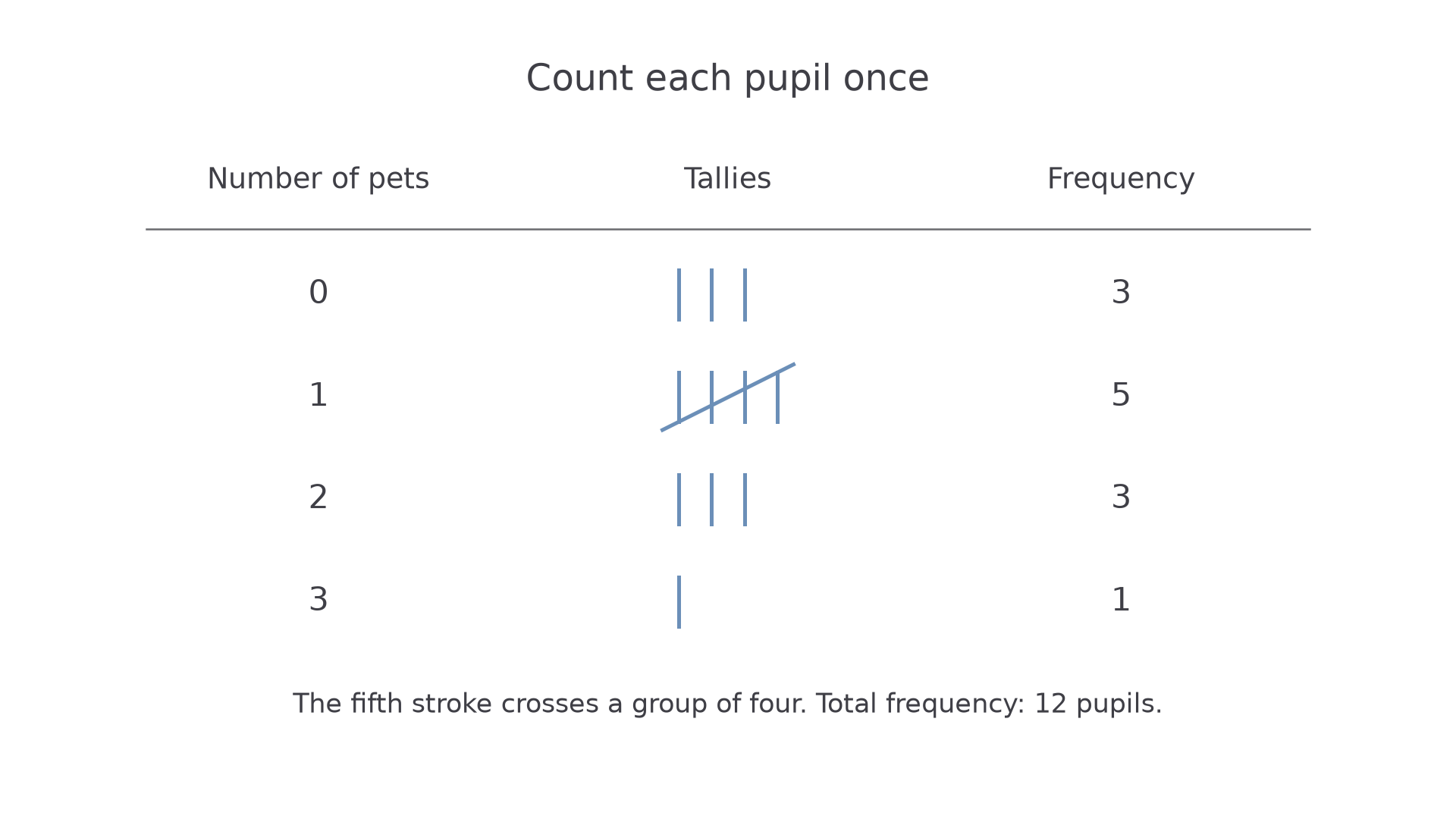
The frequency of a value or category is the number of times it occurs. A tally records one stroke per observation, usually grouped in fives: four upright strokes crossed by a fifth stroke.
Use categories that cover every observation without overlapping. Keep a zero-frequency row when it is part of the stated range. Process the list once in its original order, marking each item as you count it; then add the frequencies to check the total.
[DIAGRAM: asset_name: Pet-count tally table; asset_slug: pet_tallies; caption: Tallies record each observation, with the fifth stroke crossing four upright strokes.; description: A table has columns Number of pets, Tallies and Frequency. Rows zero one two three have tally counts three five three one and matching frequencies. The count five is drawn as four upright strokes crossed diagonally by the fifth. A footer states total frequency twelve pupils.]
Worked example 1: counting numerical values
Question. Twelve pupils report the number of pets they have: . Make a frequency table for 0, 1, 2 and 3 pets.
Plan. Allocate each pupil to the row for their number of pets, then total the counts.
The five occurrences of 1 give a complete tally group. Counting the other rows gives:
| Number of pets | Frequency |
|---|---|
| 0 | 3 |
| 1 | 5 |
| 2 | 3 |
| 3 | 1 |
| Total | 12 |
Answer. The frequencies are , in the order shown.
Check. , matching all twelve pupils. Re-reading the list for 2 gives exactly three observations.
The next record uses category names rather than numbers. The counting process stays the same, but the row labels now name choices.
Continue this lesson.
You’re previewing NovaLearn without an account. Create a free account to read the rest.
Create free account