C5.5; E5.5 - Angles at points and in triangles
Two straight lines cross, and one angle is . Can you find the other three without measuring? C5.5 and E5.5 give the angle facts for points, straight lines, triangles and quadrilaterals, together with the notation and reasons that make a calculation convincing.
Angles at a point
An angle measures a turn. One complete turn returns to the starting ray; a half-turn points along the same straight line in the opposite direction.
Angles at a point and on a line
Angles filling one complete turn around a point sum to . Adjacent angles filling a straight angle sum to . When two straight lines cross, the angles directly opposite each other are vertically opposite angles, and they are equal.
“Vertically” does not mean up and down on the page. It identifies the opposite pair made by the same two intersecting lines. Adjacent angles share a ray; vertically opposite angles do not.
Why are the opposite angles equal? If one angle is and its neighbour is , then . If the next angle is , then too. Both and equal , so .
[DIAGRAM: asset_name: Straight, opposite and full-turn angle facts; asset_slug: point_angle_facts; caption: Adjacent angles on a straight line sum to 180 degrees, opposite angles are equal, and a complete turn sums to 360 degrees.; description: Two exact panels show crossing lines with angles 128 and 52 degrees, and four angles around a point measuring 88, 115, 92 and 65 degrees. Arcs select non-overlapping regions and the straight lines genuinely continue through the vertex.]
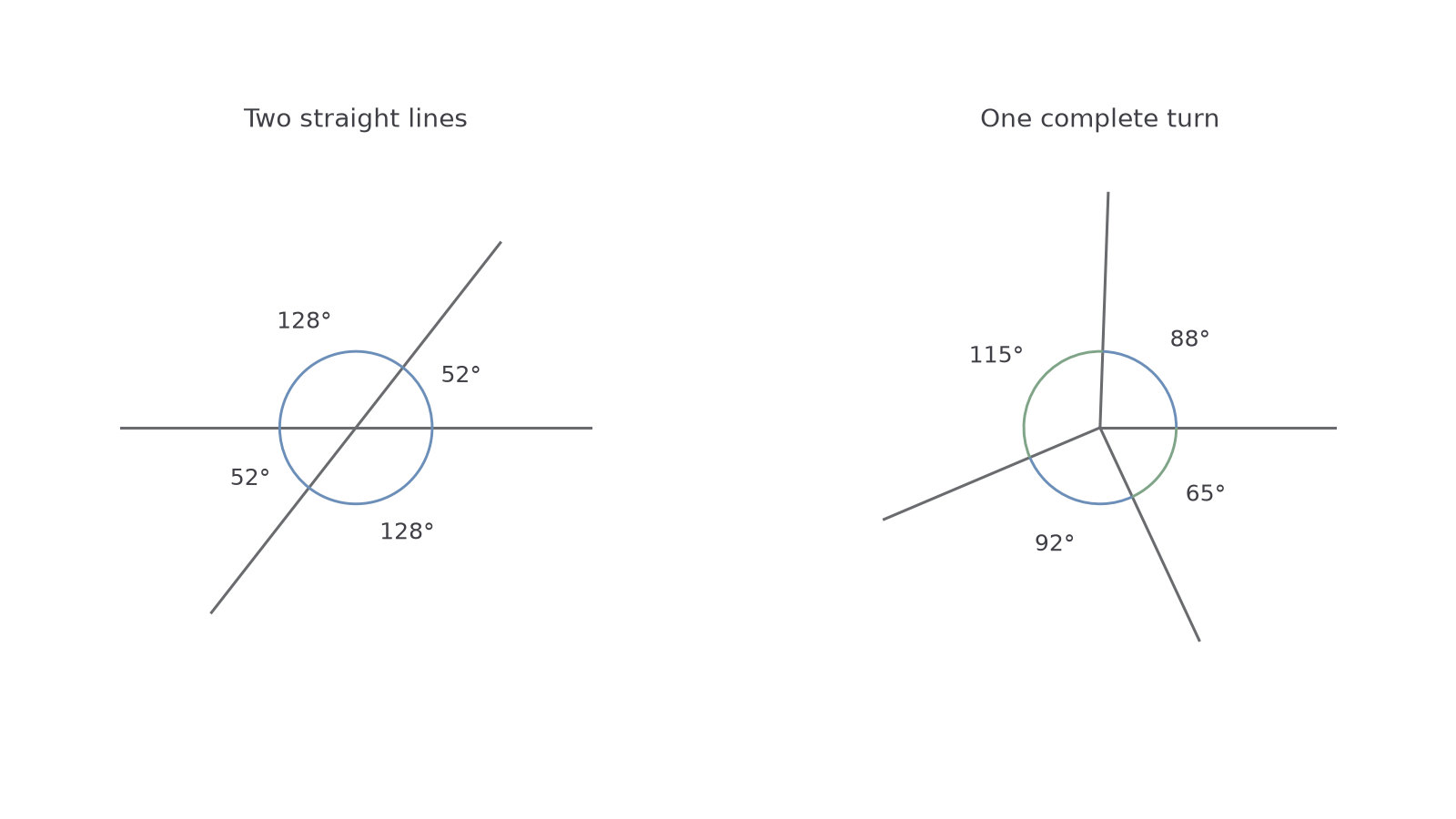
Worked example 1: crossing straight lines
Question. Two straight lines intersect. One angle is . Find each of the other three angles.
Plan. Find its adjacent angle using a straight line, then use vertically opposite equality.
Answer. The other angles are .
Check. , and each adjacent pair sums to .
Now the rays do not form two crossing straight lines. Use a complete turn rather than assuming any opposite-looking angles are equal.
Worked example 2: a full turn
Question. Four consecutive, non-overlapping angles around a point are and . Find .
Plan. Subtract the three known angles from a complete turn.
Answer. , so the missing angle is .
Check. . The four regions fill exactly one complete turn.
A pair is supplementary when its angles sum to . The word describes the sum; “angles on a straight line” explains why that sum applies to a particular diagram.
Watch out
Vertically opposite angles require two straight intersecting lines. Four arbitrary rays do not create that equality.
Use only the complete-turn information given below.
Triangle and quadrilateral sums
For a closed shape, the interior angles belong to its vertices. Count them before choosing the total: a triangle has three, while a quadrilateral has four.
Triangle and quadrilateral angle sums
The interior angles of a triangle sum to . The interior angles of a quadrilateral sum to .
A diagonal divides a quadrilateral into two triangles, so its four interior angles together make . The rule does not require a rectangle or any equal sides. For a concave quadrilateral, include its reflex interior angle in the same total.
Equal-side information can provide extra angles: an isosceles triangle has equal angles opposite its equal sides. If its unequal vertex angle is , its other two angles share , giving each.
Worked example 3: a triangle
Question. A triangle has interior angles and . Find .
Plan. Subtract the known angles from the triangle total.
Answer. .
Check. . All three angles are positive and less than , as required for a triangle.
Changing from three sides to four changes the total. Do not carry the total into the next example.
Worked example 4: a quadrilateral
Question. Three interior angles of a quadrilateral are and . Find the fourth angle.
Plan. Use the quadrilateral total of .
Answer. .
Check. . A rough estimate of leaves about , matching the result.
Continue this lesson.
You’re previewing NovaLearn without an account. Create a free account to read the rest.
Create free account