C7.1; E7.1 - Pythagoras theorem
A rectangular panel is 9 cm by 12 cm. Is a 15 cm strip long enough to run exactly between opposite corners? C7.1 and E7.1 connect the three sides of a right-angled triangle, letting you calculate a missing length and check whether an answer fits the triangle.
The hypotenuse
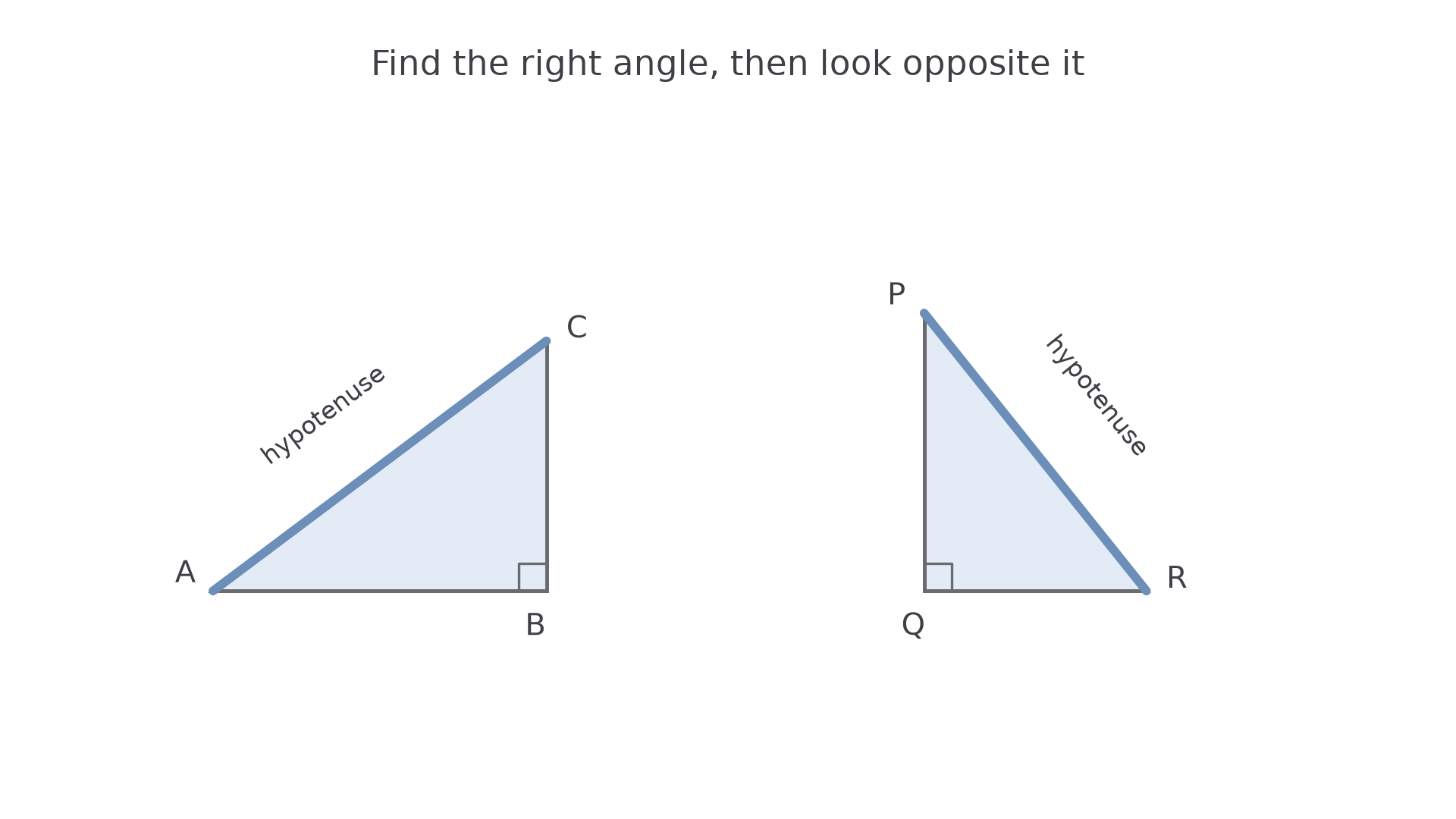
The panel's diagonal makes two right-angled triangles. In either triangle, the two sides of the panel meet at the right angle; the diagonal lies opposite it.
Hypotenuse
The hypotenuse is the side opposite the right angle in a right-angled triangle. It is the longest side. The other two sides meet at the right angle.
Turn the triangle and the names stay attached to the same sides. “The sloping side” is unreliable: a hypotenuse can be horizontal or vertical on the page. Find the small right-angle square first, then look across the triangle.
[DIAGRAM: asset_name: Finding the hypotenuse in different orientations; asset_slug: hypotenuse_orientation; caption: The highlighted side lies opposite the marked right angle in both triangles.; description: Two exact right-angled triangles in different orientations. In triangle ABC the right angle is at B and AC is highlighted. In triangle PQR the right angle is at Q and PR is highlighted. Each highlighted side is labelled hypotenuse.]
For the panel, the legs are 9 cm and 12 cm. Squares built on them have areas and square centimetres. Their sum is 225, which is . Pythagoras' theorem says this square-area relationship holds for every right-angled triangle.
Pythagoras' theorem
For a right-angled triangle with hypotenuse and other sides ,
All three lengths must use the same unit. Not on the supplied formula list for Papers 1–4: learn it.
One way to see why is to arrange four copies of the triangle inside a square of side , leaving a central square of side . Subtracting their areas gives . The right angle makes this arrangement possible.
Watch out
The letter is a choice, not a side name fixed by an exam diagram. If the right angle is at , the hypotenuse is . Put the actual hypotenuse alone on one side of the squared-length equation.
Use the right-angle information, rather than the appearance of a sketch.
Finding a side
Add the two smaller squares when the hypotenuse is missing. Subtract a smaller square from the hypotenuse's square when a shorter side is missing. Take the positive square root at the end, because a length is positive.
Worked example 1: finding the hypotenuse
Question. A triangle has perpendicular sides of 9 cm and 12 cm. Find its hypotenuse.
Plan. Add the squares of the perpendicular sides, then take the square root.
Answer. . The strip in the opening question fits exactly.
Check. . The diagonal is longer than either edge.
Now the longest side is given. The equation still adds the two smaller squares; rearrange it before calculating.
Continue this lesson.
You’re previewing NovaLearn without an account. Create a free account to read the rest.
Create free account