C6.5; E6.5 - Compound areas and perimeters
A rectangular sign has a semicircle attached at one end. The joining diameter helps you calculate area, but should it be included in the outside perimeter? This lesson develops the compound shapes and parts of shapes in C6.5 and E6.5 by choosing regions for area and tracing the actual boundary for perimeter.
Adding areas
A compound shape combines familiar shapes. Draw a dividing line that makes each part recognisable, find each area, then add. The pieces must fill the region exactly: no gaps and no overlap.
Problem-solving
For area, partition the region into rectangles, triangles or parts of circles. Mark missing lengths from the given total lengths before choosing formulas. Keep every length in the same unit.
The L-shape below can be divided horizontally into two rectangles. The height of the lower rectangle equals the right outside vertical side; the upper rectangle uses the remaining height.
[DIAGRAM: asset_name: Splitting an L-shape into rectangles; asset_slug: compound_l_shape; caption: A dashed internal line separates two rectangles without adding a new outside edge.; description: Exact L-shaped polygon with overall bottom width ten centimetres and left height seven centimetres. The top horizontal side is four centimetres and the right vertical side is four centimetres. The inward step is six centimetres horizontally and three centimetres vertically. A dashed horizontal line at height four divides a ten by four lower rectangle from a four by three upper rectangle, shaded in pale blue and sage.]
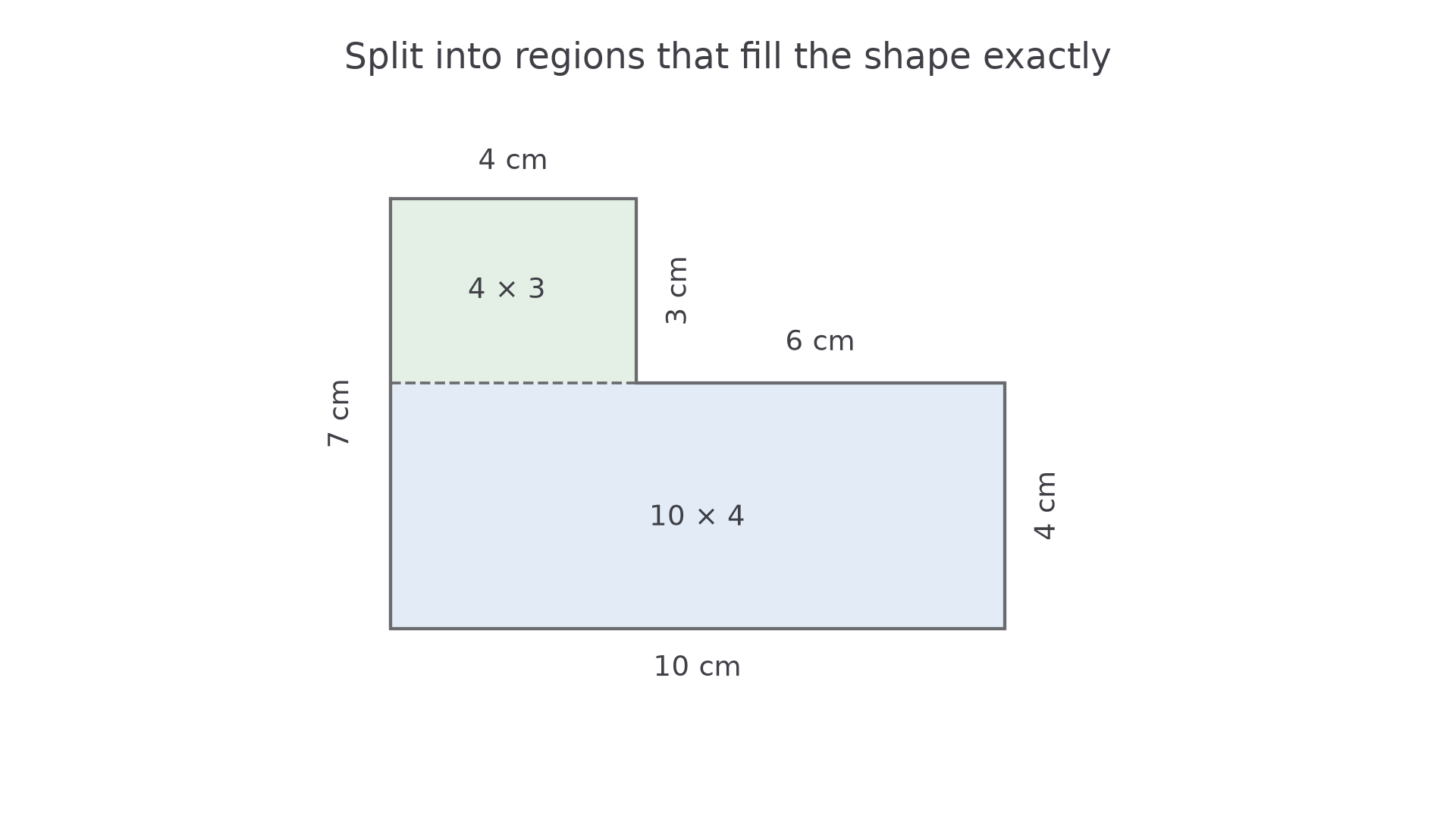
Worked example 1: two rectangles
Question. An L-shape has overall width and height . Its top arm is wide and its bottom arm is high, as shown. Find its area.
Plan. Split horizontally into a full-width lower rectangle and a narrower upper rectangle.
Answer. .
Check. A vertical split gives . The two different partitions cover the same region.
Now one of the pieces is curved. The shared straight edge gives the semicircle's diameter, not its radius.
Worked example 2: rectangle and semicircle
Question. A sign consists of a by rectangle and a semicircle attached along one complete 8 cm side. The interiors do not overlap. Find the total area in terms of .
Plan. Add the rectangle area to half the area of a circle of radius 4 cm.
Answer. .
Check. The semicircle fits inside an rectangle, so the total must lie between and . The calculated area is approximately , within these bounds. Doubling just its curved-region contribution, , also gives the full radius-4 circle area .
A dividing line has no area, so it does not create an extra region to count. If two shapes overlap in a problem, simply adding their whole areas counts the overlap twice; partition the union into non-overlapping pieces instead.
Watch out
An overall width times an overall height calculates a bounding rectangle. An L-shape does not fill that whole rectangle. Likewise, an attached semicircle contributes half a circle, not a whole circle.
The shared side supplies a diameter in the next shape.
Subtracting areas
Sometimes the simplest starting region is a whole rectangle or circle with a piece removed. Calculate the whole area, calculate the missing area, and subtract. This can be quicker than dividing the remaining region into many pieces.
Remaining area
If a cut-out lies entirely inside or along the edge of an original region, with no overlapping cut-outs,
A ring with outer radius and inner radius , where , has area . Subtract the areas, rather than subtracting the radii and squaring.
A removed region may be a fraction of a circle. First identify its radius and angle fraction from the description or diagram.
Worked example 3: a rectangular corner removed
Question. A by rectangle has a by rectangle removed from its top-right corner. Find the remaining area.
Plan. Subtract the corner area from the bounding rectangle.
Answer. .
Check. Split what remains into a lower rectangle and a upper-left rectangle: .
Change the cut-out to a semicircle. The subtraction structure stays the same; only the formula for the missing piece changes.
Continue this lesson.
You’re previewing NovaLearn without an account. Create a free account to read the rest.
Create free account