C1.10; E1.10 - Proportional reasoning
A recipe serves four people, but six people are coming. Does adding the same extra amount to every ingredient preserve the taste? C1.10 and E1.10 use proportional reasoning to scale quantities, compare purchases fairly and turn a map distance into a real distance.
Unitary method
If seven identical notebooks cost $10.50, the cost of one notebook unlocks the cost of any number. This works when every notebook has the same price and there is no extra fixed charge.
Unitary method
Find the quantity corresponding to one unit, then multiply by the number of units required. In a proportional relationship, multiplying one quantity by a factor multiplies the other quantity by the same factor.
Dividing both quantities by 7 keeps their relationship unchanged. Adding the same number to both quantities generally does not: seven notebooks and $10.50 are different kinds of quantity.
Worked example 1: finding a unit price
Question. Seven identical notebooks cost $10.50. Calculate the cost of 12 notebooks at the same price each.
Plan. Divide the total cost by 7, then multiply the unit price by 12.
Answer. $18.00.
Check. Twelve is times seven; . More notebooks cost more.
The required number of units can be fractional. The next purchase is less than one kilogram, so the final step scales down.
Worked example 2: scaling to a fractional quantity
Question. Rice costs 2.4,\mathrm{kg}0.75,\mathrm{kg}$ at the same price per kilogram.
Plan. Find the cost of one kilogram, then take three quarters of it.
Answer. $2.10.
Check. , and . The required mass is less than a third of , and its cost is less than a third of $6.72.
The same unit price must apply to the original and required quantities. This is the assumption that makes the scaling valid.
Watch out
Use this method only when the relationship is proportional. A taxi fare with a fixed starting charge does not double when the distance doubles.
Keep the units beside the quantities as you find the next unit price.
Recipes and best value
A recipe preserves its flavour when every ingredient is multiplied by the same factor. Comparing prices uses the same idea: scale each offer to a common mass, volume or number of items.
Common quantity
A common quantity is the same amount used as the basis of a comparison. For equivalent goods, the lower cost for that common quantity gives better value.
For a recipe, use as the scale factor. For a purchase, a useful common quantity might be or . Convert units before comparing.
Worked example 3: adapting a recipe
Question. A smoothie recipe for four people uses of milk and of fruit. Calculate the amounts needed for six people.
Plan. Multiply both ingredients by the servings scale factor.
Answer. of milk and of fruit.
Check. Both recipes provide of milk and of fruit per person. Each person receives the same mixture.
Now the purpose changes from making equal portions to comparing equal masses. The scaling principle stays the same.
Worked example 4: comparing two pack sizes
Question. The same oats are sold in pack A, for 1.2,\mathrm{kg}6.24. Determine which pack gives better value.
Plan. Convert both masses to grams and find each cost per .
Answer. Pack B gives better value: 100,\mathrm{g}0.54.
Check. For , A's rate costs 7.80. The conclusion agrees.
Finding a cost per compares rates; it does not claim that the shop sells a separate portion. Any convenient common mass gives the same ranking.
Watch out
The lower pack price need not be better value. Compare the same quantity, and give the costs that justify your decision. A larger pack is useful only if its contents are needed and usable.
Use a common mass to decide the next comparison.
Map scales
A map scale compares a length on a map with its corresponding real length. It is a ratio of lengths in the same units, even when the distances are later reported in different units.
Map scale
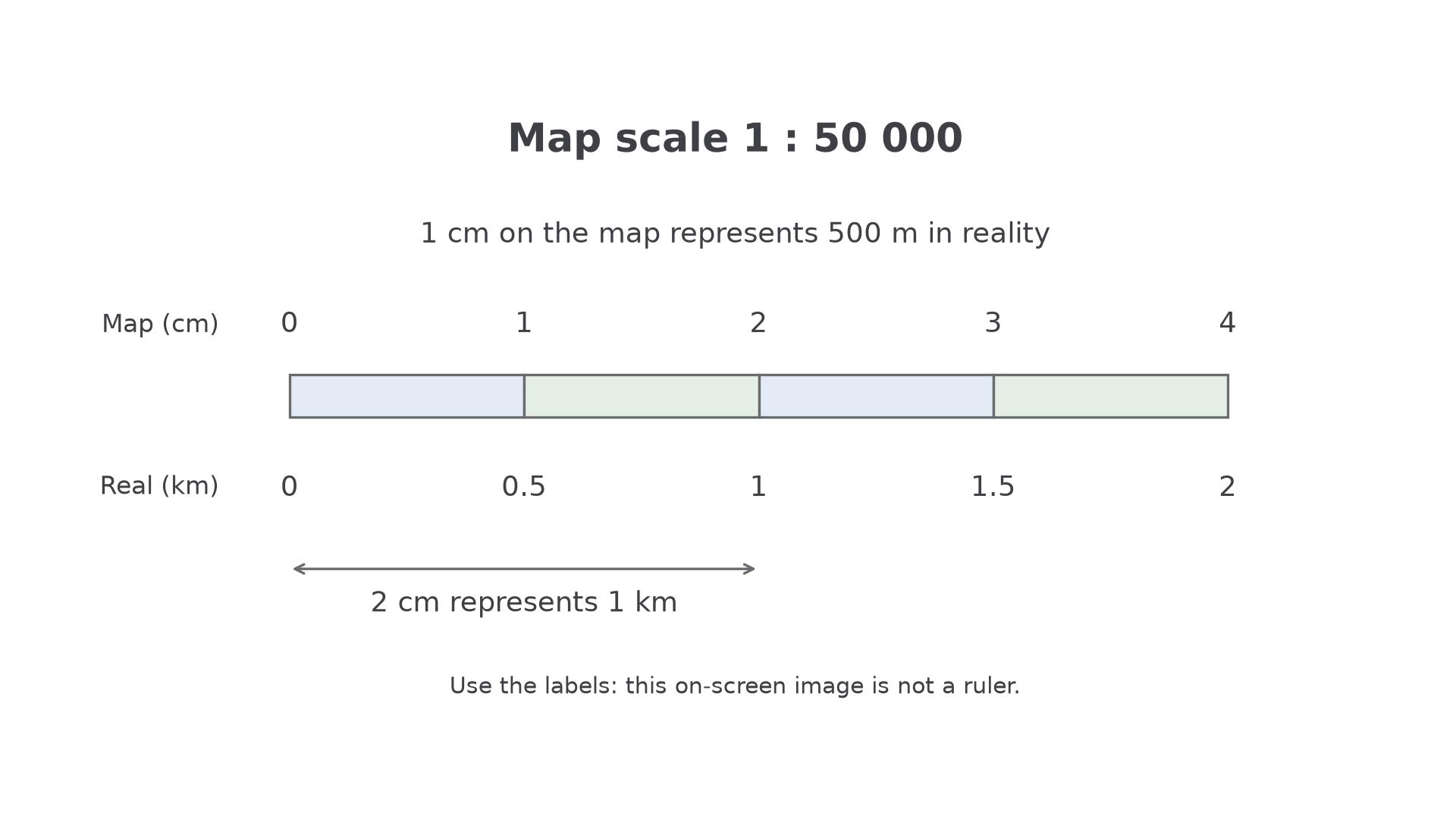
A scale means that one unit of length on the map represents of the same units in reality. At , represents .
There are in a metre and in a kilometre. Follow the units through the calculation; multiplying by a scale number does not change centimetres directly into kilometres.
[DIAGRAM: asset_name: Reading a map scale; asset_slug: map_scale_fifty_thousand; caption: At a scale of one to fifty thousand, two centimetres on the map represent one kilometre.; description: A four-segment scale bar has map positions zero, one, two, three and four centimetres aligned with real distances zero, half, one, one and a half and two kilometres. Each segment represents five hundred metres. The labels state that the on-screen image itself is not a ruler.]
Worked example 5: map to reality
Question. Two towns are apart on a map with scale . Calculate their real straight-line distance in kilometres.
Plan. Multiply the map distance by the scale, then convert centimetres to kilometres.
Answer. .
Check. Each map centimetre represents , so .
The next problem reverses the direction. A real distance must shrink to fit on the map.
Worked example 6: reality to map
Question. A path has real length . Calculate its length in centimetres on a map with scale .
Plan. Convert the real length to centimetres, then divide by the scale factor.
Answer. .
Check. , recovering the real distance.
The forward and backward calculations are inverses. Deciding which length is given tells you whether to enlarge or shrink it.
Watch out
does not mean . The two sides initially use the same unit. A scale converts lengths, so do not apply it directly to an area.
Recipe portions, unit prices and map lengths all preserve a multiplicative relationship. For the opening recipe, multiply every ingredient by ; adding a fixed amount would change its proportions.
Quick Recap
- Find one unit, then scale to the required quantity.
- Multiply every recipe ingredient by the same factor.
- Compare prices using a common quantity and compatible units.
- A map scale compares lengths expressed in the same units.
For six people instead of four, every ingredient needs the factor .