C1.6; E1.6 - Adding and subtracting fractions
A bottle contains three quarters of a litre and you pour in another eighth of a litre. Why must you change the units being counted before adding the numerators? This part of C1.6 and E1.6 develops common denominators, then uses them for improper fractions, mixed numbers and negative values.
Common denominators
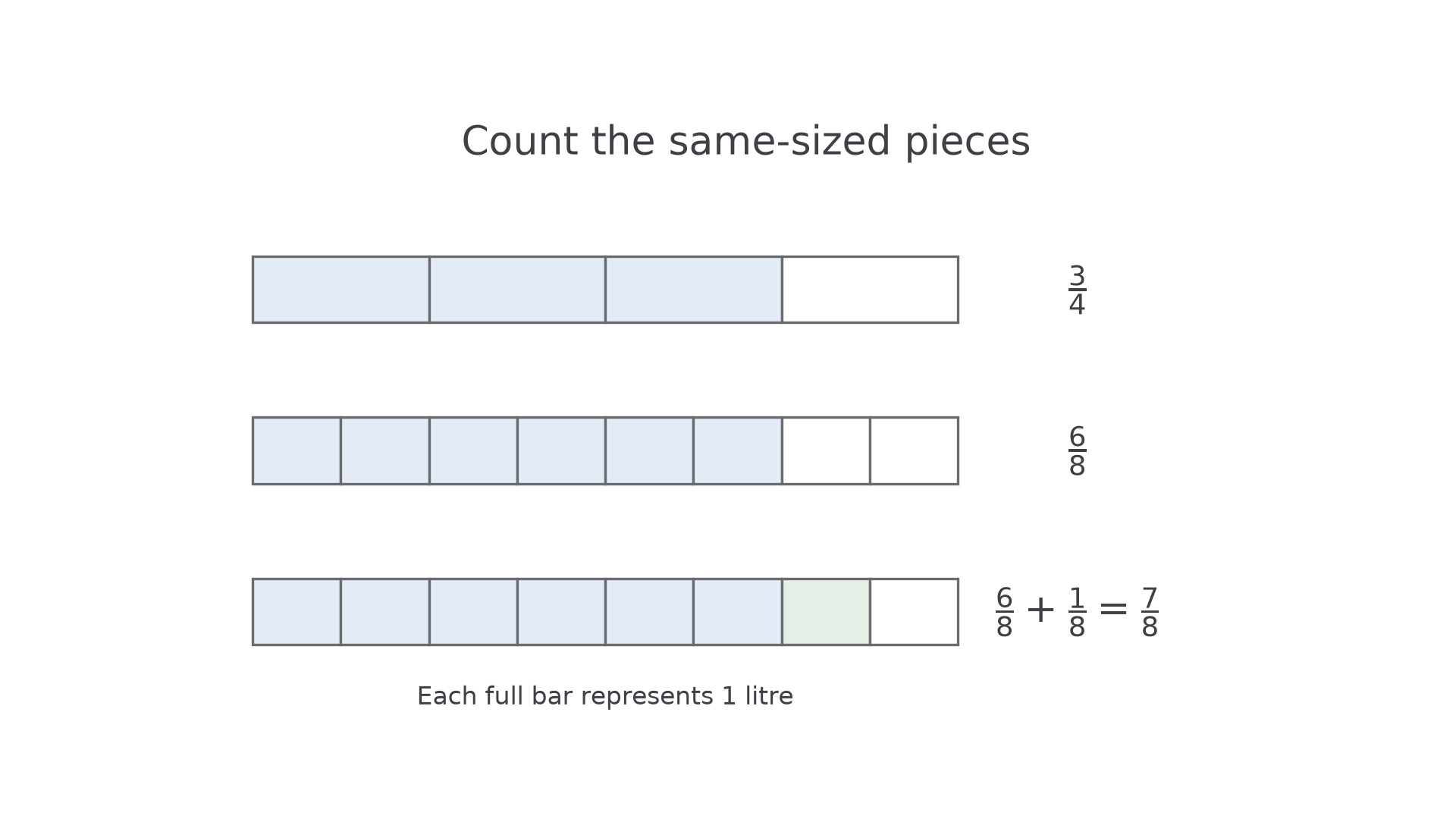
Three quarters and one eighth use different-sized pieces. Divide every quarter into two eighths: three quarters become six eighths. You can now add one more eighth to make seven eighths. The amount in the first fraction has not changed, only its subdivision.
[DIAGRAM: asset_name: Adding quarters and eighths; asset_slug: quarters_plus_eighth; caption: Three quarters become six eighths, so adding one eighth gives seven eighths.; description: Three equal bars each represent one litre. The first is divided into four quarters with three shaded blue. The second is divided into eight eighths with six shaded blue. The third has the same six eighths shaded blue and one further eighth shaded sage, leaving one eighth unshaded. Labels show three quarters equals six eighths and six eighths plus one eighth equals seven eighths.]
Common denominator
Fractions have a common denominator when their denominators are the same, so they count the same-sized pieces. To add or subtract them, add or subtract the numerators and keep that denominator. The whole being divided must be the same size.
When one denominator is a multiple of the other, use the larger denominator. Multiply both the numerator and denominator of the other fraction by the required factor. For example, converting quarters to eighths multiplies both parts by 2.
Worked example 1: adding with related denominators
Question. Work out .
Plan. Change quarters to eighths, then count all the eighths.
Answer. .
Check. Subtracting the added returns . Also, the answer is greater than but below one whole.
Change only the operation in the next example. The common denominator is still 8; subtraction removes pieces rather than joining them.
Worked example 2: subtracting with related denominators
Question. Work out .
Plan. Use eighths again, then subtract the numerators.
Answer. .
Check. Adding the removed eighth gives .
The opening bottle therefore contains of a litre after the extra eighth is added.
Watch out
Do not add denominators: . Adding does not change the size of the eighths. Convert both values to the same kind of piece before combining their counts.
Simplify your result after the subtraction.
Unrelated denominators
If neither denominator divides the other, choose a multiple of both. A denominator of 20 can represent both quarters and fifths because 20 is divisible by 4 and by 5. Each quarter becomes five twentieths and each fifth becomes four twentieths.
You already know
The LCM is the smallest positive common multiple. It gives the smallest possible common denominator, reducing the arithmetic. A larger common multiple also works if you simplify the result afterwards.
Find the multiplier separately for each fraction. With denominator 20, the multiplier for quarters is 5 while that for fifths is 4. Multiplying both numerators by the same number would not preserve both values.
Worked example 3: adding with unrelated denominators
Question. Work out . Give your answer as a mixed number.
Plan. Use denominator 20, then convert the improper result into a mixed number.
Answer. .
Check. In hundredths, and ; their total simplifies to . The answer should exceed 1 because exceeds the missing quarter.
The next question changes only addition to subtraction. Keep both conversions and change the numerator calculation.
Worked example 4: subtracting with unrelated denominators
Question. Work out .
Plan. Convert both fractions into twentieths, then subtract.
Answer. .
Check. , recovering the original value.
Multiplying the denominators always produces a common multiple. It is not always the LCM: for sixths and eighths, 48 works but 24 makes smaller numbers. Either method can earn credit when the arithmetic and final form are correct.
Watch out
For , changing only the denominators would give , which changes both original values. Show the equivalent fractions with their new numerators before subtracting.
Choose the LCM and change each fraction by its own multiplier.
Mixed numbers
Improper fractions make mixed-number calculations one signed numerator calculation. Convert every whole part first, find a common denominator, then add or subtract. Convert back only after the calculation is complete.
A leading minus sign applies to the entire mixed number: . Keep that sign with the numerator. Adding a negative fraction is subtraction; subtracting a negative fraction is addition. For example,
The denominator tells you the size of the pieces throughout; the signed numerator tells you whether the resulting quantity is above or below zero.
Worked example 5: adding mixed numbers
Question. Work out . Give your answer as a mixed number.
Plan. Change both mixed numbers into improper fractions, then use sixths.
Answer. .
Check. Add whole and fractional parts separately: , while . Their total is again .
Change only the operation. The second number is greater than the first, so predict a negative result before calculating.
Worked example 6: subtraction giving a negative mixed number
Question. Work out . Give your answer as a mixed number in simplest form.
Plan. Use the same improper fractions and subtract their numerators in the original order.
Answer. .
Check. The distance from to is . Reversing that order makes the difference negative. Adding to returns .
An alternative subtraction method exchanges one whole for a fraction. For , write instead of if you need more sixths in the fractional part. Improper fractions often make the signs easier to track, particularly when the final answer is negative.
Watch out
Do not subtract the smaller numerator from the larger automatically. , not 9. Also, means ; it does not mean .
Convert the negative mixed number as a single negative quantity.
Quick Recap
- A common denominator means you count equal-sized pieces.
- Convert each fraction without changing its value, then combine the numerators.
- The LCM keeps a common denominator as small as possible.
- Convert mixed numbers to improper fractions, preserve signs and simplify at the end.
The bottle contains of a litre: six eighths from the three quarters, plus one more eighth.