C6.4, C6.5; E6.4, E6.5 - Spheres and parts of solids
Cutting a solid in half halves its volume, but does it halve its total surface area? C6.4 and E6.4 supply the sphere formulas; C6.5 and E6.5 use them for parts and combinations of solids. You will separate volume from exposed area, including the extra flat face made by a cut and the hidden faces at a join.
Sphere formulas
A spherical ball is curved all the way round, so it has no circular base to add. Its radius runs from its centre to any point on its surface; a diameter passes through the centre and is twice the radius.
Surface area and volume of a sphere
For a sphere of radius ,
Surface area is measured in square units; volume is measured in cubic units. Both formulas are on the supplied lists for Papers 1–4; required formulas are supplied within questions on Papers 5 and 6.
The powers distinguish the quantities. Surface area covers the outside; volume fills the interior. Squaring or cubing a given diameter instead of the radius would magnify the error differently in the two formulas.
Worked example 1: radius given
Question. A sphere has radius 6 cm. Calculate its surface area and volume in terms of .
Plan. Use the same radius in both formulas, with the appropriate power.
Answer. Surface area ; volume .
Check. The surface area is four times the area of a radius-6 circle: . Also, cm, and cm, consistent with the two formulas.
A diameter is supplied next. One division is needed before either formula can be used.
Worked example 2: diameter given
Question. A sphere has diameter 10 cm. Calculate its surface area and volume in terms of .
Plan. Halve the diameter, then square or cube that radius.
Answer. Surface area ; volume .
Check. A bounding cube of side 10 cm has volume ; the sphere's volume is about , smaller as it must be. The surface area is .
Keep exact answers as multiples of . If a decimal is requested, retain the full calculator value until the final rounding.
Watch out
A sphere's surface area is already its complete outside area. Adding another invents a flat base that a sphere does not have.
Choose the radius before cubing.
Half a sphere
A plane cut through a sphere's centre makes two equal halves. Each half contains half the volume and half the original curved surface, but the cut exposes a new flat circle as well.
[DIAGRAM: asset_name: Curved and flat surfaces of half a sphere; asset_slug: half_sphere_surfaces; caption: A half-sphere solid has a curved surface and a new circular face.; description: A half-sphere's curved part is shown in pale blue, with its flat circular cut face separated below in pale green to show both surfaces clearly. A radius r is marked across the flat face from centre to rim. Separate labels identify curved area 2 pi r squared and flat area pi r squared; a second outline shows a dome whose base is excluded from the required covering area.]
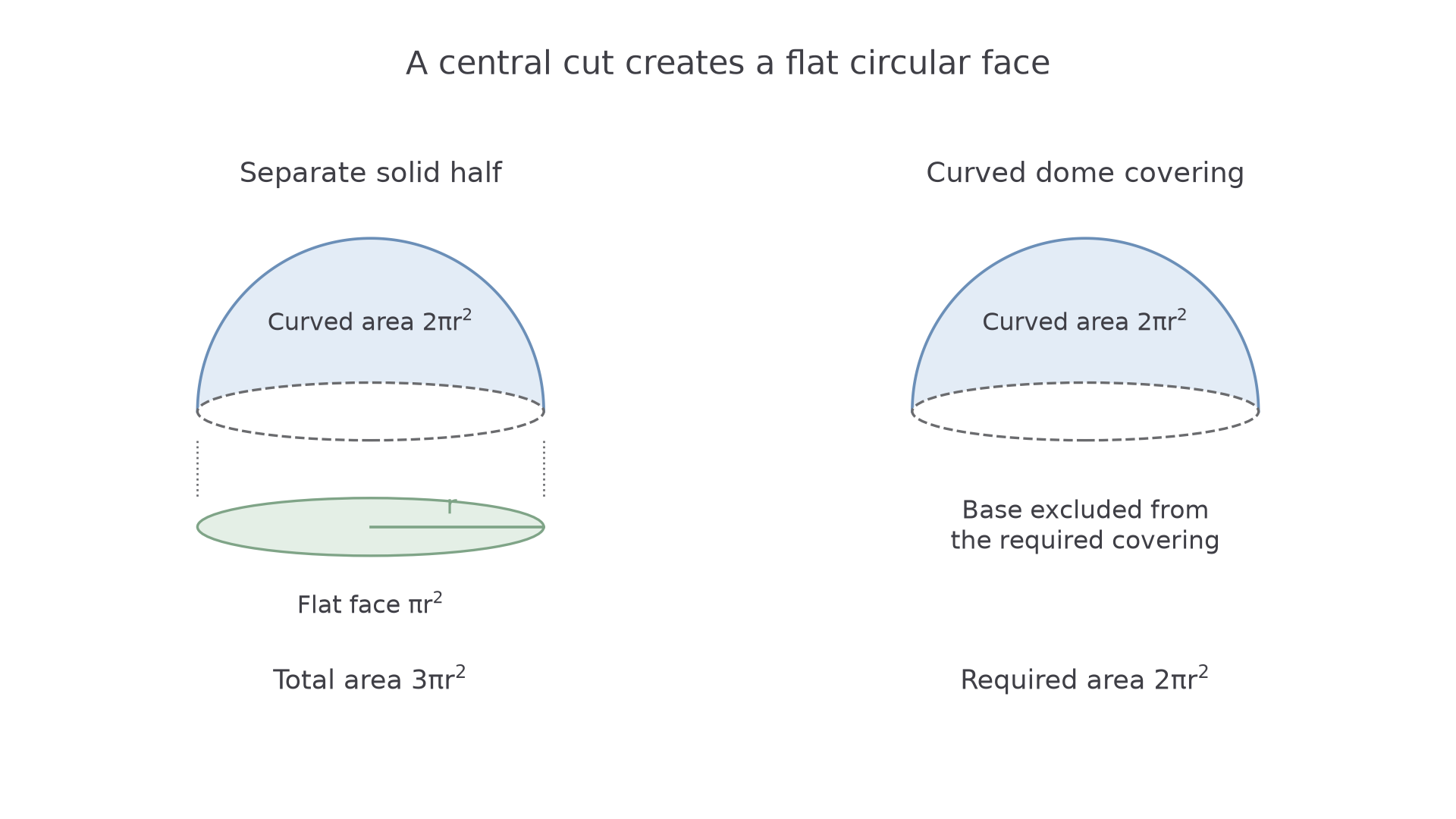
Half-sphere solid
A sphere cut through its centre gives two half-sphere solids. Each is also called a hemisphere. Its curved area is half the sphere's area; its flat face is a circle of the same radius.
You can work with “half a sphere” directly: first halve the appropriate sphere quantity, then decide whether the flat cut face is included. These derived half-sphere formulas are not separate entries on the supplied lists.
Worked example 3: a solid cut through its centre
Question. A solid sphere of radius 4 cm is cut into two equal halves. Calculate the volume and total surface area of one half, in terms of .
Plan. Halve the sphere volume, then add the flat circle to half its surface area.
Answer. Volume ; total surface area .
Check. Rejoining two halves gives the whole sphere volume . Their separate areas total ; hiding the two cut faces leaves , the whole sphere's area.
Only the exposed surfaces change next. The flat base lies against a support and needs no covering.
Worked example 4: covering a dome
Question. A dome is exactly half a sphere of radius 4 m. Only its curved outside is to be covered. Calculate the covering area in terms of .
Plan. Halve the sphere's surface area without adding a base.
Answer. .
Check. The excluded base has area . Adding it would give , the total area of a separate solid half-sphere of this radius.
Continue this lesson.
You’re previewing NovaLearn without an account. Create a free account to read the rest.
Create free account