E5.3 - Similar areas and volumes (Extended)
A model is twice as long as another similar model. Does it need twice as much paint, and can it hold twice as much liquid? E5.3 distinguishes length, surface-area and volume scale factors, then works backwards when an area or volume ratio is given.
Area scale factors
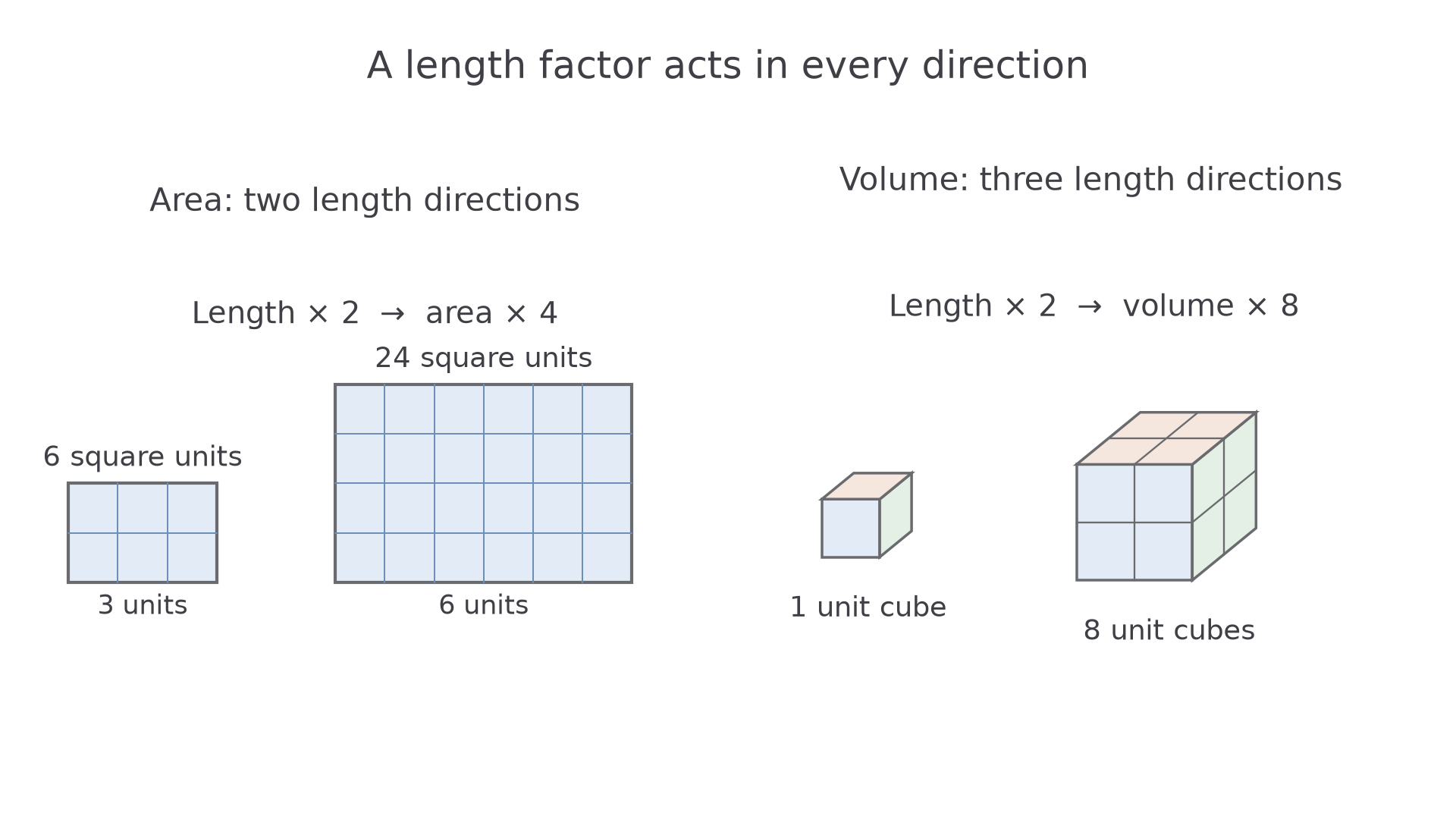
Area counts the square units covering a region. A solid's total surface area adds the areas of all its outside surfaces. Imagine a rectangle 3 units long and 2 units wide. Its area is square units. Double both lengths: the new area is , four times as large. There are two independent length directions to scale.
[DIAGRAM: asset_name: Length, area and volume factors; asset_slug: similarity_dimensions; caption: Doubling a length gives four times the area and eight times the volume.; description: Exact unit-grid rectangles of three by two units and six by four units show 6 and 24 unit squares. Alongside, a unit cube and a two by two by two cube show 1 and 8 equal unit cubes, with visible subdivision edges and counts labelled. The length multiplier is 2, area multiplier 4 and volume multiplier 8.]
Area and surface-area scale factor
If all corresponding lengths of similar shapes or solids multiply by , then
This applies to plane areas, matching faces and total surface areas of similar solids. Not on the supplied formula list: learn the dimensional relationship.
For a rectangle, . For other similar shapes, the same length scaling acts in two directions. For a solid, every matching face scales in area by , so their total surface area does too. Similarity is essential: changing just one dimension is not a uniform scale change.
Worked example 1: a plane area
Question. Two similar shapes have corresponding lengths 4 cm and 6 cm. The smaller has area . Calculate the larger area.
Plan. Find the length factor, square it, then scale the area.
Answer. .
Check. Reversing the lengths gives factor ; .
The next example changes a plane area into a solid's surface area. The exponent stays 2 because surface area is still measured in square units.
Worked example 2: a total surface area
Question. Two similar solids have corresponding lengths 4 cm and 6 cm. The smaller has total surface area . Calculate the larger total surface area.
Plan. Use the same length factor and square it for every face.
Answer. .
Check. The area ratio simplifies to , the square of the length ratio .
The same rule works for reductions: a length factor gives an area factor , which is smaller still.
Watch out
Being a solid does not make every calculation a cube. Paint covers its surface, so paint coverage uses the square of the length factor.
Use the direction specified by the corresponding lengths.
Volume scale factors
Volume measures the three-dimensional space a solid occupies, in cubic units: one cubic unit is a cube of side one unit. A cuboid's volume is its length times width times height. If each is doubled, the factors multiply as . The larger solid can be filled by eight copies of the original-sized unit cube.
Volume scale factor
If all corresponding lengths of similar solids multiply by , then
The three length directions each contribute a factor of . Not on the supplied formula list: learn the dimensional relationship.
For a cuboid, . The same relationship holds for all similar solids. This answers the opening question: doubling all lengths requires four times the paint coverage and gives eight times the volume or capacity.
Worked example 3: doubling every length
Question. A small solid has volume . A similar solid has every corresponding length twice as large. Calculate its volume.
Plan. Cube the length factor, then multiply the given volume.
Answer. .
Check. Halving each length divides volume by ; .
Continue this lesson.
You’re previewing NovaLearn without an account. Create a free account to read the rest.
Create free account