E3.3 - Inverse functions (Extended)
A function multiplies an input by 3 and subtracts 4. If its output is 11, how can you recover the input without guessing? You will reverse input-output pairs, find inverse formulas and check that the inverse really undoes the original function.
Reversing a function
If , the input 5 produces . Reversing this pair sends 11 back to 5: add 4, then divide by 3. Reverse the order as well as the operations.
Inverse function
An inverse function, written , reverses a function's input-output pairs. Thus means . The domain of the inverse is the range of the original function, and its range is the original domain.
The superscript here names an inverse function; it does not mean a reciprocal. For the example, , whereas .
[DIAGRAM: asset_name: Reversing three mapping arrows; asset_slug: inverse_mapping_pairs; caption: An inverse reverses every arrow and exchanges the input and output sets.; description: Left mapping shows f of x equals 2x plus 1 on the domain minus one, zero and two, with arrows to minus one, one and five respectively. Right mapping shows the inverse arrows from minus one, one and five back to minus one, zero and two. Input and output columns are explicitly labelled.]
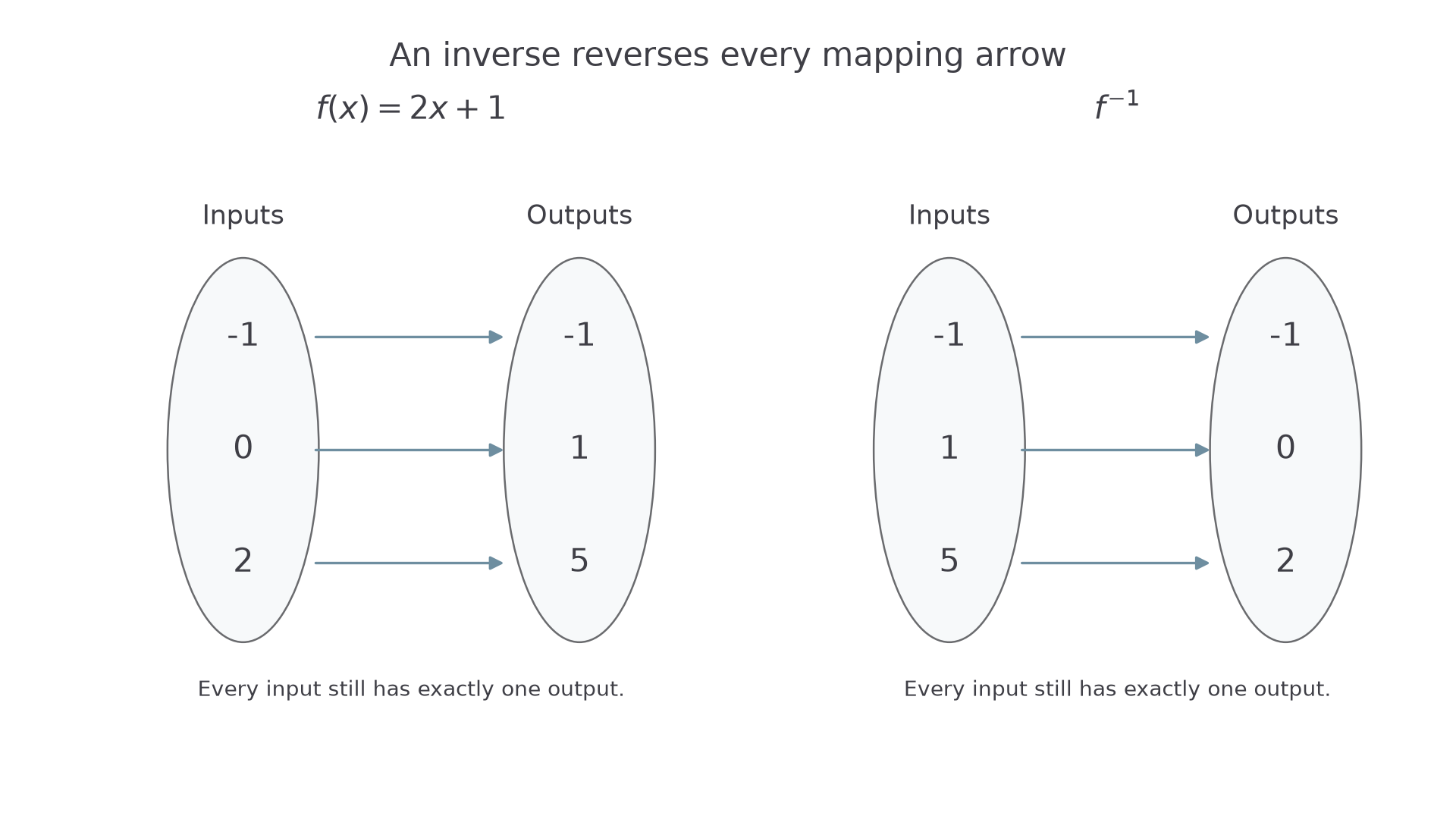
For on the finite domain , the pairs are , , . The inverse has domain and sends , for instance. A mapping diagram can therefore give inverse values without any rearrangement.
A reverse rule must still be a function: each input must have exactly one output. On the whole real line, sends both 2 and to 4, so reversing would send 4 to two different numbers. It has no inverse function on that whole domain. Restricting it to removes that ambiguity, giving the inverse for . A function whose distinct inputs always give distinct outputs is called one-to-one.
Key idea
The original domain matters. Reverse a one-to-one function, or a stated one-to-one restriction, and exchange its domain and range.
Read the inverse notation as a reversed pair.
Finding an inverse
To turn the reversed pairs into a formula, write and rearrange to make the original input the subject. The result tells you the input in terms of the output. Rename the inverse's input only after completing that rearrangement.
Worked example 1: reversing a linear rule
Question. Find when , with domain all real numbers.
Plan. Solve the equation for its input.
Answer. , with domain all real numbers.
Check. , and the inverse sends 2 to . A second pair, , reverses to . This also recovers the opening input: .
Change the input operation from to . A domain restriction is now essential when choosing the square-root sign.
Worked example 2: an inverse with a restricted domain
Question. Find when , with domain . State the inverse's domain.
Plan. Rearrange, select the non-negative root required by the original domain, then exchange the domain and range.
The least output of is , obtained at . Its outputs include every value above , so that is the inverse's domain.
Answer. , for . Its outputs are non-negative.
Check. , and . The negative root is outside the original domain and must not be included. At the boundary, , which correctly reverses .
Continue this lesson.
You’re previewing NovaLearn without an account. Create a free account to read the rest.
Create free account