E6.5 - Frustums and similar solids (Extended)
A cone with its tip removed still has part of the original curved surface. E6.5 uses similarity to recover the missing tip, then calculates a frustum's volume and exposed area by subtraction. You will distinguish the full cone, the small removed cone and the remaining solid before using their dimensions.
Matching cones
A lampshade has circular rims of different sizes. If its sides would meet at one vertex, how can you recover that missing tip? Extend the sides to the vertex and compare the two cones they form.
Conical frustum
A conical frustum is the part of a cone remaining after a smaller cone is cut off by a plane parallel to its base. In a right circular cone, the two circular faces have a common axis, and the removed cone is similar to the original cone.
[DIAGRAM: asset_name: Similar cones behind a frustum; asset_slug: frustum_similar_section; caption: Both cone heights start at the original vertex, and their radii match in the same ratio.; description: An exact axial section of a right circular cone has base radius 6 cm and full perpendicular height 15 cm. A parallel cut leaves a top radius of 2 cm, so the small removed cone has height 5 cm and the remaining frustum height is 10 cm. The retained frustum is shaded pale blue; the removed tip is dashed. Radius arrows, parallel base and cut lines, the common axis and distinct height brackets are labelled without overlap.]
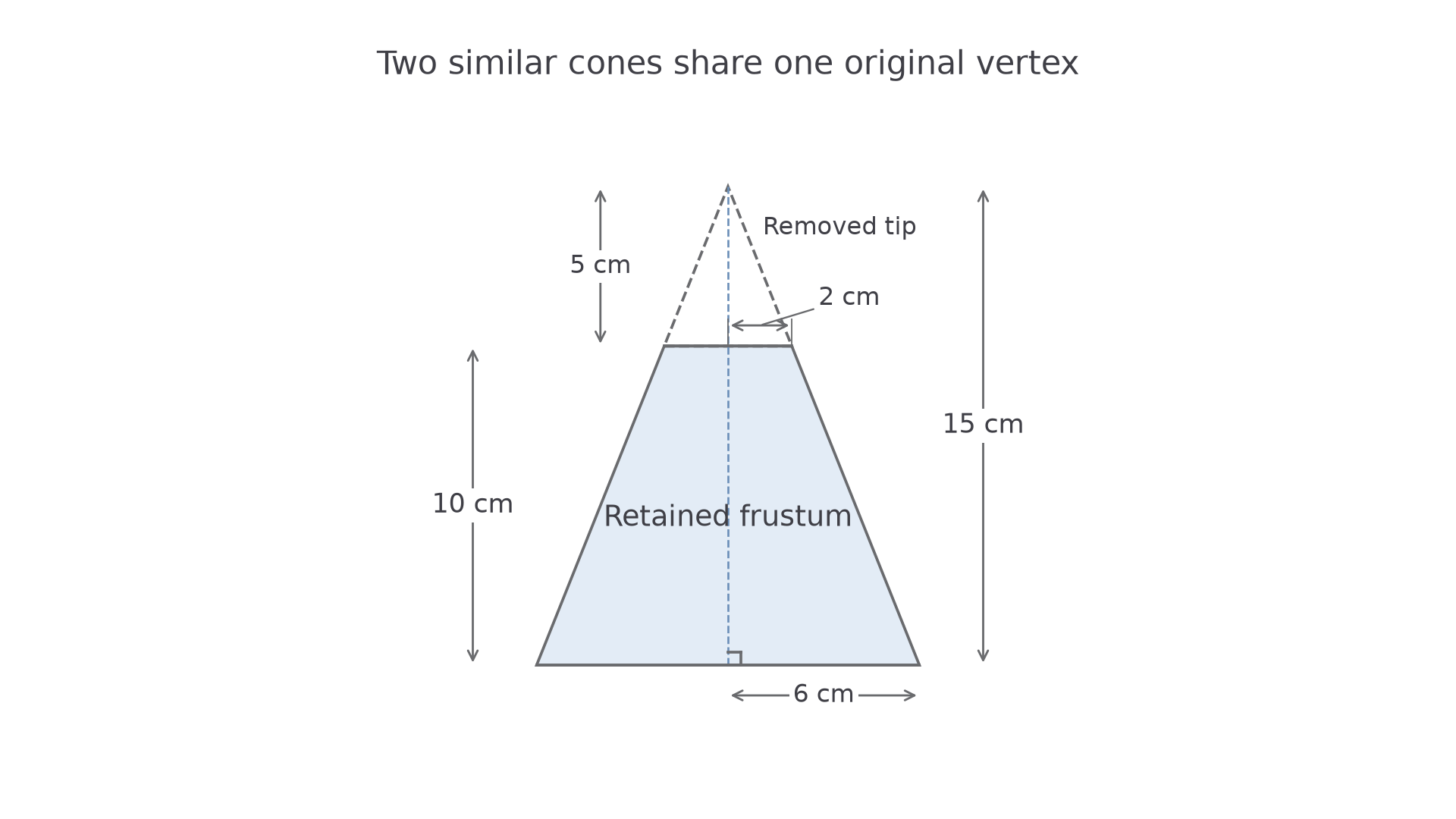
The axial section contains similar triangles: the cut is parallel to the base, giving equal corresponding angles. The radius of the small cone corresponds to the full base radius. Its height is measured from the original vertex, not from the bottom of the frustum.
Matching lengths in similar cones
For full-cone radius , height and sloping edge , and removed-cone radius , height and sloping edge ,
The frustum has perpendicular height and sloping edge , with for a cut strictly between the original base and vertex. These relationships follow from similarity; they are not separate entries on the supplied formula list.
The parallel cut is essential. A tilted cut need not produce a similar cone and these radius ratios would not describe it.
Worked example 1: full height known
Question. A right circular cone has radius 6 cm and perpendicular height 15 cm. A parallel cut removes a small cone of radius 2 cm. Calculate the small cone's height and the frustum's height.
Plan. Use the small-to-full radius ratio for the heights, then subtract.
Answer. Small-cone height 5 cm; frustum height 10 cm.
Check. , and the two heights reconstruct 15 cm.
The next frustum has the same radii, but only its own height is given. The full height must now be reconstructed rather than read off.
Worked example 2: frustum height known
Question. A conical frustum has lower radius 6 cm, upper radius 2 cm and perpendicular height 10 cm. Its circular faces are parallel. Calculate the heights of the original cone and the removed cone.
Plan. Express the small height as a fraction of the full height, then use their difference.
Answer. Full height 15 cm; removed-cone height 5 cm.
Check. cm and , satisfying both original conditions.
The full-cone and small-cone heights are not both equal to the given frustum height. Drawing a single axis helps keep the three distances separate.
Watch out
compares small cone with full cone. It does not compare small cone with frustum. For these radii, the small height is one third of the full height, not one third of 10 cm.
Use a difference equation before calculating the two cone heights.
Volume by subtraction
The full cone consists of the retained frustum and the removed tip, with no overlap of interiors. Subtracting their volumes leaves exactly the frustum.
Frustum volume from two cones
Use the full cone's height with radius , and the removed cone's height with radius . The cone-volume formula is supplied on the Papers 2 and 4 lists, but this subtraction is not a separate listed formula. Required formulas are supplied within Paper 6 questions.
If a dimension is missing, find it from similarity first. Keep the two products separate until each cone has the correct radius and height. Exact arithmetic avoids rounding two volumes before subtracting them.
Worked example 3: two cone volumes
Question. A full cone has radius 6 cm and perpendicular height 12 cm. A parallel cut removes a similar cone of radius 3 cm and height 6 cm. Calculate the frustum's volume in terms of .
Plan. Calculate the full and removed cone volumes, then subtract.
Answer. .
Check. The length factor is , so the small cone has of the full volume. The remaining of is .
Continue this lesson.
You’re previewing NovaLearn without an account. Create a free account to read the rest.
Create free account