E1.17 - Simplifying surds (Extended)
Can a square with area 48 have an exact side length that looks simpler than ? Surds keep irrational values exact rather than replacing them with rounded decimals. Develop the simplifying, adding and multiplying skills in E1.17 by recognising square factors and keeping track of like terms.
Square factors
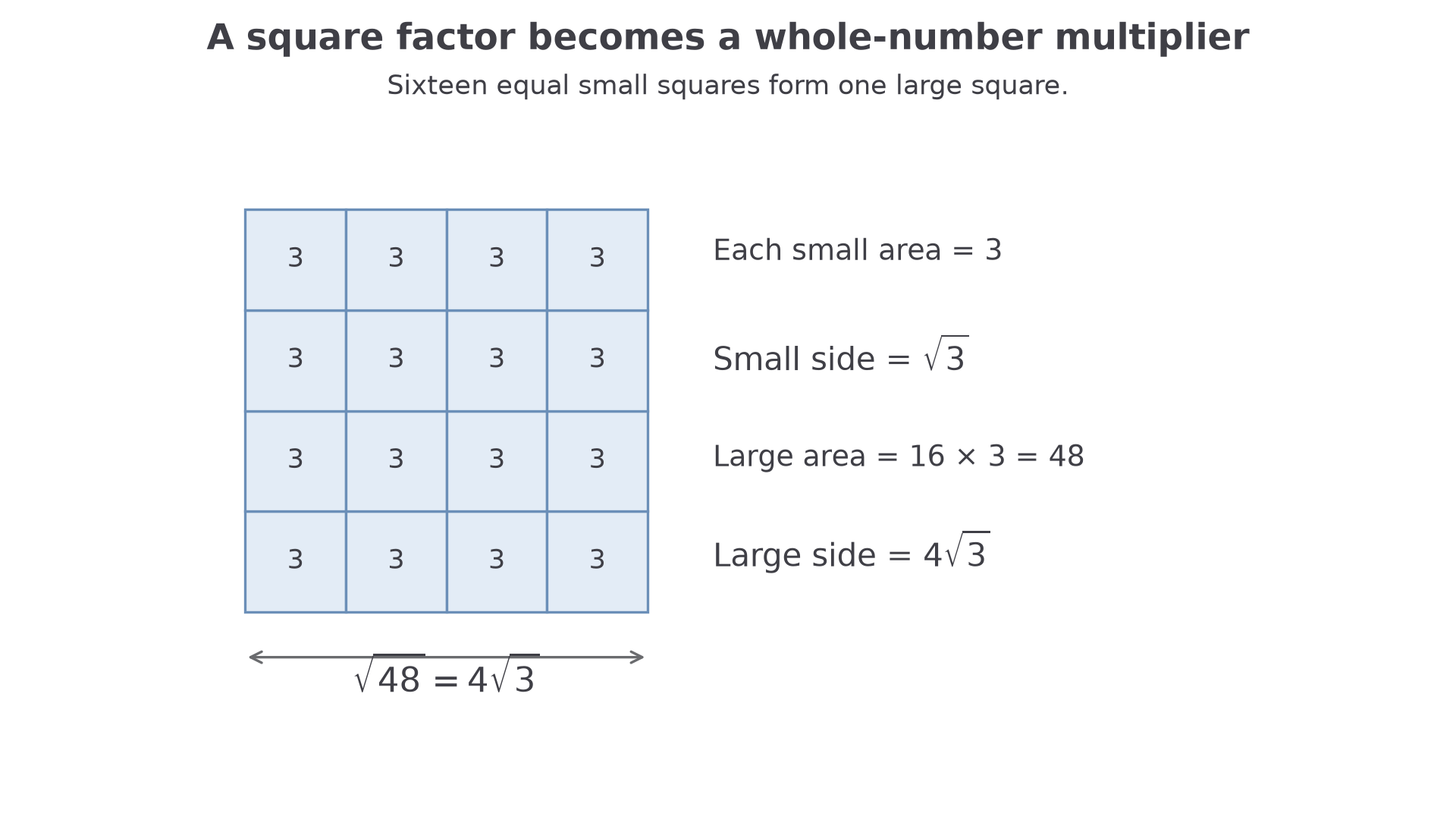
Sixteen small squares, each of area 3, can form a by square of area 48. Each small side is , so the large side is . This gives a picture of why .
Surd
A surd is an irrational root left in exact form, such as or . A root that is rational, such as , is not a surd. The square-root symbol means the nonnegative square root.
Use square factors because their square roots are whole numbers. For example, 16 is useful in 48 because .
Square root of a product
For and ,
In particular, if , then .
Not in the supplied formula list: learn it.
Both sides of the product rule are nonnegative and have square , which explains why the rule holds.
[DIAGRAM: asset_name: Square factors in a square of area forty-eight; asset_slug: surd_square_factors; caption: Four small side lengths make the large side, so the side is four times the square root of three.; description: A large square is partitioned into a four-by-four grid of sixteen equal small squares. Each small square has area three and side square root of three. The large square has area forty-eight and side four times square root of three, equal to square root of forty-eight.]
Worked example 1: extract a square factor
Question. Simplify .
Plan. Write 48 as its largest square factor times the remaining factor.
Answer. .
Check. , and is positive. Also, 3 has no square factor greater than 1.
The next radicand has a larger square factor. A radicand is the number inside the root sign.
Worked example 2: simplify fully
Question. Simplify .
Plan. Use to remove the largest square factor in one step.
Starting with also works, but gives , which still needs simplifying to .
Answer. .
Check. , and .
Try the square factors , or use prime factors to find pairs. “Fully simplified” means no square factor greater than 1 remains inside the square root.
Watch out
Square-root multiplication does not give a matching addition rule. For example, , whereas . Do not split a sum under a square root.
Use a square factor and check by squaring.
Like surds
Three lots of plus five lots of make eight lots of the same quantity. This works just as three metres plus five metres make eight metres.
Like surds
Like surds have the same root part after simplification. Their coefficients can be added or subtracted: . For example, and are like surds; and are not.
Keep the root part fixed when combining coefficients. Unlike root parts cannot be combined by this rule.
Worked example 3: combine like root parts
Question. Simplify .
Plan. Combine the coefficients because every term has root part .
Answer. .
Check. Dividing both the original expression and the answer by the nonzero number gives .
In the next expression, the matching root parts are hidden until you simplify each term.
Worked example 4: simplify before combining
Question. Simplify .
Plan. Extract square factors first, then combine the resulting like surds.
Answer. .
Check. Factor from the original form: .
Some expressions contain more than one root part. For example, ; the term stays separate.
Watch out
. First simplify to . Adding radicands does not add the roots.
Simplification will reveal one common root part in this check.
Products of surds
Multiplication differs from addition: different square-root parts can be multiplied using the product rule. Multiply ordinary coefficients together and root parts together, then simplify the result.
You already know
For nonnegative , . In particular, . A whole-number coefficient outside a root is not moved inside unchanged.
For example, has coefficient and root part .
Worked example 5: multiply two surd terms
Question. Simplify .
Plan. Multiply coefficients and root parts separately, then extract a square factor.
Answer. .
Check. Both expressions are positive. Their squares agree: , and .
When a bracket contains a sum or difference, multiply every term inside it. This is the distributive rule: .
Worked example 6: distribute a surd factor
Question. Simplify .
Plan. Multiply by each term, keeping the subtraction sign.
Answer. .
Check. With , the original expression and the answer both give approximately . The decimal is a check, not a replacement for the exact answer.
The large square at the start now fits the same rules: , so its exact side length is .
Watch out
. Moving 3 inside a square root requires squaring it: . Multiplication must account for the coefficient as well as the radicand.
Multiply both bracket terms and leave an exact answer.
Quick Recap
- Extract square factors and leave no square factor greater than 1 inside the root.
- Simplify root parts before deciding which terms are like surds.
- Add coefficients of like surds; multiply coefficients and radicands for products.
- Distribute a factor across every term of a bracket and retain exact root notation.
The opening square has exact side length , since .