C5.5; E5.5 - Angles in polygons
A regular polygon has an interior angle of . Can you work out its number of sides without drawing it? C5.5 and E5.5 connect triangle angle sums, interior angles and turning angles, giving you a reliable way to solve this problem.
Angle sums
A quadrilateral can be split into two triangles by one diagonal. Its four interior angles are made from the angles of those triangles, so their total is .
Interior angle
An interior angle is the angle inside a polygon at a vertex. A polygon is a closed shape with straight sides. Here we start with convex polygons: every interior angle is less than .
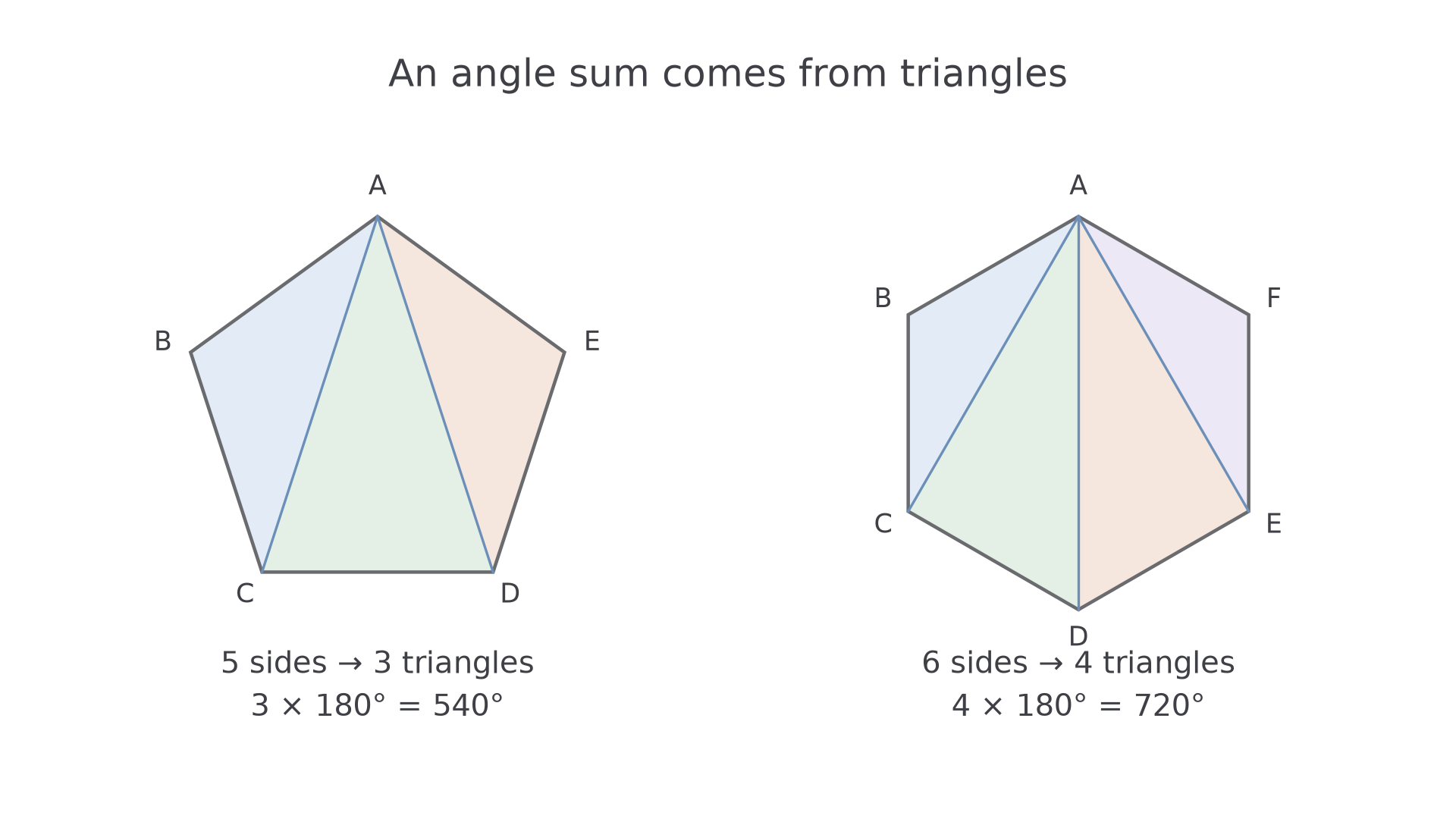
Draw diagonals from one vertex of a pentagon to the non-neighbouring vertices. You get three triangles. A hexagon gives four. Each extra side adds one triangle, so an -sided convex polygon gives triangles.
[DIAGRAM: asset_name: Triangles inside polygons; asset_slug: polygon_triangles; caption: A pentagon gives three triangles and a hexagon gives four.; description: Exact convex pentagon and hexagon with non-crossing diagonals from one vertex. Three triangular regions in the pentagon and four in the hexagon are pale shaded. The angle totals are labelled as three times 180 degrees and four times 180 degrees.]
Interior angle sum
For a convex polygon with sides,
The triangles fill the polygon without gaps or overlaps. Not on the supplied formula list: learn the triangle argument.
The sum is a total for all the corners. It is not the size of one angle.
Worked example 1: five sides
Question. Calculate the interior angle sum of a pentagon.
Plan. Count the triangles from one vertex, then multiply by .
Answer. .
Check. Splitting the pentagon into a quadrilateral and a triangle gives .
Only the number of sides changes next; the triangle argument stays the same.
Worked example 2: eight sides
Question. Calculate the interior angle sum of an octagon.
Plan. Use in the angle-sum formula.
Answer. .
Check. An octagon has three more sides than a pentagon. Its sum is .
The diagonals start at a vertex, not at a new point in the centre.
Watch out
counts two triangles too many. From one vertex, the two neighbouring sides already form the outside edges, leaving triangles.
Use the same reasoning with a different number of sides.
Regular polygons
The total angle sum becomes a single angle only when the angles are equal. A regular polygon has both equal sides and equal interior angles.
Exterior angle
Continue a side through a vertex. The exterior angle between this continuation and the next side is the turn made as you walk around a convex polygon. The interior angle and this exterior angle form a straight angle, so they add to .
Walking once around a convex polygon turns you through one complete revolution, . A regular polygon divides this turn equally between its vertices.
Angles of a regular polygon
For a regular polygon with sides,
Equivalently, . Not on the supplied formula list: learn these relationships.
Continue this lesson.
You’re previewing NovaLearn without an account. Create a free account to read the rest.
Create free account