C5.1, C5.3; E5.1, E5.3 - Similar shapes and scale factors
Two photographs show the same scene, but one is twice as wide. Must it also be twice as high to keep the same shape? C5.1 and E5.1 distinguish similarity from congruence; C5.3 and E5.3 use corresponding sides to calculate missing lengths, even when one shape is turned over or rotated.
Congruent and similar
A transparent tracing can be moved or turned over without changing its side lengths or angles. If it fits another shape exactly, the two shapes are congruent. Enlarging the tracing keeps the shape but usually changes its size.
Congruent and similar shapes
Congruent shapes have the same shape and size: corresponding sides and angles are equal. Similar shapes have equal corresponding angles and one constant ratio between all corresponding lengths. The multiplier for lengths is the length scale factor.
“Corresponding” means matching positions in the shapes, not simply both being on the left of the page. Turning or reflecting a shape does not change whether it is congruent or similar.
A cm by cm rectangle and a cm by cm rectangle are similar: both lengths double and all angles stay right angles. The rectangles are not congruent because the sizes differ. A turned cm by cm rectangle is congruent to the first one; it is also similar, with scale factor 1.
Equal angles alone do not guarantee similarity for all polygons. A cm by cm rectangle and a cm by cm rectangle both have four right angles, but while . They are not similar.
Key idea
Congruence is similarity with length scale factor 1. For general polygons, check both equal corresponding angles and a common length multiplier.
The opening photograph must double in height as well as width: one multiplier must apply to every length. Now diagnose a different pair of rectangles.
Corresponding lengths
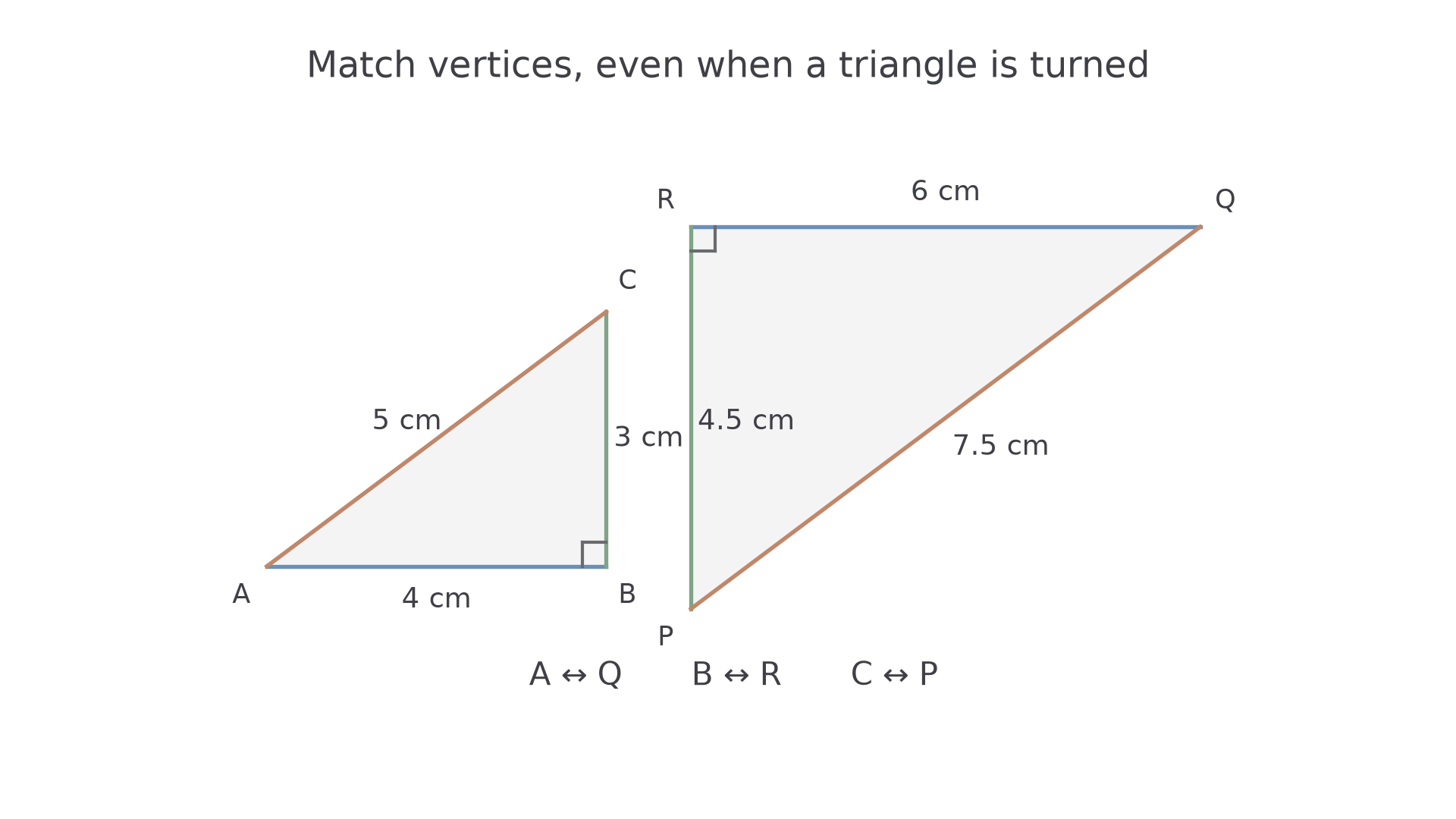
Match the vertices first. If matches , matches , and matches , then side matches , regardless of their orientations.
[DIAGRAM: asset_name: Corresponding sides of turned triangles; asset_slug: similarity_correspondence; caption: A matches Q, B matches R and C matches P; the second triangle is turned through a half-turn.; description: Two exact similar right triangles, ABC with sides AB 4 cm, BC 3 cm and AC 5 cm, and QRP with QR 6 cm, RP 4.5 cm and QP 7.5 cm. The larger triangle is rotated 180 degrees. Corresponding side pairs share pale accent colours and corresponding right angles B and R are marked.]
Length scale factor
For similar shapes,
Keep the direction the same for every pair. Here lengths are positive, so . Not on the supplied formula list: learn the relationship.
In the picture, the scale factor from to is . The other pairs give and , confirming the match.
Worked example 1: finding an enlargement factor
Question. Similar triangles and have matches , , . Given cm and cm, find the scale factor from to , and state which side corresponds to .
Plan. Divide target length by starting length, using the matched endpoints.
Since matches and matches , side matches .
Answer. Scale factor ; corresponds to .
Check. , so the factor acts in the requested direction.
Continue this lesson.
You’re previewing NovaLearn without an account. Create a free account to read the rest.
Create free account