E5.6, E5.7 - Chords and the alternate segment (Extended)
A tangent angle at the edge of a circle can equal an angle on the far side of the circle. How can you tell which one? E5.6 supplies the alternate segment theorem; E5.7 uses circle symmetry to relate equal chords, their distances from the centre and their perpendicular bisectors.
Alternate segment
A chord and a tangent meet at a point on the circumference. The tangent has two rays from that point, producing two supplementary angles with the chord. Choose the ray before applying the theorem.
Alternate segment theorem
The angle between a tangent and a chord through its point of contact equals the angle subtended by that chord in the alternate segment. The chosen tangent ray and the circumference vertex lie on opposite sides of the line containing the chord.
Let the tangent at contain in that order, and let be a chord. If and a circumference point lie on opposite sides of line , then . Both angles use the chord endpoints and , although their vertices differ.
[DIAGRAM: asset_name: Selecting the alternate segment; asset_slug: alternate_segment_rays; caption: The tangent ray and the circumference vertex are on opposite sides of the chord; reversing the ray changes the angle.; description: Exact circle tangent to horizontal line XAY at A. Chord AB rises rightwards. A point C on the major arc AB is opposite tangent ray AY across line AB. Angle YAB and angle ACB are both 52 degrees. A second panel shows the other tangent angle XAB as 128 degrees and a point D on the minor arc AB with angle ADB 128 degrees. The arcs mark only the selected regions.]
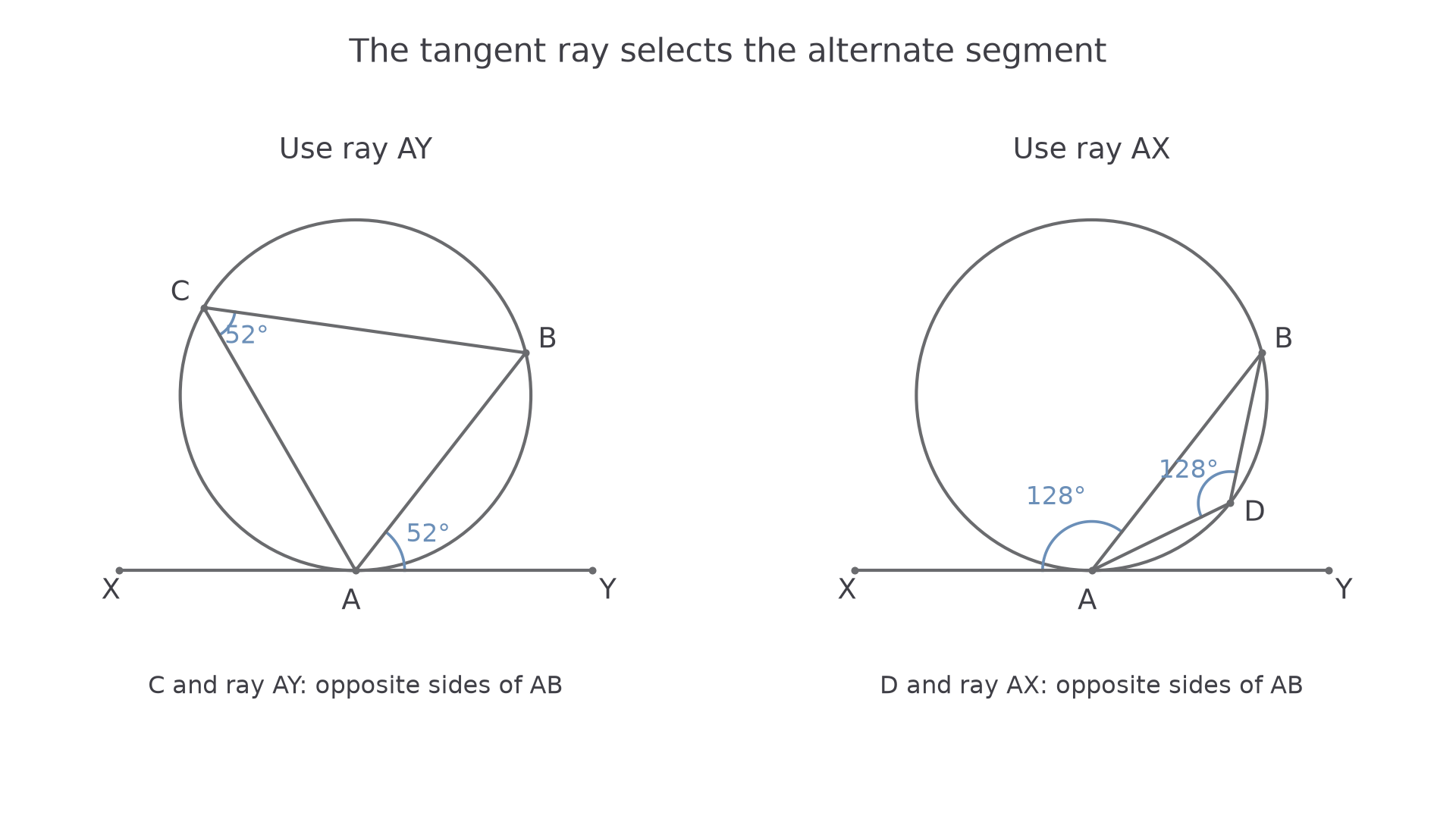
Why does it work? For a non-diameter chord, join the centre to and . If the smaller centre angle is , equal radii make the two base angles of triangle equal to . Subtracting one from the radius-tangent right angle gives
That is exactly the circumference angle on the corresponding arc. The other tangent ray makes the supplementary angle, matching the angle in the other segment. If is a diameter, the tangent-chord angle and the angle in either semicircle are both .
Worked example 1: transferring from the tangent
Question. lie in that order on the tangent at . is a chord and is another circumference point. Points and lie on opposite sides of line . Given , find , giving a reason.
Plan. Use the chord endpoints and the opposite-side condition to select the alternate segment.
- The angle at lies between tangent ray and chord .
- The angle at has arms to those same endpoints and .
- The stated side condition gives .
Answer. , by the alternate segment theorem.
Check. The other tangent ray makes , so it would be wrong to attach that obtuse angle to the specified vertex .
The next example uses the theorem in reverse: find the circumference angle first, then the tangent angle.
Worked example 2: a triangle leading to a tangent angle
Question. A tangent at contains in that order. Points lie on the circle, with and on opposite sides of line . Given and , find , giving reasons.
Plan. Find the angle subtended by chord at , then transfer it to the correct tangent ray.
Answer. .
Check. The angle on the other tangent ray is . Its sum with is , as required on straight line .
You do not need a diameter for this theorem. You do need a genuine tangent at the chord's endpoint.
Watch out
The matching circumference angle stands on the entire chord. Check both endpoints and the selected tangent ray; choosing the other ray gives the supplementary angle.
Keep the same side condition when changing the labels.
Chord symmetry
A chord's distance from the centre means the shortest distance to the line of the chord. Measure along a perpendicular, not from the centre to an endpoint.
Equal chords and centre distances
Equal chords in the same circle are equidistant from the centre. The distances are measured perpendicularly from the centre to the chords. Conversely, chords at equal perpendicular distances from the centre of the same circle have equal lengths.
The radii to a chord's endpoints make an isosceles triangle. Its symmetry line passes through the chord's midpoint at a right angle. Two equal chords give triangles with the same three side lengths: two equal radii and the equal chord. They therefore have the same shape and the same perpendicular height from the centre.
For the converse, rotate one centre-to-chord perpendicular onto the other. Their equal lengths put both feet at the same point. Both chords are perpendicular to the same radius there, so they lie on the same line and meet the unchanged circle at the same endpoints. Their lengths are therefore equal. At zero centre distance, both chords are diameters and have equal lengths.
Continue this lesson.
You’re previewing NovaLearn without an account. Create a free account to read the rest.
Create free account