E8.1 - Negative enlargements (Extended)
An image can be twice as large yet appear across the centre from its object. E8.1 uses a negative scale factor to combine a change of size with this reversal of centre rays. You will draw negative enlargements, work with negative fractions and recover the signed factor and centre from a mapping.
Opposite-side images
What does a scale factor of mean when a length cannot be negative? The size multiplier is 2, while the minus sign tells you to use the opposite direction from the centre. The resulting side lengths are positive and twice as large.
Negative enlargement
For a negative scale factor , the image P' lies on the opposite ray from the centre S to P, at distance . Equivalently, multiply the horizontal and vertical displacements from S by the signed factor . The centre is fixed.
Draw a straight line through each vertex and the centre. Extend it through the centre to the other side, mark the required distance, then join the images with a ruler. The centre lies between a moved point and its image. A negative enlargement is one transformation: its effect can be understood as a half-turn and a positive scaling about the same centre, but describe the single enlargement when one is requested.
[DIAGRAM: asset_name: Negative factor with two enlargement centres; asset_slug: negative_enlargement_centres; caption: A negative factor places every moved image across the centre, at twice its original distance.; description: Two accurate equal-scale grids show triangle A one comma one, B three comma one and C one comma two enlarged by factor minus two. Left centre is the origin, with images minus two comma minus two, minus six comma minus two and minus two comma minus four. Right centre is S one comma zero, with images one comma minus two, minus three comma minus two and one comma minus four. Straight centre lines and different pale fills distinguish object and image.]
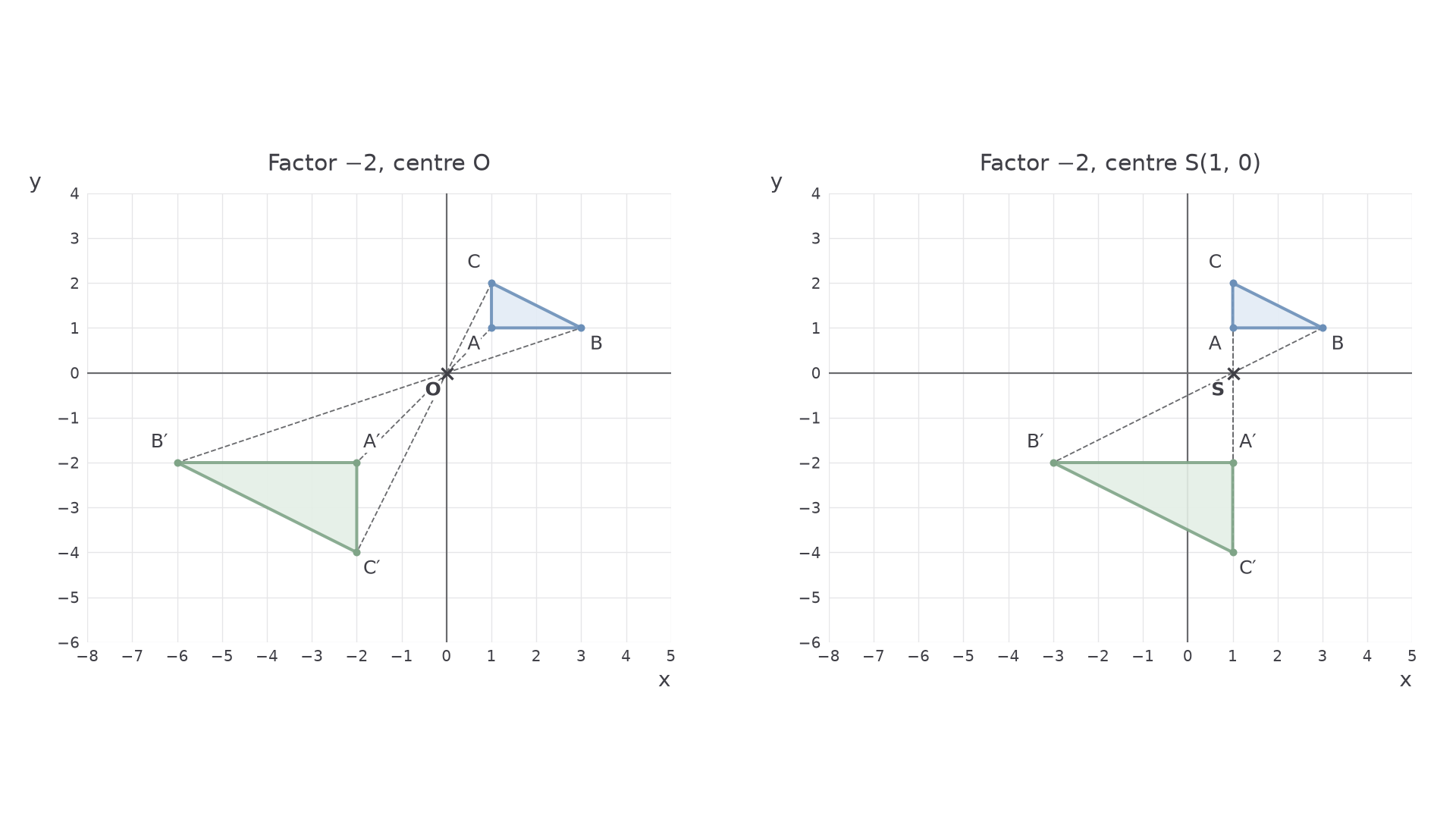
Worked example 1: factor minus two about the origin
Question. Enlarge by factor , centre .
Plan. Multiply each displacement from the origin by .
Answer. Join these image vertices in order, as on the left grid.
Check. AB is 2 units and A'B' is 4 units. Each line joining a point to its image passes through the origin, with the two points on opposite sides. A negative side length is never required.
The factor stays , but changing the centre changes the image positions. Work from that centre before multiplying.
Worked example 2: a negative factor about an offset centre
Question. Enlarge the same triangle by factor about .
Plan. Find each displacement from S, multiply by , then add S back.
Answer. , joined as on the right grid.
Check. SB moves 2 right and 1 up, while SB' moves 4 left and 2 down: opposite direction and twice the distance. The image side lengths remain 4 and 2, twice the object lengths.
Both positive and negative enlargements preserve angles. A negative factor reverses both centre displacement components; it does not reflect the shape in one mirror line.
Watch out
The sign controls the side of the centre; the magnitude controls the size. Factor does not mean “move two units left”, and a larger image does not automatically have a positive factor.
Use an offset centre in the next point calculation.
Negative fractional factors
A negative fraction does two jobs: its magnitude shrinks distances and its sign puts the image on the opposite ray. With , each image is half as far from the centre and on the other side.
Negative fractional enlargement
For , image lengths are smaller by factor , and moved vertices lie across the centre from their originals. For , the size is unchanged and the mapping is also a rotation about the same centre.
Multiplication by a negative factor is applied to both displacement coordinates. Do not make one coordinate negative and leave the other as a positive fractional scaling: that would place the point on the wrong ray.
[DIAGRAM: asset_name: Two negative fractional factors; asset_slug: negative_fractional_images; caption: Both images lie across the origin, but a factor of minus one quarter is smaller and closer than minus one half.; description: Two accurate equal-scale grids show object A four comma two, B eight comma two and C four comma six. Left images for minus one half are minus two comma minus one, minus four comma minus one and minus two comma minus three. Right images for minus one quarter are minus one comma minus one half, minus two comma minus one half and minus one comma minus one point five. Centre lines pass through the origin between each object and image.]
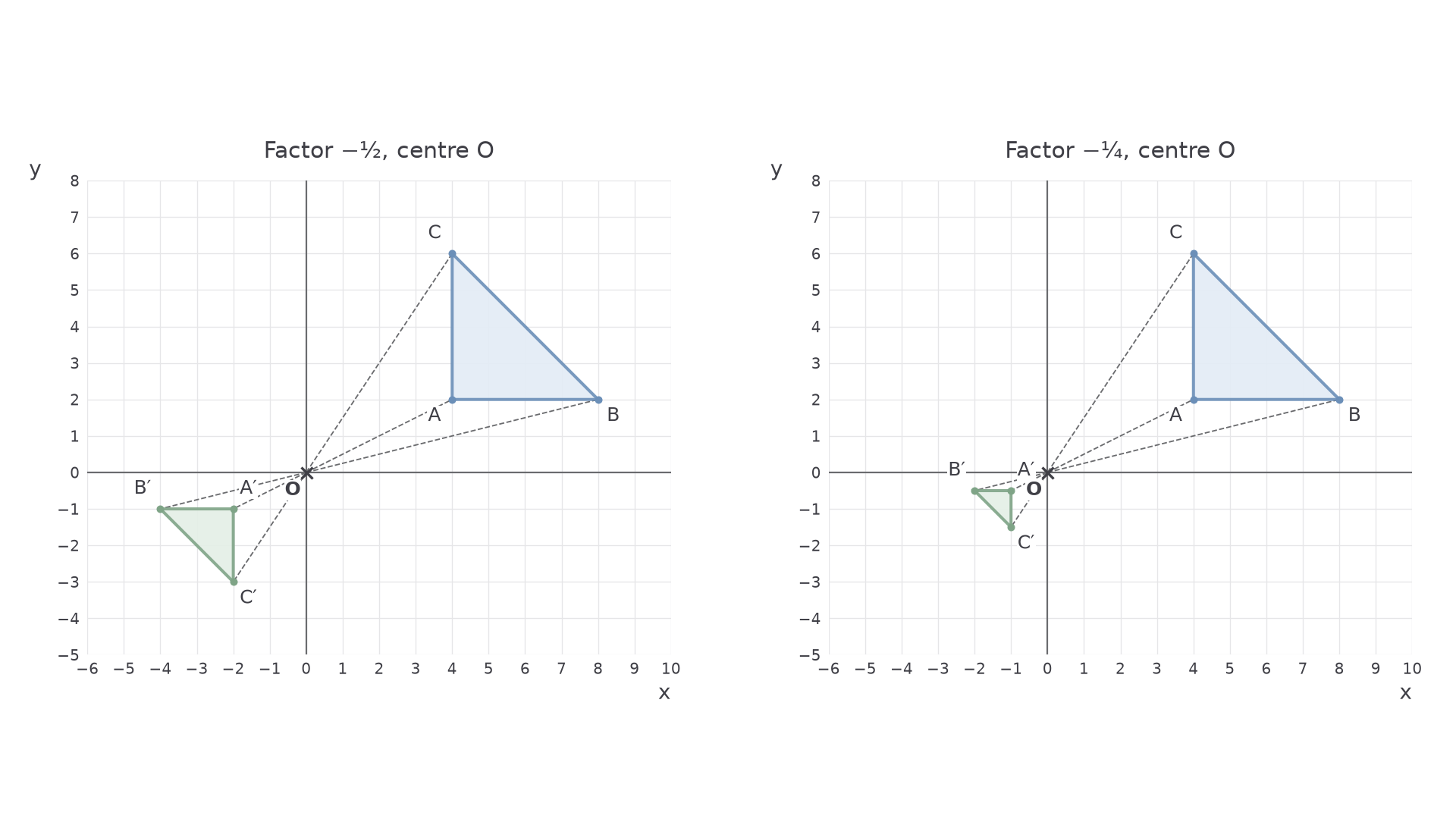
Worked example 3: a half-size reversed image
Question. Enlarge by about the origin.
Plan. Halve both coordinates and reverse both signs.
Answer. Join the three image vertices as on the left grid.
Check. The original horizontal side has length 4 and the image side length 2. Each image-to-object distance ratio from the centre is , with the image across the origin.
Continue this lesson.
You’re previewing NovaLearn without an account. Create a free account to read the rest.
Create free account