C5.2; E5.2 - Three-figure bearings
You travel from a harbour on a bearing of . Which bearing takes you directly back? C5.2 and E5.2 give directions a precise meaning: measure clockwise from north at the starting point, draw the route, then use parallel north lines to reverse it.
Bearing conventions
“The bearing of from ” tells you to stand at and look towards . The word from identifies the vertex of the angle.
Three-figure bearing
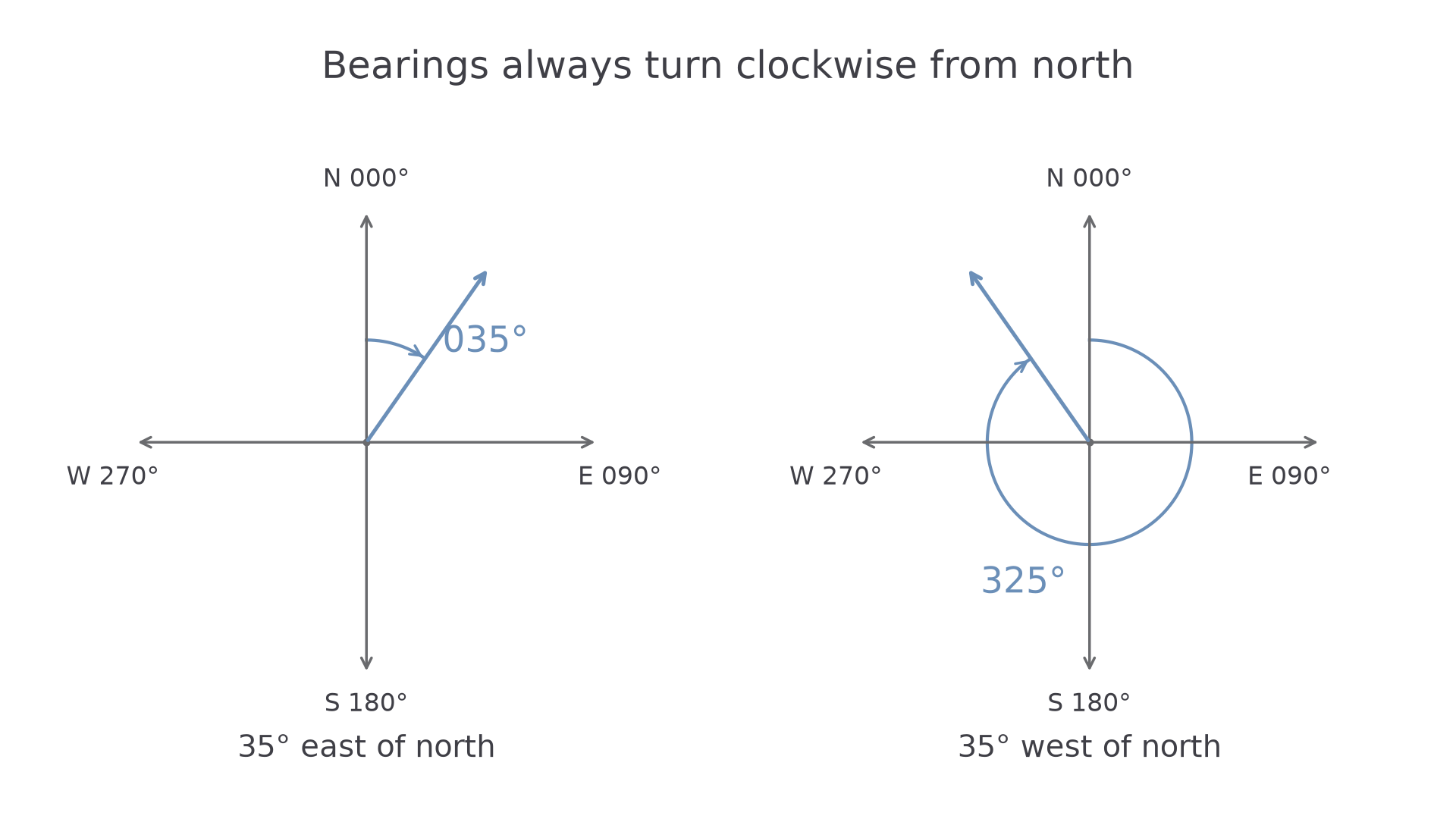
A bearing is an angle measured clockwise from north at the starting point. Write it with three figures: , not . Due north is (also ), due east , due south , and due west .
Draw a north arrow through the starting point. Follow the clockwise turn all the way to the direction line, even when it exceeds .
[DIAGRAM: asset_name: Clockwise bearings from north; asset_slug: bearing_clockwise; caption: A north-east direction has bearing 035 degrees; a north-west direction has bearing 325 degrees.; description: Two exact compass diagrams with north up and east right. The first ray is 35 degrees clockwise from north. The second ray is 35 degrees west of north, with the full clockwise 325 degree arc marked. North, east, south and west are labelled with three-figure bearings.]
Worked example 1: east of north
Question. lies east of north from . Write down the bearing of from .
Plan. Start at north at and turn clockwise towards .
The clockwise angle is . Add a leading zero to write three figures.
Answer. .
Check. The direction lies between north and east , as does.
Only the side of north changes next. The short angle is now anticlockwise, so it is not the bearing.
Worked example 2: west of north
Question. lies west of north from . Calculate the bearing of from .
Plan. Subtract the short anticlockwise angle from a complete turn.
Answer. .
Check. North-west directions have bearings between west and north . Also .
A bearing measures direction, not distance. Moving further along the same ray leaves the bearing unchanged.
Watch out
The smaller angle between north and the route is not always the bearing. Use the clockwise angle, and keep the three figures.
Choose the correct start point and turn in this new case.
Drawing bearings
A bearing fixes a ray; a distance fixes the endpoint on that ray. Use a ruler for straight edges and a protractor for the angle. If the distance is too large for the page, choose or use the given scale.
You already know
At a scale of 1 cm representing 2 km, divide a real distance in kilometres by 2 to get its drawing length in centimetres. A protractor's centre belongs exactly on the starting point.
Keep the north line and the route ray distinct. For a bearing greater than , a semicircular protractor can mark the remaining angle on the west side of north, but the labelled bearing is still the full clockwise turn.
Worked example 3: drawing a north-east route
Question. is 8 km from on a bearing of . Describe an accurate construction using 1 cm to represent 2 km.
Plan. Draw north at , measure the direction, then scale the distance.
- Mark and draw a vertical north arrow through it.
- Centre the protractor on , with zero aligned to north. Mark clockwise, on the east side, and draw the ray using a ruler.
- Calculate . Measure 4 cm from along the ray and label the endpoint .
Answer. A 4 cm segment from , clockwise from north, with the bearing labelled .
Check. Measuring back gives a clockwise angle; km checks the distance. lies north-east of .
The next route has the same scale and distance but is west of north.
Continue this lesson.
You’re previewing NovaLearn without an account. Create a free account to read the rest.
Create free account