C6.4; E6.4 - Pyramids and cones
A pointed container holds less than a straight-sided container with the same base and height. C6.4 and E6.4 use the one-third relationship to calculate pyramid and cone volumes. You will choose the perpendicular height, keep exact multiples of and work backwards to find a missing dimension.
Pyramid volume
A pyramid and a prism have the same base area and perpendicular height. How do their volumes compare? The prism keeps its full cross-section throughout; the pyramid narrows to a vertex, and its volume is exactly one third of the prism's.
Pyramid and perpendicular height
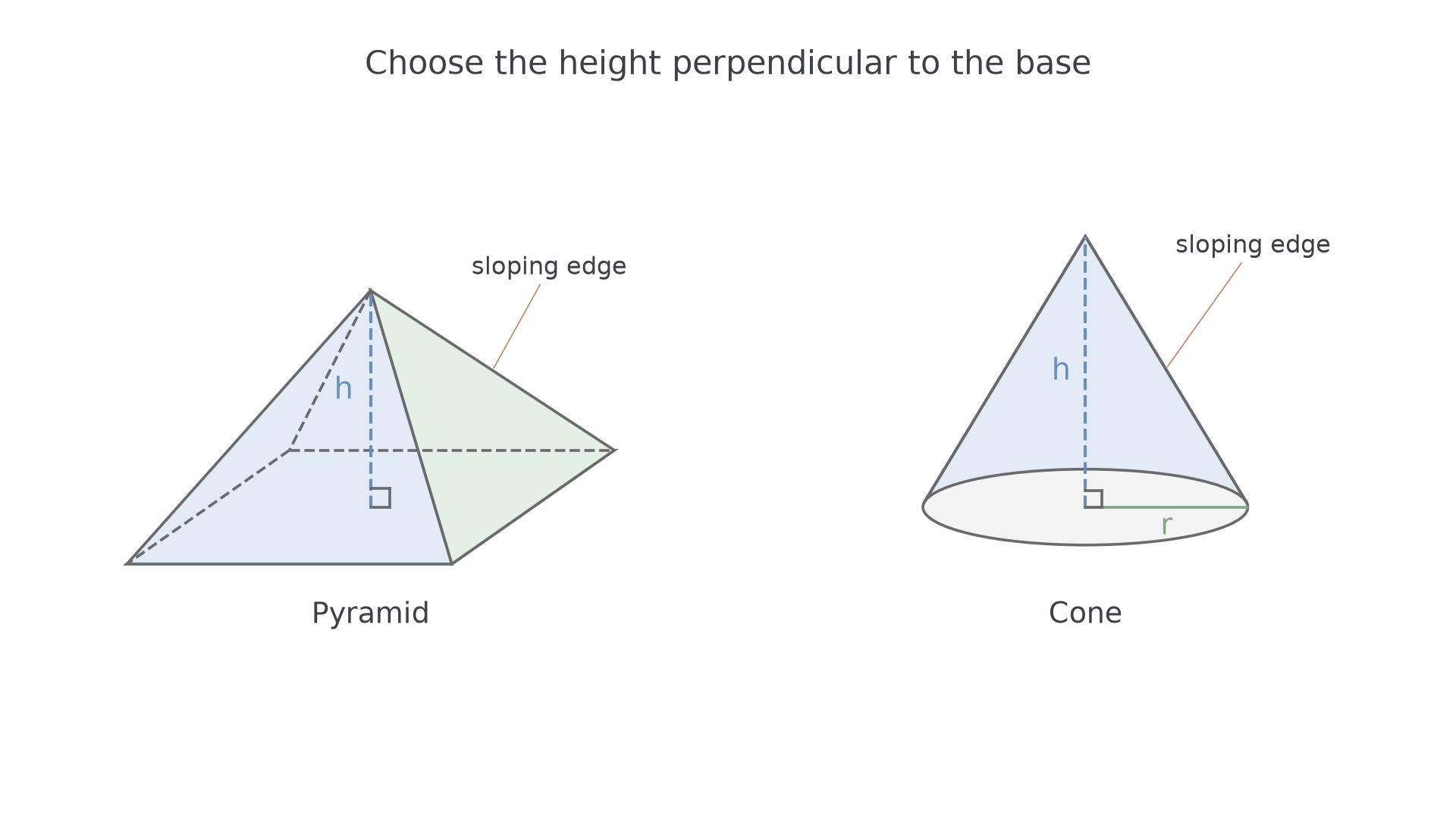
A pyramid has a polygonal base and triangular side faces that meet at one vertex. Its perpendicular height is the shortest distance from that vertex to the plane of its base.
The height can be inside the solid. An edge from the vertex to a corner of the base is usually sloping, so it is not the height required for volume.
[DIAGRAM: asset_name: Heights in pointed solids; asset_slug: perpendicular_pointed_heights; caption: Volume uses the height perpendicular to the base; a sloping edge is a different length.; description: A square-based pyramid and a right circular cone are shown side by side. Each has a dashed vertical height from its vertex to the centre of its base, a right-angle marker at the foot, and a contrasting sloping edge. The cone also has its base radius marked from centre to rim. The labels h and sloping edge are kept separate.]
Volume of a pyramid
is the base area and is the perpendicular height. This formula is on the supplied lists for Papers 1–4; required formulas are supplied within questions on Papers 5 and 6.
First find the entire base area. Then multiply by the perpendicular height and divide by 3. The factor applies to any pyramid base, not just a square.
Worked example 1: a square base
Question. A pyramid has a square base of side 6 cm and perpendicular height 10 cm. Calculate its volume.
Plan. Calculate the square base area, then take one third of the matching prism volume.
Answer. .
Check. Three such volumes give , the volume of the prism with the same base and height.
The second base is triangular. The pyramid factor is still one third; the extra half belongs to the base area.
Worked example 2: a triangular base
Question. A pyramid has a triangular base with base length 6 cm and perpendicular triangle height 4 cm. The perpendicular height of the pyramid is 10 cm. Calculate its volume.
Plan. Find the triangular base area before using the pyramid height.
Answer. .
Check. The triangular base has one third of the previous base area, , while the solid height is unchanged. The volume is correspondingly .
A triangle's own height lies in the base plane. The solid's perpendicular height runs from that plane to the vertex: label both clearly when they occur together.
Watch out
Do not use the sloping edge for . Also, is correct here: the half finds the triangular base, and the third turns its prism into a pyramid.
Identify the base first in this check.
Cone volume
A cone has a circular base and narrows to a vertex. Its volume is one third of a cylinder with the same circular base and perpendicular height, so the base area replaces .
Volume of a cone
is the base radius and is the perpendicular height from the base plane to the vertex. This formula is on the supplied lists for Papers 1–4; required formulas are supplied within questions on Papers 5 and 6.
The sloping edge is used for curved surface area in the next lesson. It has no place in this volume formula. Keep all lengths in the same unit before calculating.
Continue this lesson.
You’re previewing NovaLearn without an account. Create a free account to read the rest.
Create free account