E3.3 - Domain and range (Extended)
A function needs an allowed set of inputs as well as a rule. Learn to describe its domain, read the outputs actually reached, and track included or excluded endpoints. The same rule can have different ranges when its domain changes.
Allowed inputs
Does always have the same range? First decide which inputs are permitted: restricting the input can remove some of the curve and its outputs.
Domain
The domain of a function is its allowed set of inputs. It may be stated in the question, restricted by the rule, or limited by a context. Every input in the domain must have a defined output.
A denominator cannot be zero. For a rule involving a fraction, find which input would make the denominator zero and exclude it. A context may impose extra restrictions: time may be non-negative, a length may be positive, and a count uses whole numbers. Do not assume a count takes every decimal value between its endpoints.
Worked example 1: excluding a denominator zero
Question. State the domain of , allowing every input for which the rule is defined.
Plan. Find and exclude the input that makes the denominator zero.
All other real inputs give a non-zero denominator and therefore a defined output.
Answer. All real with .
Check. and are defined, but would require , which is undefined. A small denominator is allowed; an exactly zero denominator is not.
The next restriction comes from what the input represents, even though its algebraic rule accepts other numbers.
Worked example 2: a domain of counts
Question. A booking costs pounds for tickets. A booking can contain from zero to eight tickets. State the domain.
Plan. Use the permitted count, including both stated endpoints.
The possible inputs are the whole numbers from 0 to 8. A fractional ticket is not an available booking.
Answer. .
Check. and are valid boundary bookings. Although the expression can calculate , 2.5 tickets is outside this context's domain.
When restrictions come from both a rule and a context, an input must satisfy both.
Watch out
A denominator such as is not zero at . Solve : the excluded input is , not automatically zero.
State the allowed inputs precisely.
Output values
The range records the outputs reached from the chosen domain, rather than all the numbers displayed on a graph's vertical axis.
Range
The range is the set of output values actually produced by inputs in the domain. On a graph, examine the heights reached by the permitted part of the graph, including any interior maximum or minimum.
Follow the allowed graph from one end of its domain to the other. Identify its lowest and highest included heights, and whether it reaches every height between them. For a continuous arc it does; for a finite domain, list the actual outputs instead. A window cut-off does not itself give a range boundary.
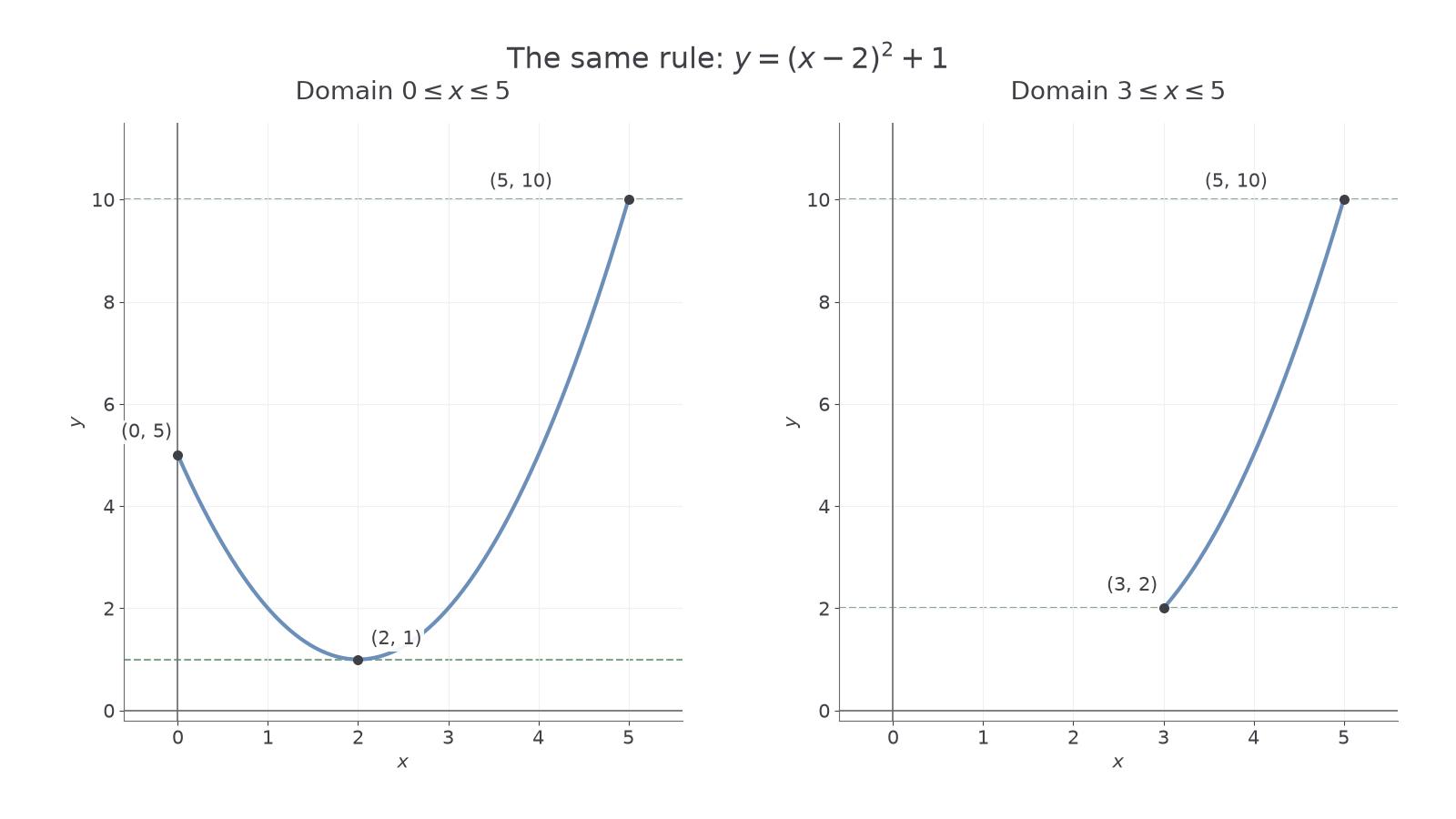
[DIAGRAM: asset_name: Restricting a parabola changes its range; asset_slug: restricted_parabola_ranges; caption: The first domain contains the vertex; the second contains only the increasing branch.; description: Two exact panels of y equals x minus two squared plus one. The first shows the permitted arc for zero less than or equal to x less than or equal to five, with closed endpoints zero five and five ten and vertex two one. The second shows the permitted arc from three to five with closed endpoints three two and five ten. Light guide lines show their lowest and highest heights on numbered axes.]
Worked example 3: a vertex inside the domain
Question. Find the range of for .
Plan. Read the minimum at the vertex and compare both endpoint heights.
- The vertex lies in the domain, so the minimum output is 1.
- At the endpoints, and . The greatest output on this arc is 10.
- The continuous arc reaches every height from 1 to 10, including both.
Answer. , or range .
Check. A squared quantity cannot be negative, so no output can be below 1. Throughout this domain , so its square is at most 9 and the output at most 10.
Now change only the domain. The vertex disappears from the permitted arc.
Continue this lesson.
You’re previewing NovaLearn without an account. Create a free account to read the rest.
Create free account