C5.2; E5.2 - Measuring lines and angles
A ruler's end may be worn, and a protractor has two number scales: which marks should you trust? C5.2 and E5.2 teach you to measure and draw straight segments and acute, obtuse and reflex angles accurately, keeping the intended orientation.
Length measurements
A ruler measures the distance between two positions. Its printed zero, rather than its plastic end, is the starting reference.
Ruler scale
Each centimetre is divided into ten millimetres: . On an ordinary millimetre ruler, one small division is . A line segment's length is its ending reading minus its starting reading.
Put the ruler along the whole straight segment, with the zero tick at one endpoint. Look directly above the other endpoint to avoid an offset reading. Read the scale's divisions; do not assume each small tick represents a centimetre.
To draw , mark a starting point at the ruler's zero, mark another point at , then join the points with a ruled straight line. Reposition the ruler and check the finished segment. Use a sharp pencil so a thick mark does not hide the endpoint.
[DIAGRAM: asset_name: Reading a ruler from two starting positions; asset_slug: ruler_segment_readings; caption: Subtract the starting reading when the segment does not begin at zero.; description: Two exact ruler scales from zero to eight centimetres with one-millimetre ticks. The first segment runs from zero to 5.8 cm; the second runs from 1.3 to 7.1 cm. Dashed endpoint guides stop at the matching tick positions.]
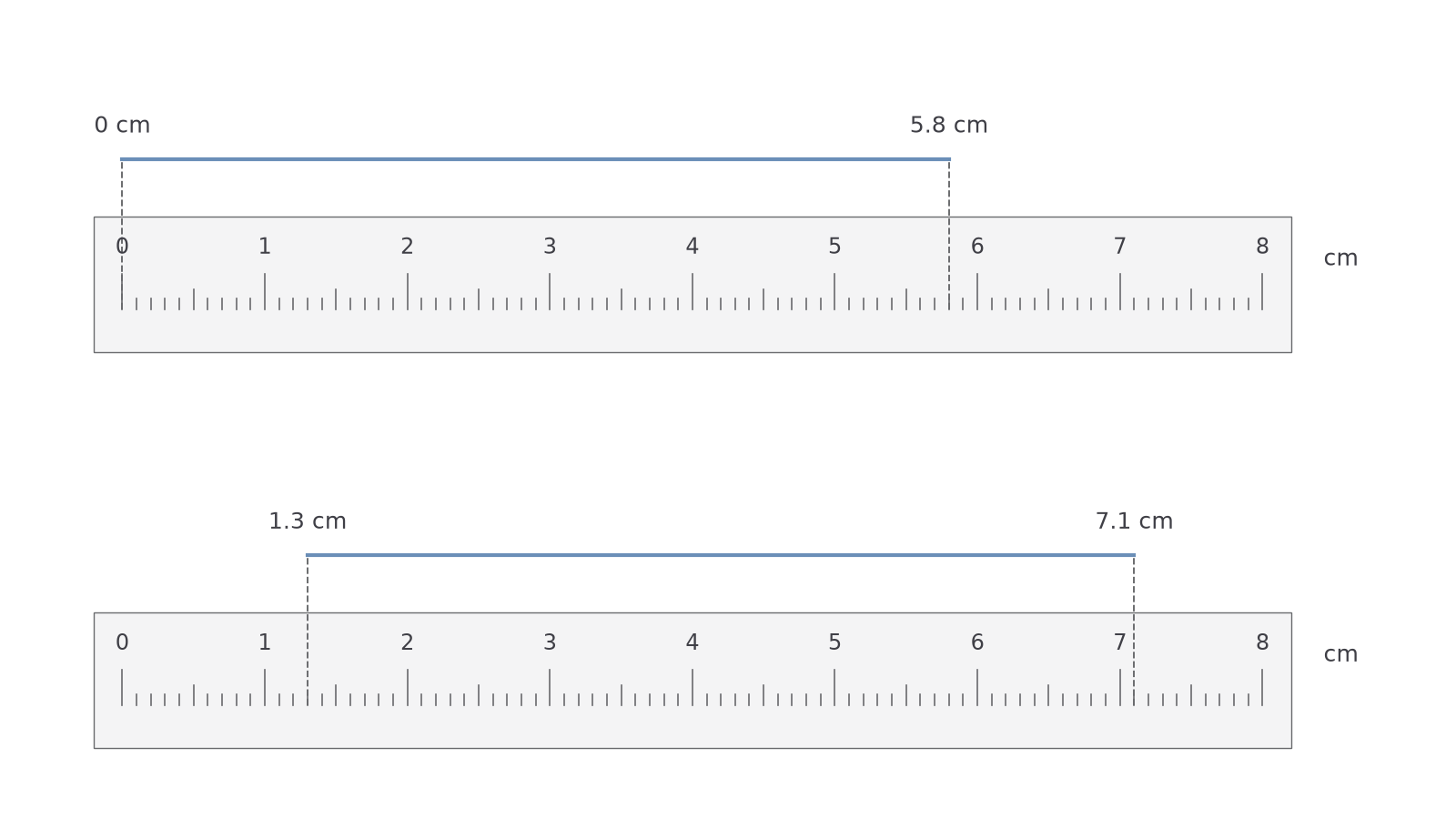
Worked example 1: starting at zero
Question. One endpoint of a segment is at the zero tick of a centimetre ruler. Its other endpoint is at the eighth small tick after 5. Find its length.
Plan. Read whole centimetres, then add the millimetre divisions.
Answer. .
Check. This is , between 5 and 6 centimetres and nearer 6.
The next segment starts away from zero. The endpoint reading alone is now too large.
Worked example 2: starting away from zero
Question. A ruler is aligned with a segment. Its endpoints are at and . Find the segment's length.
Plan. Subtract the first reading from the second.
Answer. .
Check. Moving from the first reading gives , the other endpoint.
A drawing displayed on a screen can change size with zoom. Use the printed tick values in a ruler diagram; do not put a physical ruler against the screen and assume the image has life-size centimetres. For practical drawing, use your own paper and ruler.
Watch out
The plastic edge may lie before the zero tick. Align with the printed zero, or subtract both endpoint readings.
Apply the same difference method to fresh readings.
Protractor readings
A protractor measures a turn about its centre mark. Its two scales allow you to start from either end of the baseline.
Reading an angle
Place the protractor's centre mark on the angle's vertex and its baseline along one ray. Use the scale whose lies on that starting ray. Read where the other ray crosses that same scale.
Extend a short ray with a ruler if it does not reach the scale. Estimate the angle first: an acute angle must be below , and an obtuse angle must be above but below . This catches a reading from the wrong scale.
[DIAGRAM: asset_name: Choosing the protractor scale; asset_slug: protractor_scale_choice; caption: Start from zero on the ray you are using as the baseline; the opposite scale gives the supplementary reading.; description: Two exact semicircular protractors with centres O and two degree scales. The first has a rightward baseline and ray at 58 degrees, showing 58 on the scale beginning at the right and 122 on the other. The second has a leftward baseline and the same sloping ray, marking the 122-degree smaller turn and the 238-degree reflex turn.]
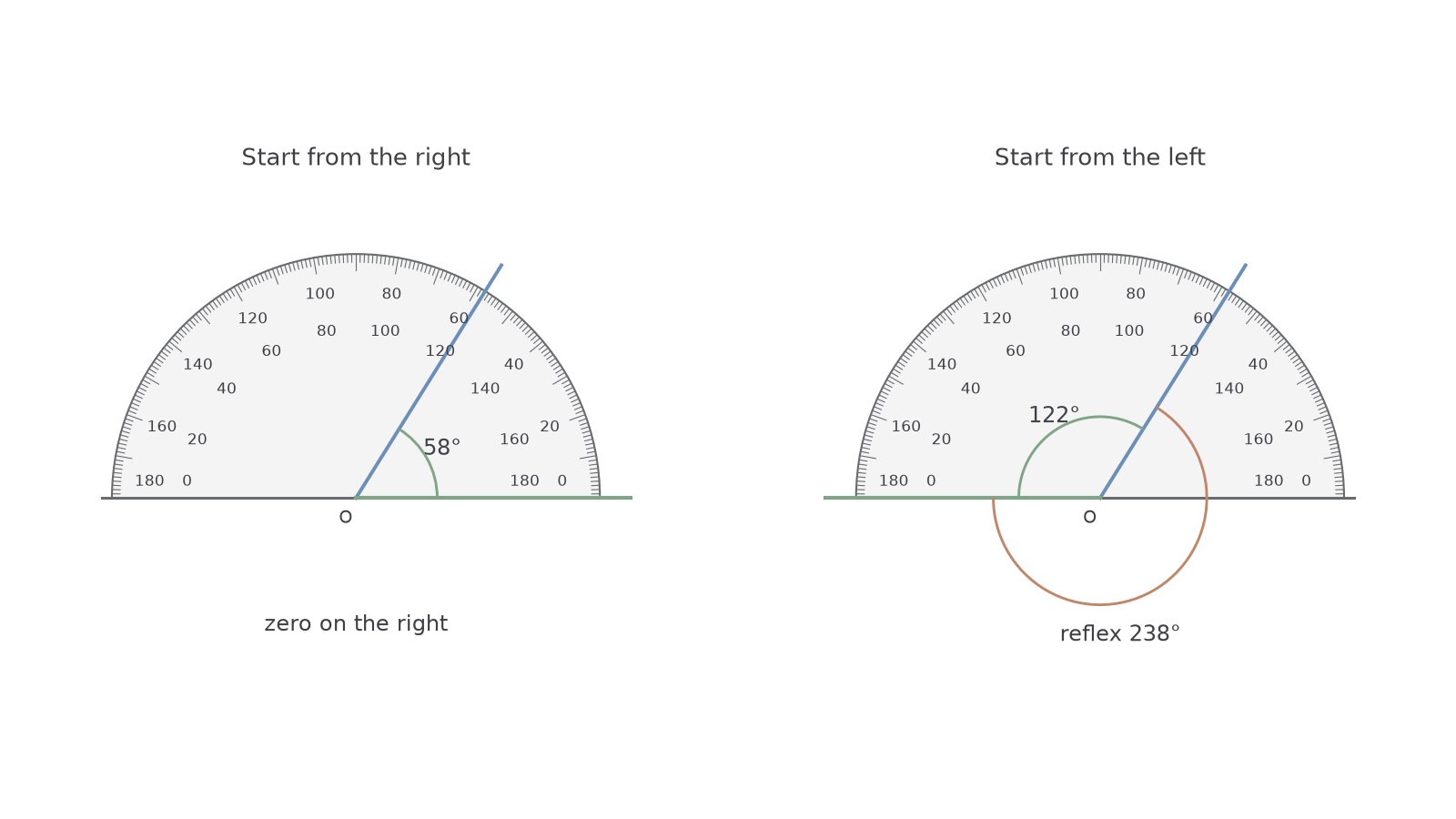
Worked example 3: an acute reading
Question. An angle's starting ray points right. The other ray crosses a protractor at 58 on the scale beginning at the right and 122 on the scale beginning at the left. Measure the smaller angle.
Plan. Choose the scale with zero on the rightward starting ray.
Answer. .
Check. The ray is less than a quarter-turn from the rightward baseline, so an acute reading fits; does not.
Now change the starting ray to the left. The same sloping ray gives a different smaller turn, and the reflex angle goes the long way round.
Worked example 4: obtuse and reflex readings
Question. The starting ray points left. The other ray crosses a protractor at 122 on the scale beginning at the left and 58 on the other scale. Find (a) the smaller angle and (b) the reflex angle between the rays.
Plan. Read from the left-hand zero, then subtract that smaller turn from a full turn.
Answer. (a) ; (b) .
Check. is obtuse; is reflex. Together they make , and the two rays bound both turns.
Continue this lesson.
You’re previewing NovaLearn without an account. Create a free account to read the rest.
Create free account