AO1, AO2 - Systematic investigations
Twenty-four square tiles can make several rectangles with the same area. Do they need the same length of edging? AO1 and AO2 connect organised cases, tables and graphs to a precise conjecture, with enough working for someone else to follow your investigation.
Choosing cases
An investigation needs a way to generate cases without losing any or counting the same case twice. For the tile problem, define a case by the number of rows. The number of columns is then fixed by the total number of tiles.
Systematic cases
Cases are systematic when a stated ordering or construction makes omissions and repetitions detectable. State the allowed values and what counts as the same case. Here all rectangles use whole tiles, have positive whole-number side lengths and are unchanged by turning them through a right angle.
Start with one row, then increase the shorter side. Only divisors of the tile total give whole-number columns. Once the proposed row count exceeds the column count, the rectangles start repeating in reverse.
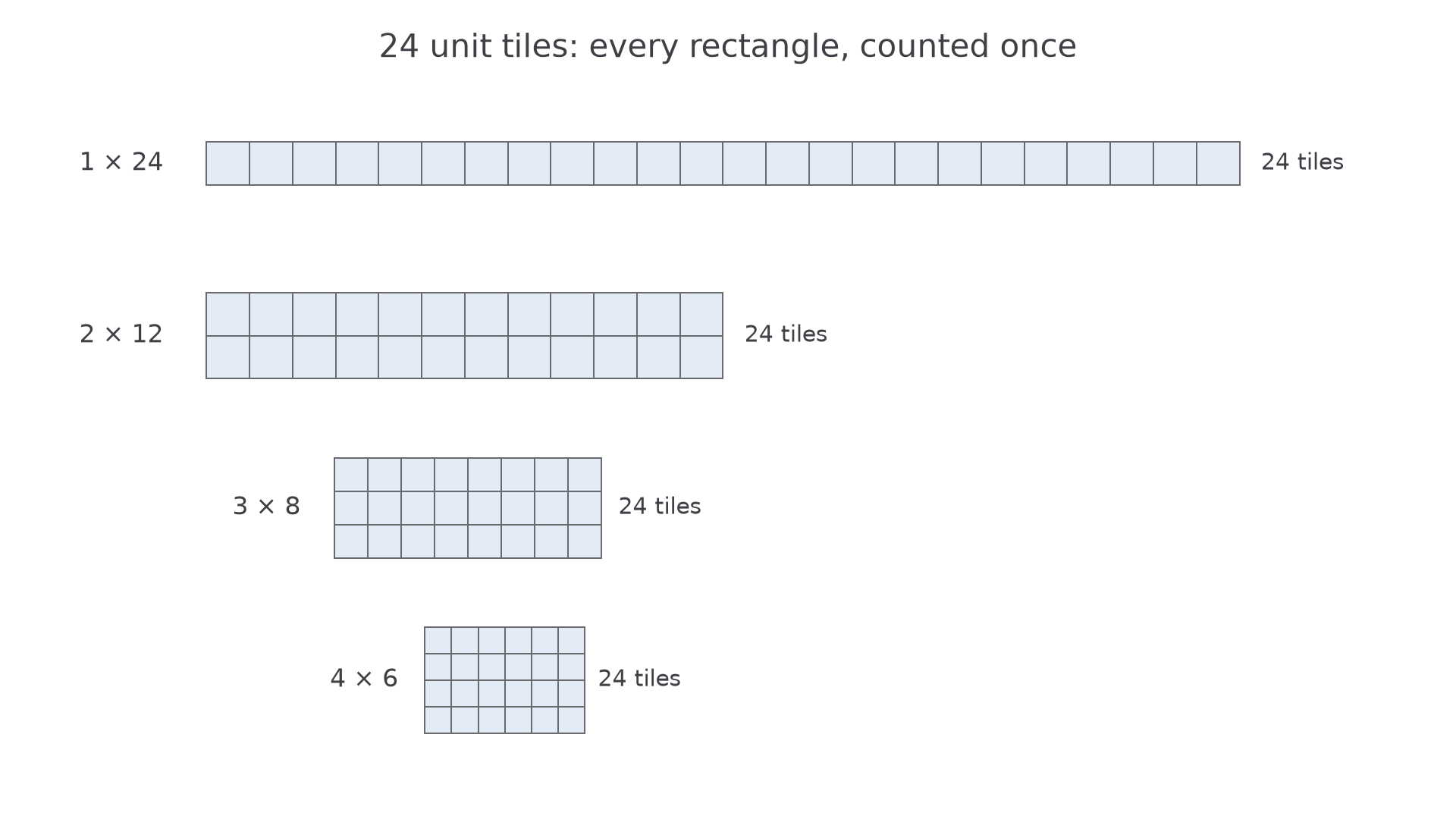
[DIAGRAM: asset_name: Every rectangle using twenty-four tiles; asset_slug: investigation_rectangles_24; caption: Ordering the shorter side gives four cases, with no turned duplicates.; description: Four exact unit-square arrays contain twenty-four squares each. Their dimensions are one by twenty-four, two by twelve, three by eight and four by six. Every array has a labelled shorter side and longer side. Each internal grid edge is distinct and all squares have equal side length within an array.]
Worked example 1: a complete rectangular search
Question. List every rectangle made from 24 unit square tiles. Count a turned rectangle as the same case. Explain why the list is complete.
Plan. Test shorter sides in order and pair each divisor with the required longer side.
5 does not divide 24. A shorter side of 6 or more would require both sides to be at least 6, using at least 36 tiles, so it cannot give a new case.
Answer. . These are all four cases.
Check. Each pair multiplies to 24. Every possible shorter side from 1 to 5 was considered; larger shorter sides are impossible.
Now allow a square case. Equal sides belong in the list once, rather than being omitted at the stopping point.
Worked example 2: including the equal-sided boundary
Question. Repeat the search for 36 unit square tiles, explaining the stopping point.
Plan. Test shorter sides through 6, including equality of the sides.
5 does not divide 36. A shorter side of 7 would require at least tiles.
Answer. There are five cases: .
Check. The corresponding shorter sides all divide 36. Their partners are all at least as large, and the square is not counted twice.
This method investigates the construction, rather than an arbitrary run of numbers. For a different problem, your case might be a stage number, a starting value or a step size. Keep other features fixed while investigating the chosen one.
Watch out
A long list is not necessarily complete. Explain the allowed inputs and a stopping reason. If turned rectangles count as one case, and must not become two results.
Use a new tile total for the next search.
Tables and plots
A table makes the same calculation visible for every case. Give each row or column a meaning, use consistent units and show a calculation that explains how an output was obtained. A point plot can then reveal a relationship that is harder to see in a list.
For a rectangle with sides and , its perimeter is . In a fixed-area tile problem with tiles, , so a useful calculator entry is . This entry alone does not enforce whole tiles: retain only allowed factor pairs.
Worked example 3: turning cases into data
Question. Find the perimeters of every 24-tile rectangle and prepare a GDC point plot of perimeter against shorter side.
Plan. Use the complete cases, calculate , then enter paired lists.
| Shorter side | 1 | 2 | 3 | 4 |
|---|---|---|---|---|
| Longer side | 24 | 12 | 8 | 6 |
| Perimeter | 50 | 28 | 22 | 20 |
For example, gives , then .
Enter input list and output list . A window , shows all four points. Do not join them into a continuous curve of tile cases.
Answer. The four plotted pairs are ; the smallest listed perimeter is 20 units.
Check. For the case, tracing the boundary gives , independently checking the table's smallest result.
Change the tile total to 36. A table with unit input steps will now contain one invalid input among the valid ones.
Worked example 4: filtering calculator inputs
Question. Use a GDC table for from to 6 in steps of 1. Identify the tile cases and their perimeters.
Plan. Generate the function table, then keep only inputs giving whole-number columns and .
| 1 | 2 | 3 | 4 | 5 | 6 | |
|---|---|---|---|---|---|---|
| 36 | 18 | 12 | 9 | 7.2 | 6 | |
| 74 | 40 | 30 | 26 | 24.4 | 24 |
The input 5 produces a numerical output, but is not a rectangle made from whole unit tiles.
Answer. Keep perimeters at shorter sides . The minimum among the allowed cases is 24 units.
Check. Directly counting the sides of the square gives . The filtered list has five entries, agreeing with the earlier complete case count.
Continue this lesson.
You’re previewing NovaLearn without an account. Create a free account to read the rest.
Create free account