C1.4; E1.4 - Equivalent fractions and mixed numbers
A measuring strip shows seven quarter-metres. How can the same length be written using whole metres and a fraction? This part of C1.4 and E1.4 develops fraction notation, equivalent fractions in simplest form, and conversion between improper fractions and mixed numbers.
Fraction notation
Split one metre into four equal parts. Each part is one quarter of a metre, written . Three such parts have length . The parts must be equal and must refer to the same-sized whole.
Numerator and denominator
In , the denominator tells you how many equal parts make one whole, and the numerator tells you how many of those parts are counted. The denominator cannot be zero. The fraction also means .
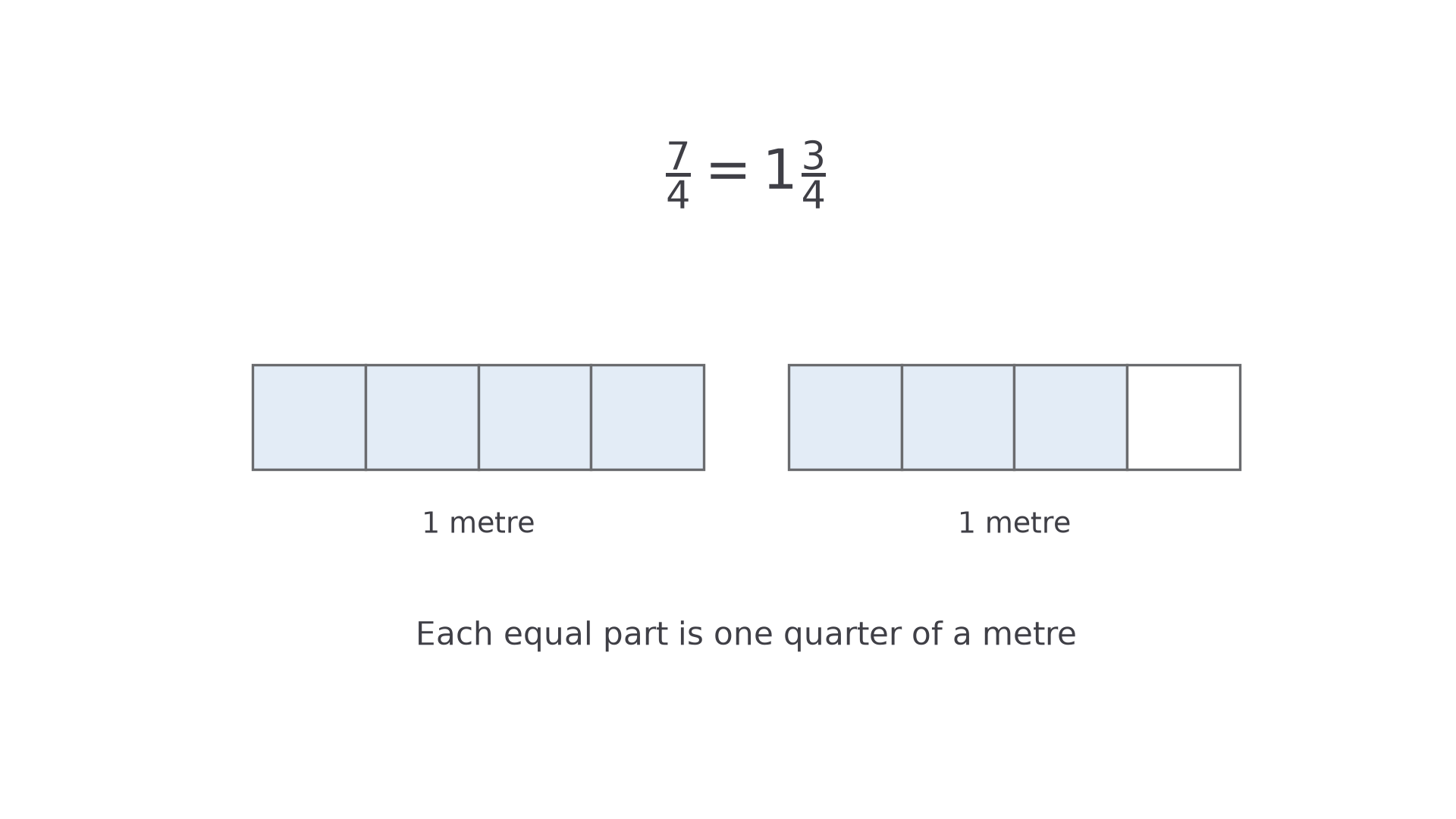
Fractions can describe more than one whole. After four quarter-metres fill one metre, three more quarter-metres give a total of . You can instead count one whole metre and three quarters: .
[DIAGRAM: asset_name: Seven quarters as a mixed number; asset_slug: seven_quarters; caption: Seven quarter-metres fill one whole metre and three quarters of another.; description: Two equal one-metre bars are each divided into four equal parts. All four parts of the first bar and three of the second bar are shaded blue. The remaining quarter is unshaded. Labels show seven quarters equals one and three quarters, with each complete bar labelled one metre.]
Proper, improper and mixed forms
For positive fractions, a proper fraction has numerator less than denominator, such as . An improper fraction has numerator greater than or equal to denominator, such as or . A mixed number combines a whole-number part and a proper fraction, such as , meaning .
The denominator gives the unit being counted. Seven quarters are , not : changing the order would count four sevenths instead. An improper fraction is valid notation; the word “improper” does not mean the value is wrong. For example, represents exactly three wholes.
Key idea
A fraction counts equal parts of a fixed whole. Improper fractions and mixed numbers can represent the same quantity in different forms.
Choose the classification by comparing the numerator and denominator.
Simplest form
Two quarters and one half cover the same part of the same whole. The number of pieces changes when you divide each half into two, but the total amount does not. This is why multiplying both parts of a fraction by the same non-zero number preserves its value.
Equivalent fractions and simplest form
Equivalent fractions have the same value. Multiply or divide the numerator and denominator by the same non-zero number to obtain an equivalent fraction. A fraction is in simplest form when its integer numerator and positive integer denominator have no common factor greater than 1.
For example, : each fifth has been split into three fifteenths. To simplify, reverse the process. Dividing by the HCF removes all common factors in one step; several smaller common-factor divisions also work.
Worked example 1: simplifying with the HCF
Question. Write in its simplest form.
Plan. Divide the numerator and denominator by their HCF, 6.
Answer. .
Check. Multiplying both parts by 6 returns . The integers 3 and 5 share no factor greater than 1.
The next fraction is larger in numerator and denominator, but reduces to the same amount. A first common factor need not be the highest: you can simplify in stages if you check again at the end.
Worked example 2: simplifying in stages
Question. Write in its simplest form.
Plan. Divide both parts by 2, then remove the remaining common factor.
Answer. .
Check. A single division by the HCF, 14, also gives and . No common factor remains.
Keep an answer requested as a fraction in integer numerator and denominator form, and simplify fully. For a negative fraction, the sign stays: . It is convenient to keep the denominator positive.
Watch out
: dividing only the numerator changes the value. Also, is equivalent to , but it is not yet in simplest form because both parts divide by 7.
A final common-factor check tells you when to stop.
Mixed-number conversions
Changing between an improper fraction and a mixed number changes the way you count, rather than the amount. Count complete groups of the denominator to find wholes. Count all the fractional pieces to reverse the conversion.
You already know
counts seven quarters. Four quarters make one whole, so those seven pieces fill one whole and leave three quarters. This gives .
For an improper fraction, divide the numerator by the denominator: the quotient counts whole groups and the remainder stays over the same denominator. For a mixed number, each whole contributes one denominator's worth of pieces; add the fractional pieces afterwards. These conversion rules are knowledge to learn rather than supplied formulas.
Worked example 3: improper fraction to mixed number
Question. Write as a mixed number.
Plan. Divide 17 by 5 to count whole groups and leftover fifths.
Answer. .
Check. Three wholes contain 15 fifths; adding 2 fifths returns 17 fifths. Also, , so the value belongs between 3 and 4.
Now reverse the direction: the whole groups are given, and you need a single count of fractional pieces.
Worked example 4: mixed number to improper fraction
Question. Write as an improper fraction.
Plan. Convert three wholes into sevenths, then add the four remaining sevenths.
Answer. .
Check. Dividing 25 by 7 gives quotient 3 and remainder 4, which reconstructs .
When a mixed number has a leading minus sign, it applies to the whole value: , rather than . Convert the positive size, then keep the minus sign in front.
Watch out
Do not multiply the whole number by the numerator: is , not . The denominator stays 7 because you are still counting sevenths.
Use the quotient and remainder to check both directions.
Quick Recap
- The numerator counts pieces; the denominator names the equal-sized pieces.
- Equivalent fractions have the same value; multiply or divide both parts together.
- Simplest form has no common factor greater than 1 left.
- Divide to find wholes and a remainder; multiply the wholes by the denominator to convert back.
Seven quarter-metres are , answering the opening question.