C5.6, C5.7; E5.6, E5.7 - Right angles and tangents in circles
Join the ends of a diameter to a third point on the circle. Why is the angle at that third point always a right angle, even when the point moves? C5.6 and E5.6 give two circle facts about right angles; C5.7 and E5.7 add the equal lengths of tangents from one external point.
Semicircle angles
The crucial information is that the chord passes through the centre. A chord that merely looks long does not give the same conclusion.
Angle in a semicircle
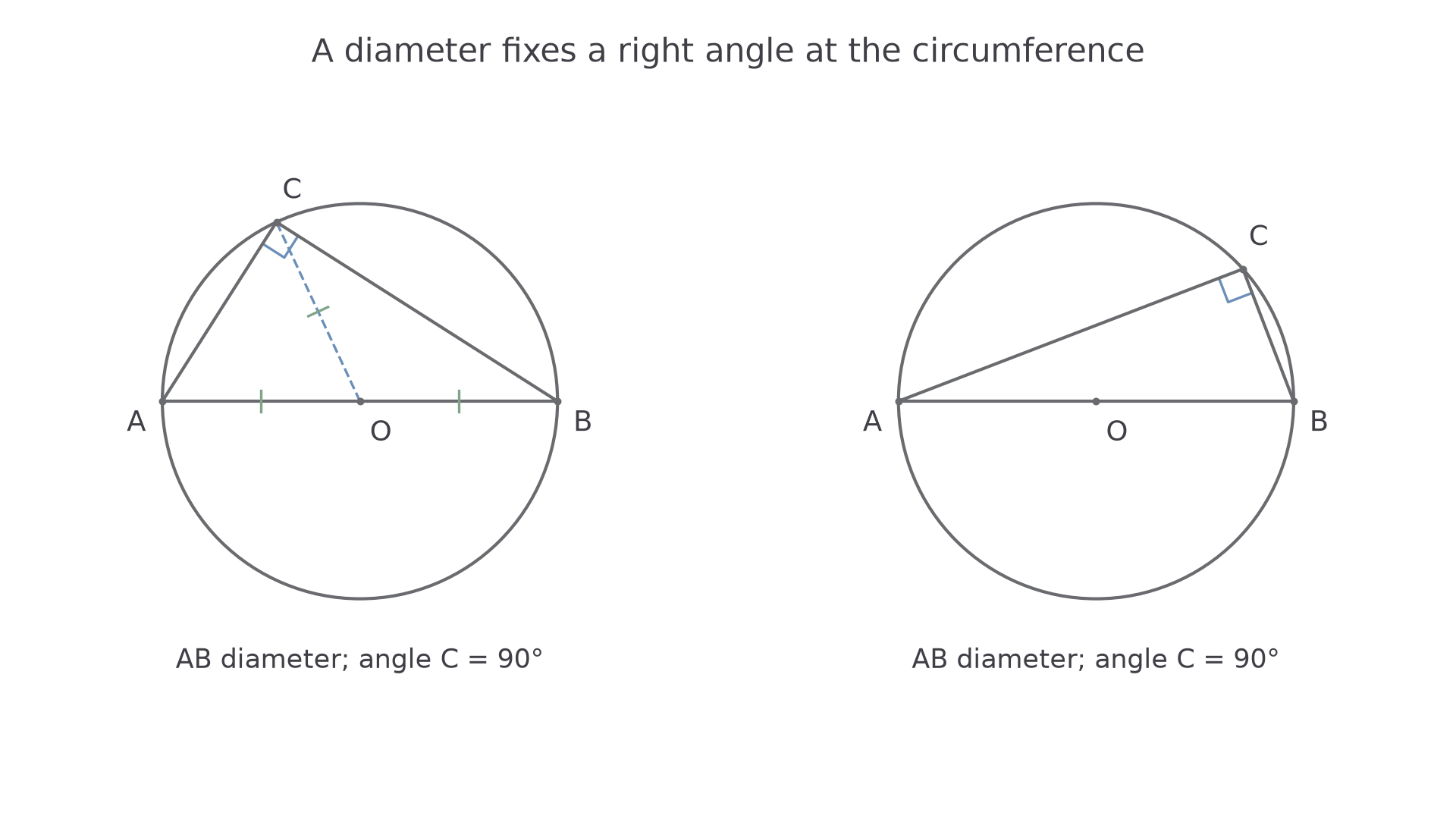
If is a diameter and is any other point on the circumference, then . The angle has its vertex on the circumference and its arms join the two ends of the diameter.
Here is why. Let be the centre and join . The radii , and are equal. In the two isosceles triangles, write and . Since lie in a straight line, the full triangle has angles , and . Its angle sum gives , so .
[DIAGRAM: asset_name: The right angle in a semicircle; asset_slug: semicircle_right_angle; caption: Both triangles use the same diameter AB; moving the third vertex keeps the angle at C equal to 90 degrees.; description: Two exact circle panels have a horizontal diameter AB through centre O and different circumference points C above it. Both angles ACB are marked with right-angle squares. One panel includes OC and equal-radius ticks to support the isosceles-triangle explanation.]
Worked example 1: finding the right angle
Question. is a diameter of a circle and is another point on its circumference. Find , giving a reason.
Plan. Match the angle's arms to the two ends of the diameter.
- The angle's vertex is on the circle.
- Its arms and meet the endpoints of diameter .
- Therefore , by the angle in a semicircle.
Answer. , because the angle in a semicircle is a right angle.
Check. The right angle is at , opposite the diameter. It is not the straight angle at the centre.
The right angle now becomes one step in finding a different triangle angle.
Worked example 2: a second angle in the triangle
Question. is a diameter and lies on the circumference. Given , calculate , giving reasons.
Plan. Establish the right angle at , then use the triangle angle sum.
Answer. .
Check. The two acute angles are complementary: . Together with the right angle they make .
The point may be above or below the diameter; the condition is still the same. It must be on the circumference and different from the diameter's endpoints.
Watch out
“Angle in a semicircle” requires a diameter. A general chord does not guarantee , and an angle with vertex at the centre is a different angle.
Identify the diameter before using the triangle sum.
Radius and tangent
A tangent touches a circle at one point. Draw the radius to that exact point of contact: it makes a right angle with the tangent on both sides.
Radius perpendicular to tangent
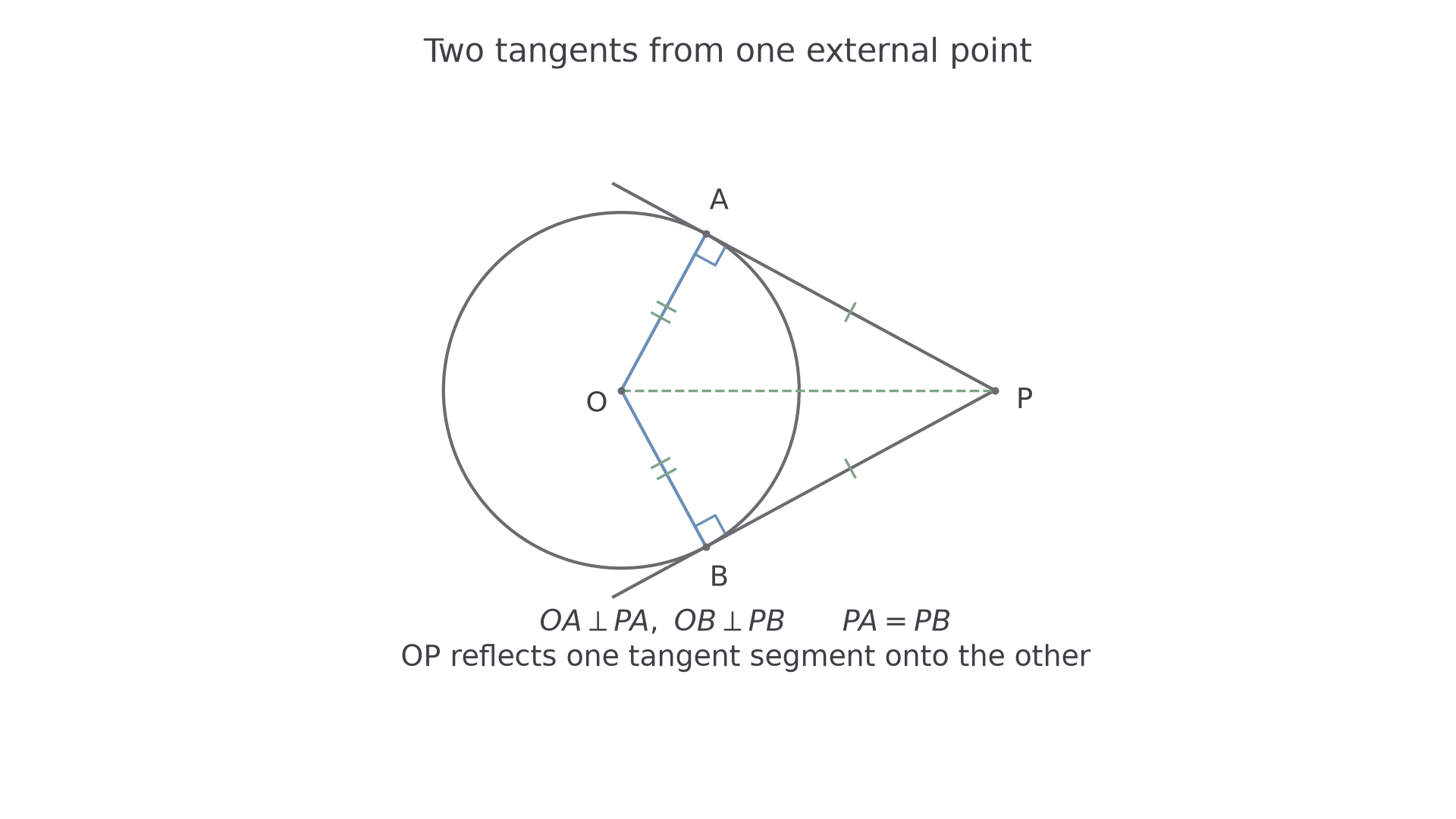
The tangent to a circle at is perpendicular to the radius , where is the centre. Thus the angle between and either direction along the tangent is .
The radius points straight towards the tangent's contact point. Any other point on the tangent is outside the circle, so is the tangent's closest point to the centre. The shortest connection from a point to a line is perpendicular, explaining the right angle.
[DIAGRAM: asset_name: Radii and two tangents; asset_slug: radius_and_equal_tangents; caption: Each radius meets its tangent at 90 degrees, and the two tangent segments from P have equal lengths.; description: Exact circle with centre O, an external point P and contact points A and B. PA and PB touch the circle at A and B respectively, OA and OB have equal-radius ticks, and right-angle squares mark OAP and OBP. The central line OP is dashed to show the reflection symmetry exchanging the contact points.]
Continue this lesson.
You’re previewing NovaLearn without an account. Create a free account to read the rest.
Create free account