E7.5 - Area using two sides and an angle (Extended)
Can two triangles have the same two side lengths and the same area, but different included angles? A perpendicular height connects the familiar triangle-area formula to sine. You will use that connection for acute and obtuse triangles, reverse it to find missing information and combine it with the cosine rule when an angle is not given.
Sine area formula
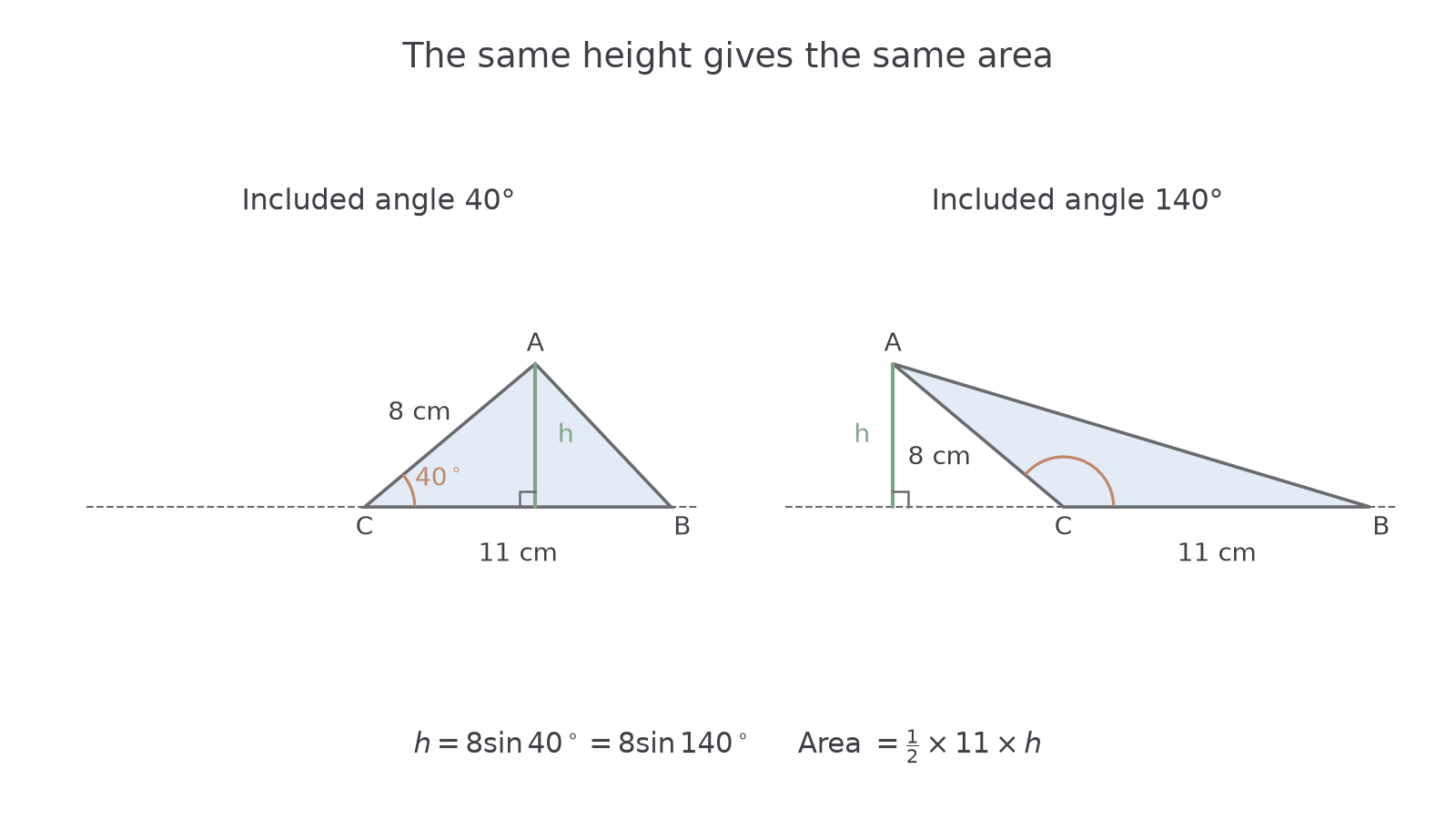
A triangle has sides and with an included angle of . What happens to its area if that angle changes to ? The two triangles have different shapes but equal perpendicular heights above the same base.
Take as the base and as the sloping side. The height is . Substituting in gives . If is obtuse, the perpendicular meets the extension of the base; its height is still , because supplementary angles have equal sines.
Triangle area from two sides and their included angle
must be the included angle between the sides and . The formula applies to acute, right and obtuse triangles. Supplied in the Extended formula list on Papers 2 and 4.
[DIAGRAM: asset_name: Equal heights with supplementary angles; asset_slug: sine_area_heights; caption: The included angles 40 and 140 degrees give equal heights and equal areas for the same two sides.; description: Two exact triangles have base 11 cm and sloping side 8 cm meeting at the left base vertex. Their included angles are 40 and 140 degrees. Perpendicular heights from the top vertex meet the base or its extension and are both 8 sin 40 degrees, approximately 5.1423 cm. Right-angle marks and the exterior foot for the obtuse triangle are clear.]
Worked example 1: an acute included angle
Question. Calculate the area of a triangle with sides and and included angle .
Plan. Multiply half the product of the two given sides by the sine of the angle between them.
Answer. , to 3 significant figures.
Check. The height is . Using base and height gives . The height is shorter than the sloping side 8 cm.
Change only the included angle to its supplement. The foot of the perpendicular moves outside the triangle, but the area formula still applies.
Worked example 2: an obtuse included angle
Question. Calculate the area of a triangle with sides and and included angle .
Plan. Use the given included angle directly in the sine-area formula.
Answer. , to 3 significant figures.
Check. , so reflecting the sloping side across the vertical through the base vertex preserves the height and area. Both areas are less than the maximum , which occurs at a right included angle.
Area uses square units even though the two given lengths use ordinary length units.
Watch out
The angle must sit between the two sides you multiply. If you know a different angle, first find the included angle or calculate a suitable missing side. Do not treat a sloping side as a perpendicular height.
Apply the formula with new lengths.
Missing dimensions
An area can supply a missing length or angle. Write the area equation with the known numbers before rearranging it. The factor remains part of the equation when you reverse the calculation.
For a missing side, divide the area by . For a missing angle, isolate its sine, then test the acute and supplementary angles against any stated condition.
Worked example 3: finding a side from area
Question. A triangle has area . Two of its sides have lengths and , with included angle . Calculate .
Plan. Form the sine-area equation, then divide by the entire coefficient of .
Answer. , to 3 significant figures.
Check. Taking 8 cm as base, the required perpendicular height is . The calculated side gives , using the unrounded value.
The second example changes the unknown from a side to the included angle. You must now make an angle decision after rearranging.
Continue this lesson.
You’re previewing NovaLearn without an account. Create a free account to read the rest.
Create free account