C2.2; E2.2 - Factorising common factors
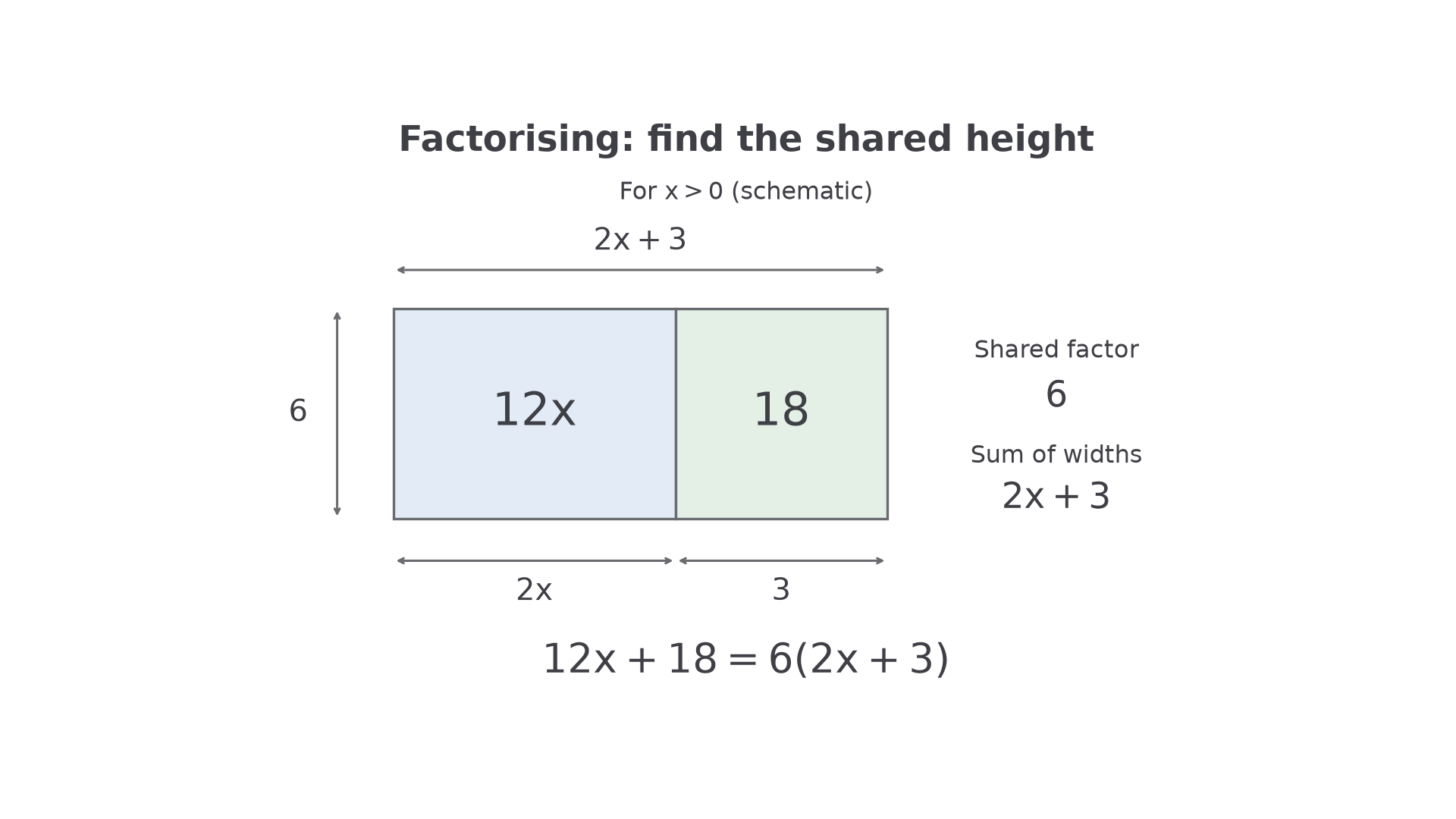
Two adjacent rectangles have areas and 18 square units. If they share a height of 6 units, what is the width of the whole rectangle? C2.2 and E2.2 reverse expansion to extract numerical and variable common factors, then check a complete factorisation by multiplying back.
Numerical factors
The two widths in the opening problem are and . Together they make a rectangle with area . This is the same area as , written as a product instead of a sum.
[DIAGRAM: asset_name: A common height gives a common factor; asset_slug: common_factor_area; caption: The shared height 6 is outside the bracket and the widths add inside it.; description: A schematic rectangle for positive x is split into adjacent regions with areas twelve x and eighteen. Its common height is six, and the widths are two x and three. The total area is written as twelve x plus eighteen equals six times the bracket two x plus three.]
Factorising
Factorising writes an expression as a product of factors. Extracting a common factor reverses expansion: . The outside factor must multiply every term inside the bracket to recover the original expression.
Choose the highest common factor of all the numerical coefficients. Divide each original term by it to find the bracket contents. The outside factor is retained: you are rewriting the expression, not dividing it away.
Worked example 1: a highest common numerical factor
Question. Factorise .
Plan. Extract the HCF of 12 and 18, which is 6.
Answer. .
Check. Re-expanding gives . At , both forms give 42.
Now change only the sign of the constant. Keep that sign when finding the second bracket term.
Worked example 2: retaining a subtraction
Question. Factorise .
Plan. Extract the same numerical HCF and divide the signed terms by it.
Answer. .
Check. by expansion. At , both forms give 6.
The expressions and also expand to , but they leave another common numerical factor inside the bracket.
Watch out
“Factorise” means factorise fully. is unfinished because both inside coefficients share 3. Continue to . Do not replace the whole expression by : that loses the factor 6.
Extract the highest factor in the next expression.
Variable factors
A common factor can contain letters. Since and , both contain two copies of . The largest common power is the smallest power present in every term.
For each variable, ask how many copies every term contains. If even one term has no copy of that variable, it cannot be included in the common factor. Combine the shared variable powers with the numerical HCF.
Worked example 3: a shared squared factor
Question. Factorise .
Plan. Extract the numerical HCF 4 and the shared power .
Answer. .
Check. Re-expansion gives . At , both forms give .
The next expression adds a second variable. Choose its shared power independently of the shared power of .
Worked example 4: two shared variables
Question. Factorise .
Plan. Extract : the HCF is 4, the common -power is 2 and the common -power is 1.
Answer. .
Check. At , , the original is . The product gives . Multiplying the factors symbolically also restores both original terms.
This is an identity, including when a shared variable is zero. Finding the factors does not cancel the outside variable from the expression; both forms are still zero when that factor is zero.
Watch out
Choose the smallest shared power, not the largest. Extracting from would leave a fraction in the second term rather than the intended polynomial bracket. Also keep the entire outside factor in the answer.
Check both variables in every original term.
Full factorisation
A factorisation can be correct but unfinished. Check every original term when selecting the common factor, then inspect the bracket: is another numerical or variable factor still common to all its terms? Finally re-expand. Re-expansion checks the whole expression, including the signs and the outside factor.
Worked example 5: finishing a partial factorisation
Question. A student writes . Factorise the expression fully.
Plan. Keep the correct factor , then remove the common numerical factor still inside the bracket.
Answer. .
Check. . There is no common numerical or variable factor left in . At , both forms give 6.
Now add just one constant term to the original expression. The numerical HCF remains 6, but is no longer a factor of every term.
Worked example 6: a term with no letter
Question. Factorise .
Plan. Test the proposed common factor against all three terms, then extract 6.
Answer. .
Check. Re-expansion gives . The inside coefficients have HCF 1, and the constant term prevents a shared letter. At , both forms give 12.
The final 1 matters: dividing a term by itself gives 1. A factorisation with that term omitted would re-expand to an expression missing its constant.
Watch out
A common factor must be common to every term. In , taking out and writing changes the last term from 6 to . Re-expanding exposes the error immediately.
Make the checking step explicit for this three-term expression.
Quick Recap
- Factorising reverses expansion and keeps the expression's value.
- Extract the numerical HCF and the smallest power of each variable present in every term.
- Inspect the remaining bracket for any further common factor.
- Re-expand every term to verify the result.
The opening rectangle's width is , so its area is .