C1.6; E1.6 - Multiplying and dividing fractions
A jug contains litre of juice. How much is of that amount, and how many -litre cups could it fill? This lesson develops fraction multiplication and division in C1.6 and E1.6, then uses the same methods with mixed numbers and estimates.
Fraction products
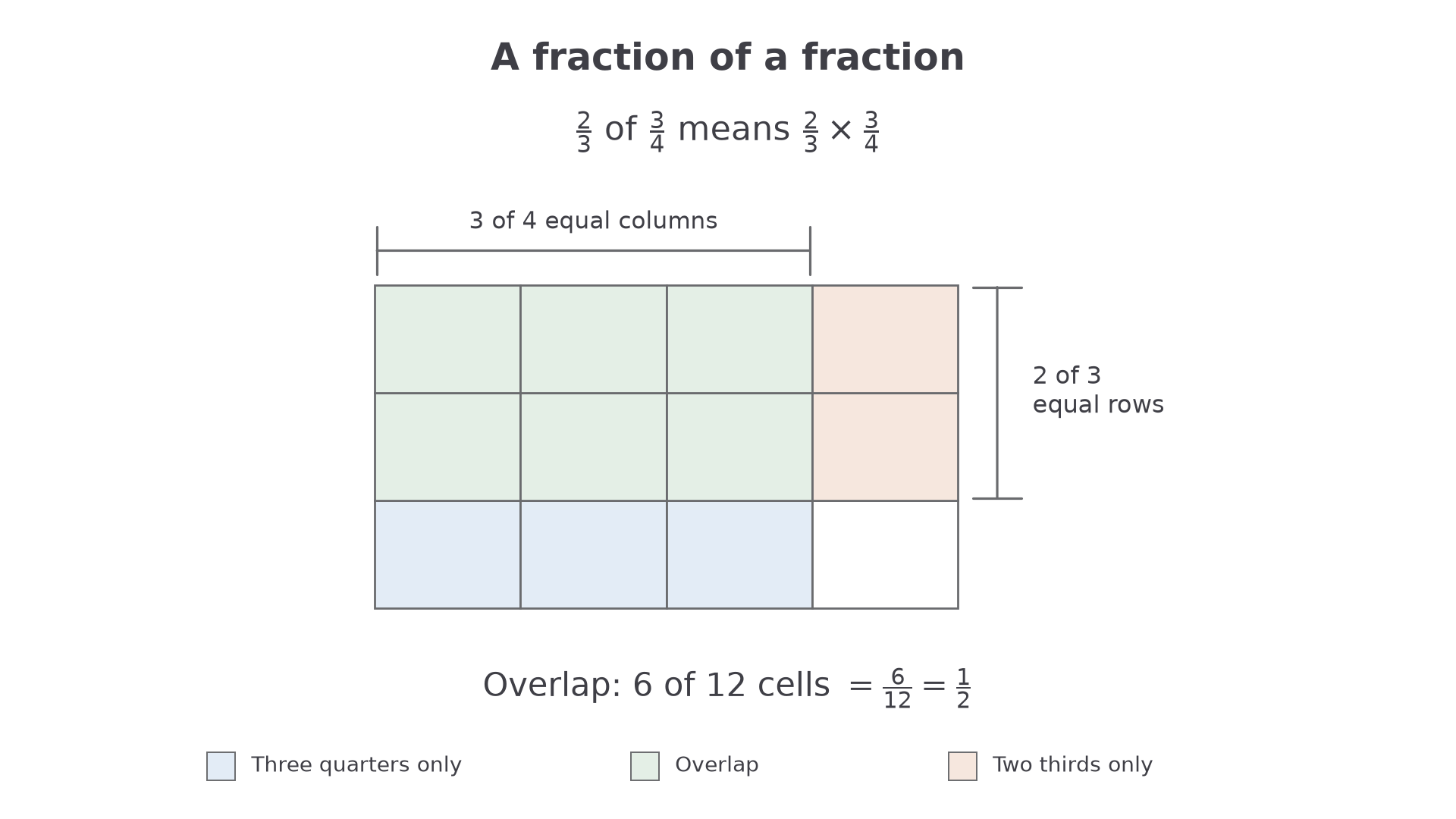
Taking a fraction of an amount means multiplying. To find of , divide the three quarters into three equal shares, then take two shares. Each share is , so two shares make .
A rectangle gives another view. Dividing a whole into 4 columns and 3 rows makes 12 equal cells. The overlap of 3 columns and 2 rows contains 6 cells, so the product is .
[DIAGRAM: asset_name: A fraction of a fraction; asset_slug: fraction_product_area; caption: Two thirds of three quarters covers six of twelve equal cells.; description: A unit rectangle divided into four equal columns and three equal rows. The left three columns represent three quarters, the top two rows represent two thirds and their overlap is six twelfths, equal to one half.]
Multiplying fractions
Multiply the numerators and multiply the denominators. Simplify by dividing numerator and denominator by a common factor.
Not in the supplied formula list: learn it.
Cancellation makes the multiplication smaller. It divides a factor in the numerator and a factor in the denominator by the same non-zero number, so the fraction's value stays unchanged. It works across a product, not across an addition.
Worked example 1: taking part of an amount
Question. Work out .
Plan. Multiply, then simplify the fraction.
Answer. .
Check. One third of is ; two thirds is , agreeing with the area picture.
The next product has larger numbers. Cancel before multiplying to avoid an unnecessarily large intermediate fraction.
Worked example 2: cancelling first
Question. Work out , giving your answer in its simplest form.
Plan. Cancel the common factors 14 and 3 across the product.
Answer. .
Check. Multiplying without cancellation gives . Dividing its numerator and denominator by 42 gives .
The sign rules are the same as for integers: one negative factor gives a negative product; two negative factors give a positive product. For example, .
Watch out
Multiplying does not always make a number larger. Multiplying a positive amount by a fraction between 0 and 1 takes only part of it, so the result is smaller.
Use cancellation to keep the next calculation manageable.
Fraction quotients
Division can ask how many equal portions fit into an amount. There are 6 eighths in , so . A quotient can also be less than 1: half a litre is only two thirds of a -litre portion.
Reciprocal
The reciprocal of a non-zero number is the number that multiplies it to give 1. The reciprocal of is , where and . Zero has no reciprocal.
To divide by , multiply both numbers in the division by . The divisor becomes 1, leaving multiplication by the reciprocal:
Keep the first fraction unchanged. Only the divisor is replaced by its reciprocal. A zero divisor is never allowed.
Worked example 3: counting portions
Question. How many -litre cups can be filled from litre of juice?
Plan. Divide the total volume by the volume of one cup.
Answer. 6 cups.
Check. litre, the original volume.
The divisor now has a numerator greater than 1. Its reciprocal must swap both parts; it is not enough to multiply by its denominator.
Worked example 4: a fractional quotient
Question. Work out .
Plan. Multiply by , then cancel common factors.
Answer. .
Check. . Also, is half of .
Signed fractions follow the ordinary division sign rules. For example, ; the reciprocal changes the operation, not the sign rule.
Watch out
is not . Reversing the first fraction changes the question. Multiply your proposed quotient by the original divisor to check it.
Check your quotient by multiplication.
Mixed calculations
A mixed number is a whole amount plus a fraction: . For multiplication or division, change the complete mixed number into an improper fraction first. For a negative mixed number, the sign applies to the whole amount: .
An estimate gives a separate check on size. Choose nearby simple amounts, calculate roughly, then compare with your exact answer. Keep the exact fractions during the actual calculation.
Worked example 5: multiplying mixed numbers
Question. Work out , giving your answer as a mixed number.
Plan. Convert both mixed numbers, multiply, then convert back.
Answer. 4, which is a whole number.
Check. is about and is about . Their product is about , consistent with 4. Exactly, .
The next calculation uses division. Converting the mixed numbers still comes first; then take the reciprocal of the divisor.
Worked example 6: dividing mixed numbers
Question. A ribbon is metres long. How many lengths of metres does it contain? Give the quotient as a mixed number.
Plan. Divide the total length by the length of one piece, using improper fractions.
Answer. lengths. This means 2 complete pieces and half of another piece.
Check. The estimate is a little more than . Exactly, metres.
If a question asks for complete pieces, the answer here would be 2, with metre left. Read whether it asks for a quotient or a whole-number count.
Watch out
is not . That approach loses the products between a whole part and a fractional part. Convert to improper fractions first.
Give the exact result before estimating its size.
Quick Recap
- Multiply fractions by multiplying their numerators and denominators; cancel common factors to simplify.
- Divide by a non-zero fraction by multiplying by its reciprocal.
- Convert mixed numbers to improper fractions before multiplying or dividing.
- Estimate the size, then use an inverse operation for an exact check.
For the opening jug, two thirds of three quarters is half a litre, while three quarters of a litre fills six eighth-litre cups.