C8.1; E8.1 - Rotations
A triangle turns through a quarter-turn, but one corner remains fixed. Where must the turn have been centred? C8.1 and E8.1 teach rotations through multiples of 90 degrees and the centre, angle and direction needed to describe them. Core uses the origin, shape vertices or edge midpoints as centres; the labelled Extended section also uses an arbitrary centre.
Quarter and half turns
A rotation turns every point through the same angle around one fixed centre. The distance from the centre stays constant. The centre itself is fixed, while other points follow circular paths.
Angle and direction of rotation
A quarter-turn is , a half-turn is , and three quarter-turns make . Clockwise follows clock hands; anticlockwise goes the other way. A turn has the same result in either direction.
For a rotation about the origin, first picture the horizontal and vertical moves from . A move 4 right and 1 up becomes 1 right and 4 down after a clockwise quarter-turn. Useful origin rules follow:
| Turn about the origin | Image of |
|---|---|
| clockwise | |
| anticlockwise | |
A clockwise turn has the same endpoint as anticlockwise. Choose the direction before using a rule.
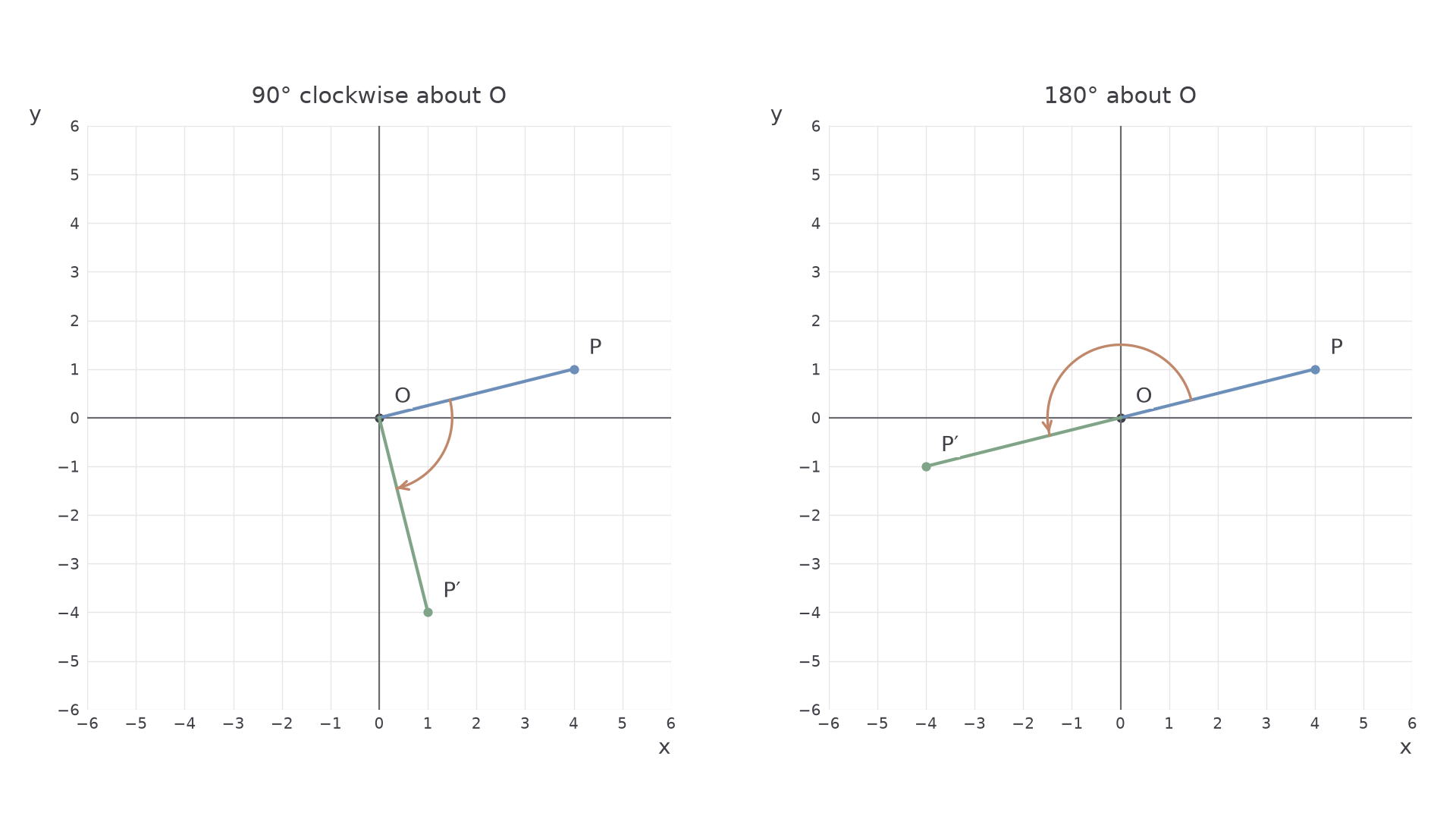
[DIAGRAM: asset_name: Quarter and half turns about the origin; asset_slug: origin_rotations; caption: Each image stays the same distance from O, while the angle changes.; description: Two accurate equal-scale grids show P four comma one and centre O zero comma zero. Left rotates P clockwise through ninety degrees to one comma minus four. Right rotates P through one hundred eighty degrees to minus four comma minus one. Equal-radius segments and direction arcs show the turns.]
Worked example 1: a clockwise quarter-turn
Question. Rotate through clockwise about the origin.
Plan. Turn the horizontal and vertical moves around the origin.
The 4-right component turns to 4 down; the 1-up component turns to 1 right.
Answer. .
Check. Both radius lengths have square . The rays OP and OP' form the clockwise right angle shown, rather than a reflection in an axis.
Only the angle changes in the second example. A half-turn reverses both moves.
Worked example 2: a half-turn
Question. Rotate through about the origin.
Plan. Reverse both the horizontal and vertical displacements.
Answer. .
Check. The origin is halfway between P and P': their horizontal coordinates and vertical coordinates both sum to zero. A further half-turn returns to P.
A shape rotates by applying the same turn to every vertex and joining the images in the original order with a ruler. Side lengths and angles stay unchanged.
Watch out
A turn swaps component sizes and changes one sign; simply changing both signs gives a half-turn. Use the stated centre and direction, not whichever image fits conveniently on the grid.
Picture which quadrant contains the image before calculating.
Centres of rotation
The centre is the point around which you turn, so measure all moves from that point. A fixed vertex can be the centre, and an edge midpoint can exchange that edge's endpoints during a half-turn. Neither requires the centre to be the origin.
Problem-solving
For each vertex, find the horizontal and vertical moves from the centre, turn those moves, then start the turned moves at the centre. Turning the actual coordinates as if the centre were the origin shifts the whole answer.
A tracing can help: mark the centre on tracing paper, copy the shape, pin the centre and turn it through the required angle. Transfer all vertices to the grid and use a ruler to join them.
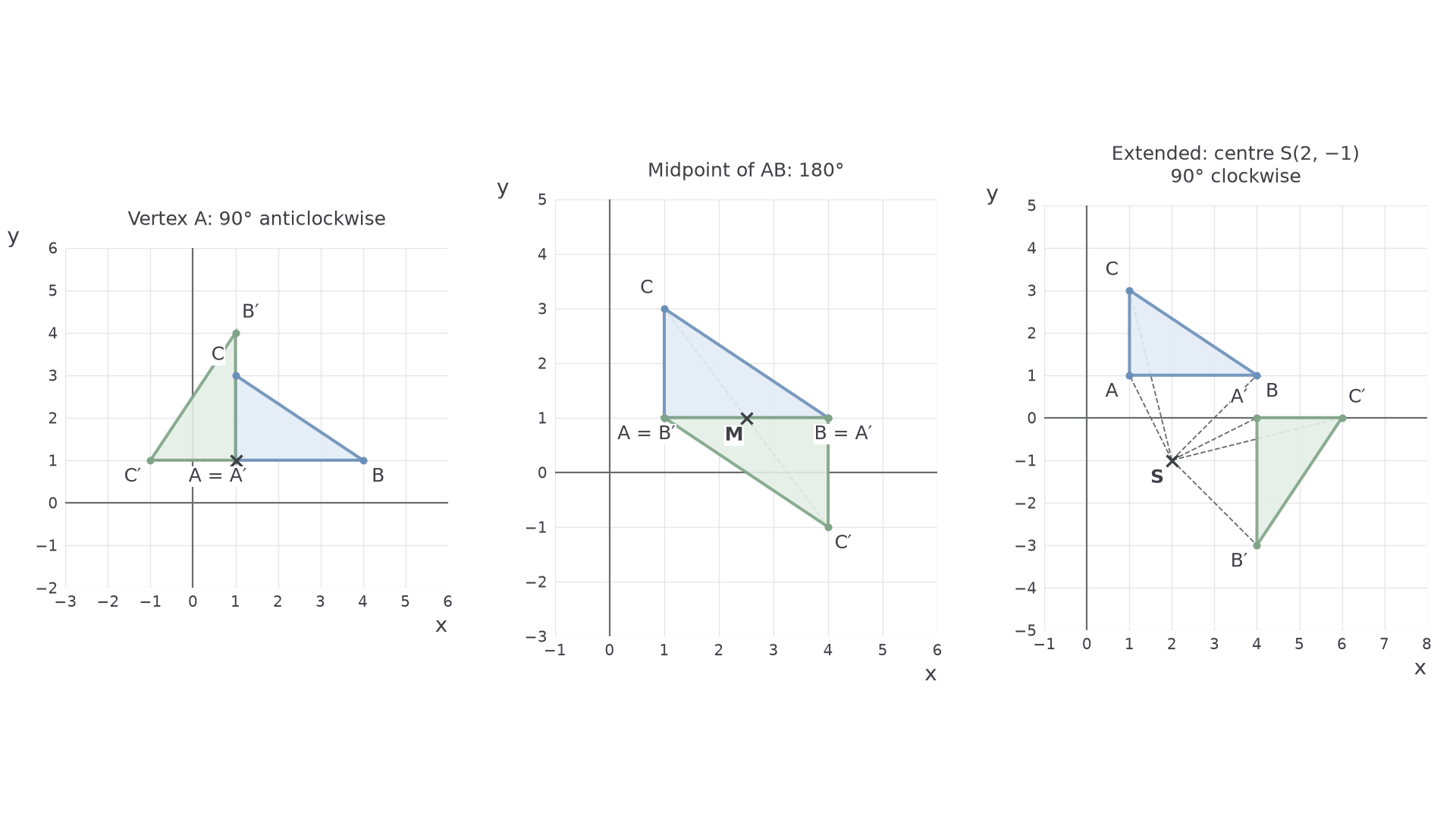
[DIAGRAM: asset_name: Rotation about a vertex, edge midpoint and another point; asset_slug: rotation_centres; caption: Start each turned displacement at the specified centre, which stays fixed.; description: Three accurate equal-scale grids use triangle A one comma one, B four comma one and C one comma three. First rotates ninety degrees anticlockwise about vertex A, giving A prime one comma one, B prime one comma four, C prime minus one comma one. Second rotates one hundred eighty degrees about the midpoint two point five comma one of AB, giving four comma one, one comma one and four comma minus one. Third is labelled Extended and rotates ninety degrees clockwise about S two comma minus one, giving four comma zero, four comma minus three and six comma zero.]
Worked example 3: a vertex as centre
Question. Rotate triangle , , through anticlockwise about A.
Plan. Keep A fixed and turn the moves from A to B and C.
Answer. Join , as in the first panel.
Check. A'B' is 3 units and A'C' is 2 units, matching AB and AC. Both rays have turned through the same anticlockwise right angle. The fixed corner in the opening problem can therefore be the centre.
Now use the midpoint of an edge as the centre and a half-turn. The edge endpoints exchange places.
Continue this lesson.
You’re previewing NovaLearn without an account. Create a free account to read the rest.
Create free account