E1.2 - Three sets and subset notation (Extended)
A person can belong to three clubs at once, and a whole set can sit inside another set. Extend the set language of E1.2 to distinguish elements from sets, use subset notation and organise three overlapping groups. You will also interpret a set defined by a rule for coordinate pairs.
Membership and empty set
If A is the set of even natural numbers below 8, is 0 in A? Natural numbers include zero in this course, and zero is even because .
Membership
The notation means “ is an element of A”. The notation means “ is not an element of A”. Use membership to compare an individual object with a set.
For , zero is an element, so . The braces describe the collection; the numbers inside are its individual elements.
Worked example 1: membership statements
Question. Let . Complete and using or , and find .
Plan. Check whether each object occurs in the list, then count the distinct elements.
Answer. , , and .
Check. Every listed number is even and below 8; 3 fails the even-number condition.
A condition can select no objects at all.
Empty set
The empty set, written or , has no elements. Thus . The set is different: it has the single element 0.
The next example changes a nonempty list to a condition that no allowed number satisfies.
Worked example 2: a set with no elements
Question. Let . Write B using set notation, find , and state whether .
Plan. Check for natural numbers strictly between 4 and 5.
There is no whole number in that interval, so
Answer. , , and .
Check. The consecutive natural numbers 4 and 5 are both excluded by the strict bounds. Zero also fails .
An empty overlap is written , while its count is . Keep the set and the count distinct.
Watch out
The statement confuses a set with a number. Write . Also, , because .
Use the definitions to choose the correct pair of statements.
Subsets
Membership asks about one object. A subset statement asks whether every element of one set also belongs to another set.
Subset and not a subset
The notation means A is a subset of B: every element of A is also an element of B. Equality is allowed. The notation means at least one element of A is not in B.
To establish a subset relationship for finite sets, check all elements. To disprove it, one counterexample is enough. For example, because 4 is missing from the second set.
Worked example 3: a subset defined by conditions
Question. Let , , and . Complete using or . Give a reason.
Plan. List the allowed elements and check every element of A against B.
All four elements of A occur in B.
Answer. , because every allowed multiple of 4 is even.
Check. Each element of A is twice a whole number: , , , .
Now add a bound to B's rule. A general fact about multiples is not enough if the allowed ranges differ.
Worked example 4: a counterexample to a subset claim
Question. Keep and , but let . Is ? Give a reason.
Plan. Look for an element of A that fails C's added bound.
Answer. , because 12 is in A but not in C.
Check. The other elements 0, 4 and 8 are in C, but “every” fails as soon as 12 fails.
Every set is a subset of itself, so . The empty set is a subset of every set: it has no element that could fail the condition. Neither statement says that an individual number is a set.
Watch out
For , write for an element and for a one-element set. The two left-hand objects have different roles.
Choose a counterexample if the subset statement is false.
Three-set diagrams
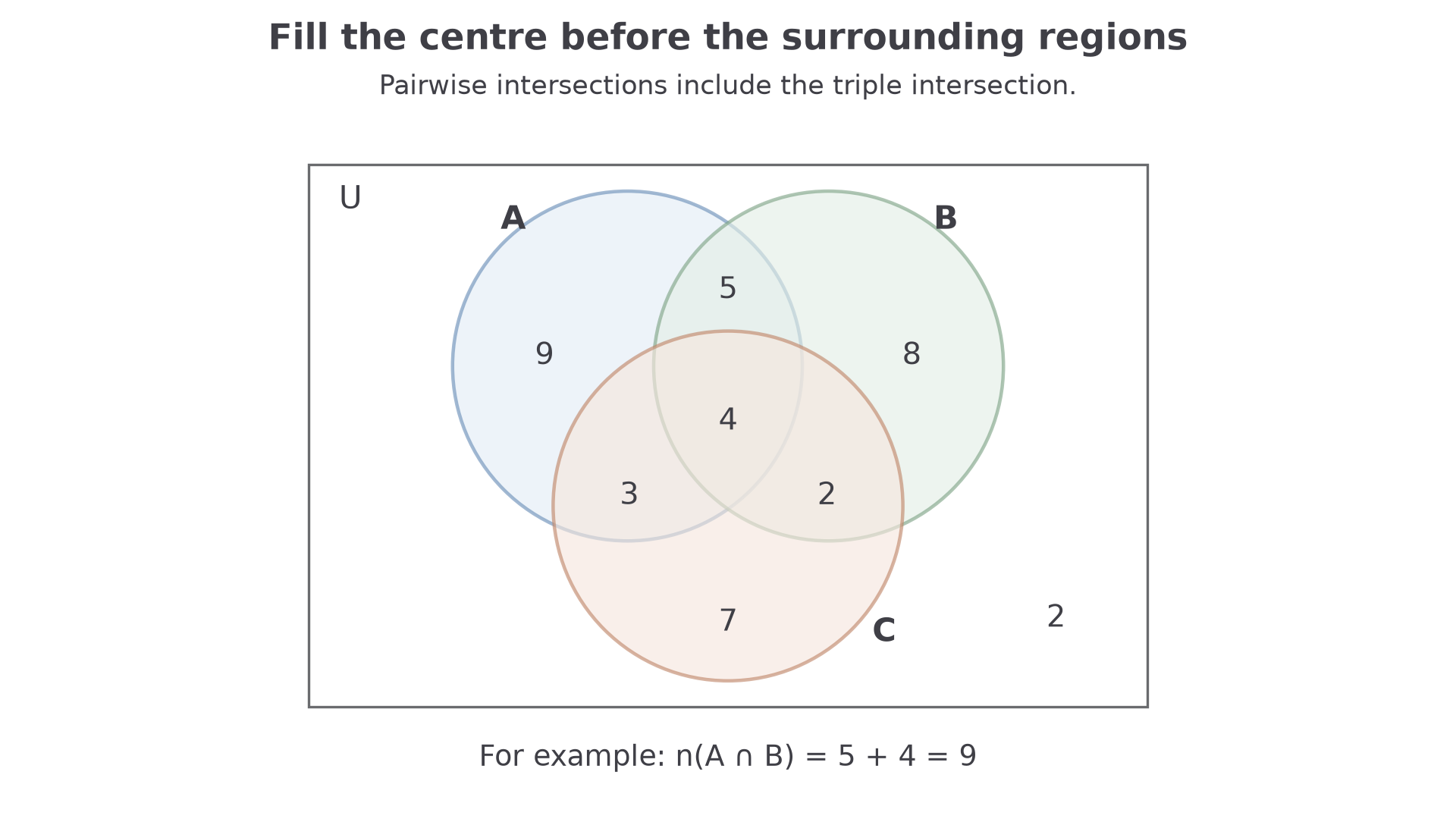
Three overlapping sets divide the universe into eight disjoint regions: three “only” regions, three “exactly two” regions, one triple overlap and one outside all three. Put each object or count in exactly one of these regions.
Three-set intersection
The set contains elements in all three sets. The set also includes this triple overlap. To select A and B but not C, use .
For numerical survey data, fill the triple overlap first. Then subtract it from each pairwise total before filling the single-set regions.
Worked example 5: complete a three-set survey
Question. In a group of 40 people, , , , , , , and . Find all eight region counts.
Plan. Work from the centre outwards so no person is counted twice.
Answer. A only 9, B only 8, C only 7; A and B only 5, A and C only 3, B and C only 2; all three 4; none 2.
Check. Each circle has its stated total: , , . All eight regions sum to 40.
The completed diagram distinguishes a pairwise intersection from its “only” region.
[DIAGRAM: asset_name: Eight regions in a three-set survey; asset_slug: three_sets_counts; caption: The centre is included in each pairwise intersection. For example, n of A intersection B is 5 plus 4.; description: Three overlapping circles A, B and C lie in a universal rectangle. The A-only, B-only and C-only counts are nine, eight and seven. The A-and-B-only, A-and-C-only and B-and-C-only counts are five, three and two. The triple overlap contains four and the outside region contains two.]
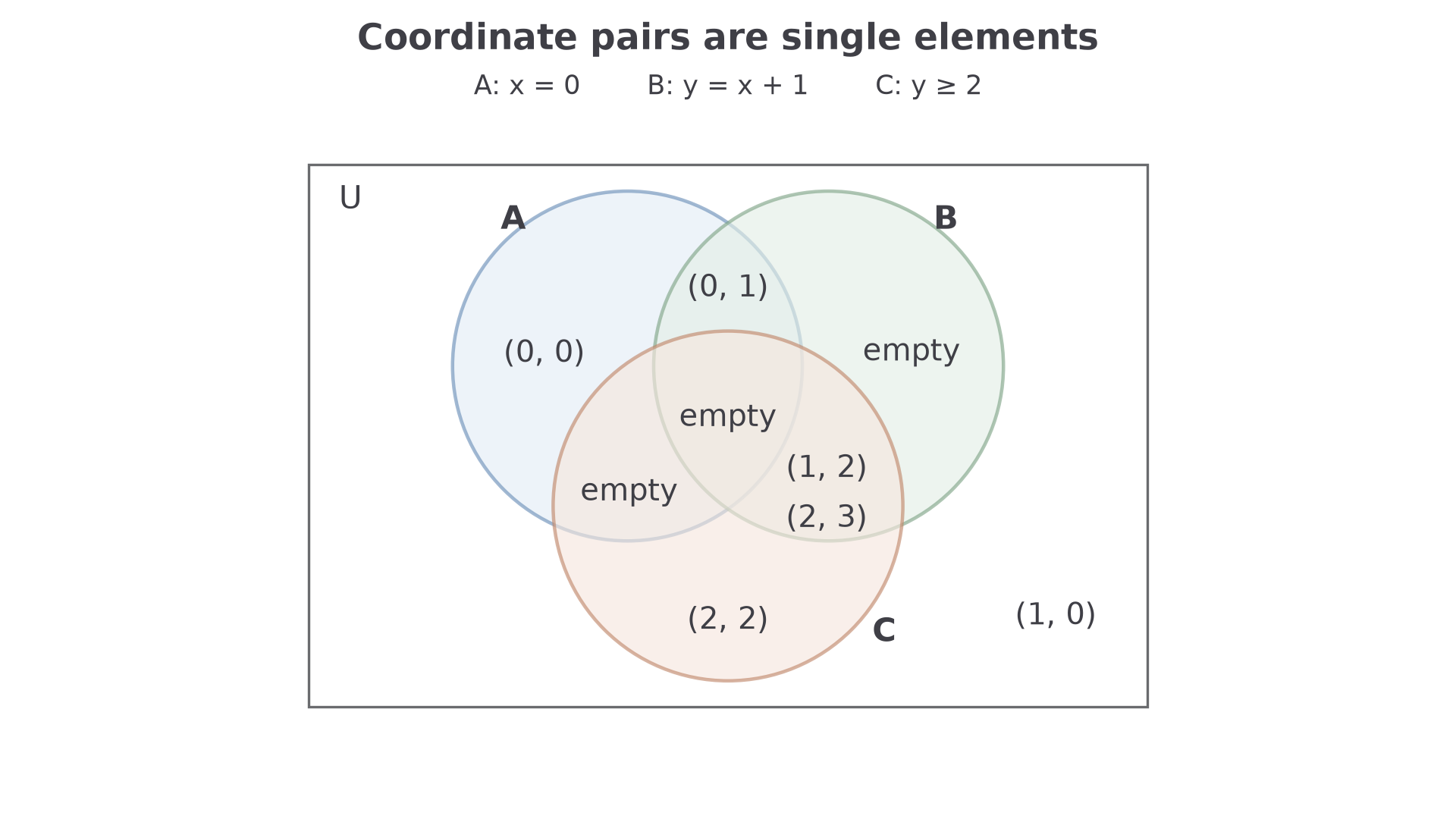
A set can contain coordinate pairs. The pair has first coordinate and second coordinate ; its order matters. The rule selects pairs whose second number is one greater than the first. For example, satisfies it because .
Worked example 6: sets defined by coordinate rules
Question. Let . Define , , and , using only pairs in . Place the pairs into the Venn regions and find and .
Plan. Test each pair against all three conditions; use the complete pair as one element.
| Pair | In A? | In B? | In C? | Region |
|---|---|---|---|---|
| Yes | No | No | A only | |
| Yes | Yes | No | A and B only | |
| No | No | No | Outside all three | |
| No | Yes | Yes | B and C only | |
| No | No | Yes | C only | |
| No | Yes | Yes | B and C only |
Answer. The placements are shown in the table. and . The B-only, A-and-C-only and triple regions are empty.
Check. All six original pairs appear once. For the two elements of , the second coordinate is both at least 2 and one greater than the first.
The mathematical rule changes in this example, but the Venn decision stays the same: test each condition and place the element once.
[DIAGRAM: asset_name: Coordinate pairs in three sets; asset_slug: three_sets_pairs; caption: Treat each coordinate pair as one element and test its two coordinates against the set rules.; description: A three-set Venn diagram for the six coordinate pairs in the preceding table. A-only has zero comma zero, A-and-B-only has zero comma one, B-and-C-only has one comma two and two comma three, C-only has two comma two, and outside all three has one comma zero. B-only, A-and-C-only and the centre are labelled empty.]
Watch out
“In A and B” includes anyone also in C. “In A and B only” excludes C. Subtract the centre from pairwise totals before placing the exclusive pair counts.
Use a centre-out calculation for this smaller survey.
Quick Recap
- Use and for elements; is a set with no elements.
- Use for a subset, allowing equality; one missing element proves .
- Fill three-set counts from the centre outwards, then check the complete universe.
- A coordinate pair is one ordered element; test its coordinates against each set's defining rule.
Three clubs can overlap without confusion when each person is placed in just one of the eight regions.