C8.1; E8.1 - Reflections
A point is 3 squares from a mirror line. How do you place its image so that folding along the line would match the two points? C8.1 and E8.1 use equal perpendicular distances to reflect points and shapes, then describe a single reflection precisely using its mirror line.
Reflected points
A reflection makes a mirror image. Join a point to its image: the joining segment crosses the mirror at a right angle, and the mirror cuts it into two equal halves. A point on the mirror stays where it is.
Reflection
A reflection maps each point to the point equally far on the opposite side of a mirror line, measured perpendicularly to that line. The mirror line is the perpendicular bisector of each segment joining a point to its image, except when the point lies on the mirror and is fixed.
For a horizontal mirror, measure vertically. For a vertical mirror, measure horizontally. Sliding diagonally away from a horizontal mirror does not give the correct image, even if the distance from the mirror is right.
[DIAGRAM: asset_name: Equal perpendicular distances to horizontal mirrors; asset_slug: reflected_point_distances; caption: Moving the mirror changes the image, while the perpendicular-distance rule stays the same.; description: Two accurate unit grids show P at three comma two. The left mirror is the x-axis, with image P prime at three comma minus two. The right mirror is y equals one, with image P prime at three comma zero. Perpendicular joining segments have equal-distance marks, with their midpoints on the mirrors.]
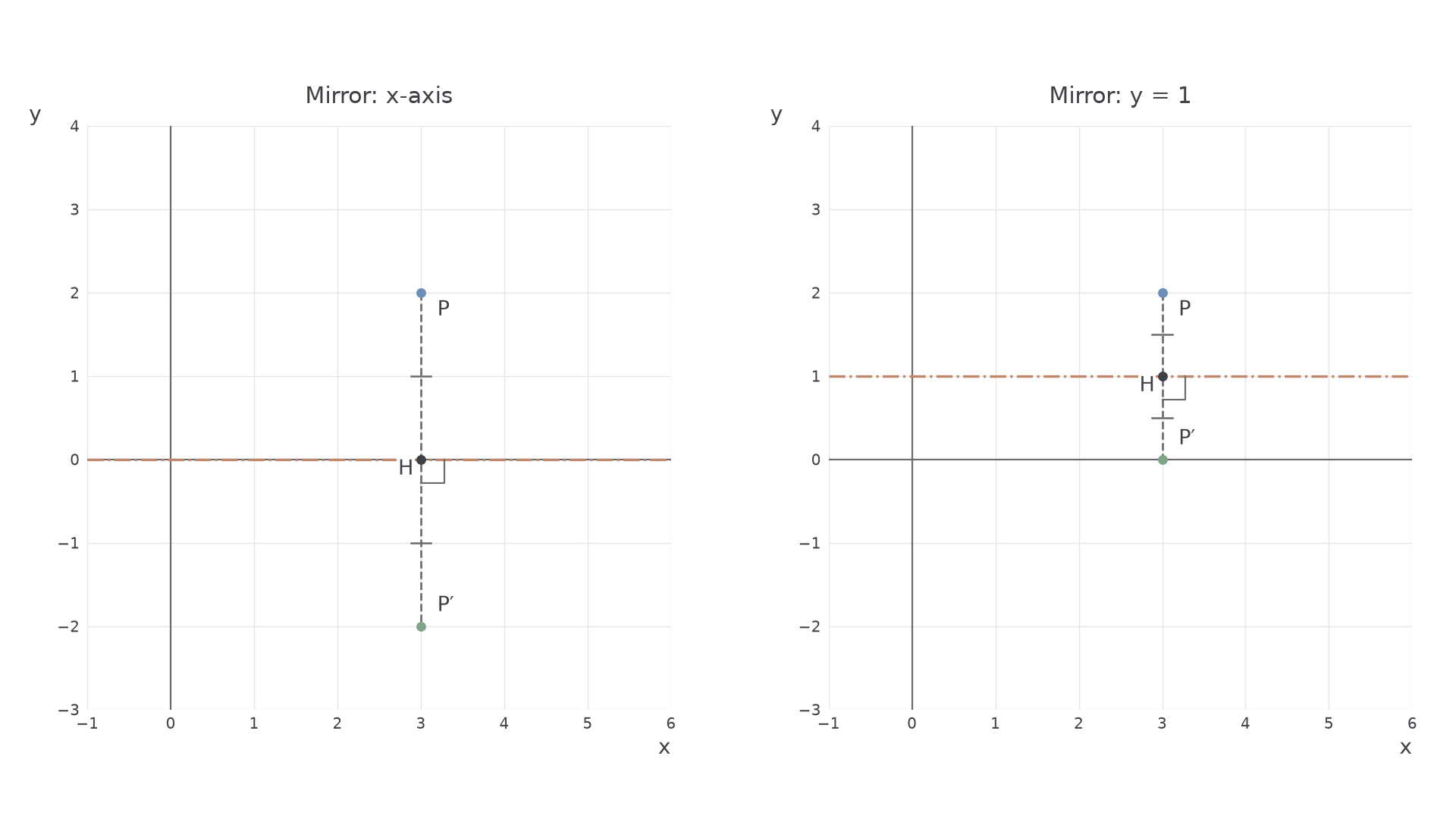
Worked example 1: reflecting in an axis
Question. Reflect in the -axis. Give its image coordinates.
Plan. Keep the horizontal position and move the same distance below the horizontal mirror.
Answer. .
Check. The joining segment is vertical, hence perpendicular to the mirror. Its halfway height is , on the mirror.
The second example changes only the mirror's height. Changing the sign of alone now gives the wrong image.
Worked example 2: a mirror above the axis
Question. Reflect in the line .
Plan. Measure P's distance above height 1, then go that far below it.
Answer. .
Check. The average of the two heights is . Both points have , so their joining segment is perpendicular to the horizontal mirror.
For any horizontal mirror , the two heights add to . For a vertical mirror , the two horizontal coordinates add to . Counting the distance each side explains these relationships.
Watch out
Reflecting in is not reflecting in the -axis. Name the mirror first, then measure from that line rather than automatically from zero.
Keep the unchanged coordinate unchanged in this next reflection.
Vertical and horizontal mirrors
Reflect a shape by reflecting each vertex, keeping the vertex correspondence clear. Label an image with primes, such as , then join matching vertices in the same order with a ruler. Reflecting preserves side lengths and angles, so the image is congruent to the starting shape.
You already know
The equation is a vertical line through horizontal coordinate 4; is a horizontal line through height . These equations identify which coordinate remains constant along the mirror itself.
A whole shape may cross the mirror: reflect each vertex separately rather than trying to slide the shape across. Vertices on the mirror remain fixed.
[DIAGRAM: asset_name: A triangle reflected in vertical and horizontal lines; asset_slug: reflected_triangles; caption: Every corresponding pair has the same midpoint line and perpendicular direction.; description: Two accurate unit grids show the triangle with vertices A one comma one, B three comma one and C one comma four. In the left panel the mirror is x equals four and images are A prime seven comma one, B prime five comma one and C prime seven comma four. In the right the mirror is y equals minus one and images are A prime one comma minus three, B prime three comma minus three and C prime one comma minus six.]
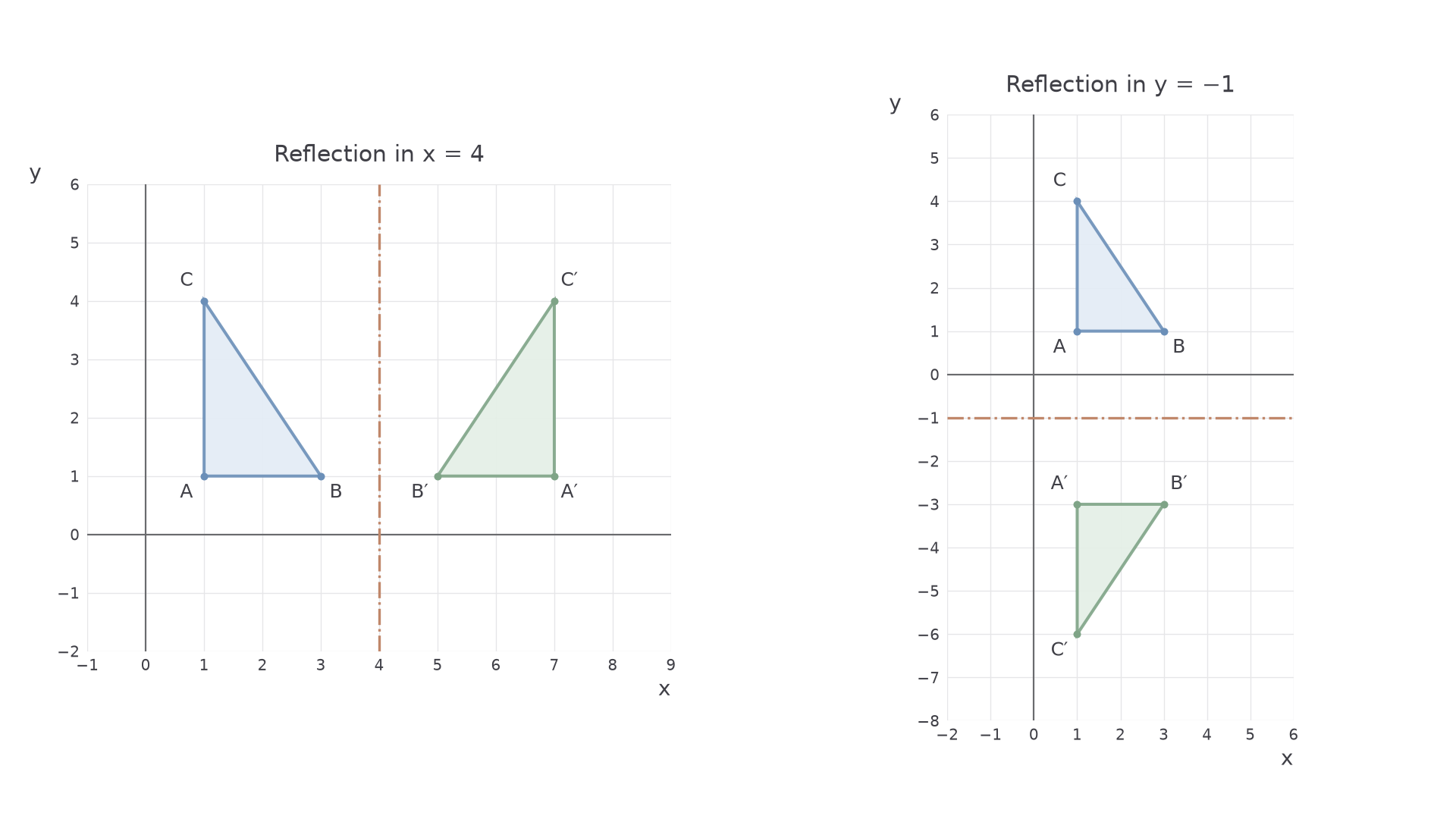
Worked example 3: a vertical mirror
Question. Triangle has vertices , , . Reflect it in .
Plan. Measure each vertex horizontally to , place its image equally far beyond, and retain its height.
Answer. Draw and join , , , as in the left panel.
Check. Each horizontal midpoint has . The original horizontal side AB has length 2; its image A'B' also has length 2, facing the other way.
Continue this lesson.
You’re previewing NovaLearn without an account. Create a free account to read the rest.
Create free account