C1.1, C1.3; E1.1, E1.3 - Squares, cubes and roots
You can build 16 dots into a square, but 16 dots do not make a complete triangular pattern with consecutive rows. What distinguishes these number patterns? C1.1 and E1.1 identify square, cube and triangle numbers; C1.3 and E1.3 use powers and roots to build quantities and work backwards.
Square numbers
A square array with 4 dots along each side contains dots. The two equal dimensions explain both the name square number and the notation .
Square and square root
The square of a number is that number multiplied by itself: . A square number is the square of a whole number. The square root symbol asks for the non-negative number whose square is the given value. For example, because .
Learn these squares and read the table backwards for the corresponding roots. For example, the entry for 13 also tells you that . Zero is a square too: .
| Number | Square | Number | Square | Number | Square |
|---|---|---|---|---|---|
| 1 | 1 | 6 | 36 | 11 | 121 |
| 2 | 4 | 7 | 49 | 12 | 144 |
| 3 | 9 | 8 | 64 | 13 | 169 |
| 4 | 16 | 9 | 81 | 14 | 196 |
| 5 | 25 | 10 | 100 | 15 | 225 |
Worked example 1: finding a square
Question. Work out .
Plan. Multiply 11 by itself, using to organise the calculation.
Answer. 121.
Check. , so the product has two equal factors of 11.
Now the total is known and the side length is missing. A square root reverses squaring.
Worked example 2: finding a square root
Question. Write down .
Plan. Find the non-negative number which multiplies by itself to give 144.
Answer. 12.
Check. . The answer is non-negative, as the root symbol requires.
Although as well, the expression has the single value 12. Solving an equation with a squared unknown is a different task, which can have two answers.
Watch out
means , not . Also, a square root is not division by 2: , whereas .
Reverse the multiplication to check your recall.
Cube numbers
A cube with 3 small cubes along each edge contains three layers of cubes. Its total is , using three equal dimensions rather than two.
Cube and cube root
The cube of a number is the product of three copies: . A cube number is the cube of an integer. The cube root, written , is the number whose cube is .
Learn the following cubes and their corresponding roots. A root's small index tells you how many equal factors are needed. A square root has an unwritten index 2; a cube root shows 3.
| Number | 1 | 2 | 3 | 4 | 5 | 10 |
|---|---|---|---|---|---|---|
| Cube | 1 | 8 | 27 | 64 | 125 | 1000 |
Worked example 3: finding a cube
Question. Work out .
Plan. Multiply three copies of 4, dealing with two factors first.
Answer. 64.
Check. and , leaving the third copy of 4.
Reverse the direction again: the root finds the repeated factor, not one third of the total.
Worked example 4: finding a cube root
Question. Write down .
Plan. Look for three equal factors with product 125.
Answer. 5.
Check. Cubing 5 returns the original value, 125.
Zero has cube zero. A negative number can also have a cube root: , so . A cube preserves the sign, unlike a square.
Watch out
, not 9. The index counts copies of the base being multiplied; it is not a multiplier of the base.
Use the recalled cube facts in both directions.
Other powers and roots
The same notation works beyond squares and cubes. For example, . A fifth root reverses this: , because five equal factors of 2 give 32.
Power and root
In , is the base and is the index or exponent. For a positive whole-number index, multiply copies of the base. The root of order asks for the repeated factor. For a positive value and an even root, the root symbol selects the non-negative answer.
Write the repeated product when an unfamiliar power appears. Grouping its factors can shorten the arithmetic, but cannot change how many copies there are. These definitions and the recall tables are knowledge to learn; they do not appear in the supplied formula list.
Worked example 5: a fourth power
Question. Work out .
Plan. Write four copies of 3 and pair them.
Answer. 81.
Check. Starting with 81 and dividing by 3 four times gives : four factors of 3 were present.
The next example changes a power into a root. Trial a sensible small whole number, then verify it by multiplying.
Worked example 6: a fourth root
Question. Work out .
Plan. Find a non-negative number whose fourth power is 625.
Answer. 5.
Check. Four factors of 5 reconstruct 625; dividing 625 by 4 would give a different quantity.
On a calculator paper, use the appropriate power or root key and check that the display contains the intended root index. For this lesson's exact integer roots, raising the answer back to the indicated power is a reliable check without a calculator.
Watch out
does not mean , and it does not mean four times . The index describes repeated multiplication that you are undoing.
Check a new root by reversing it.
Triangle numbers
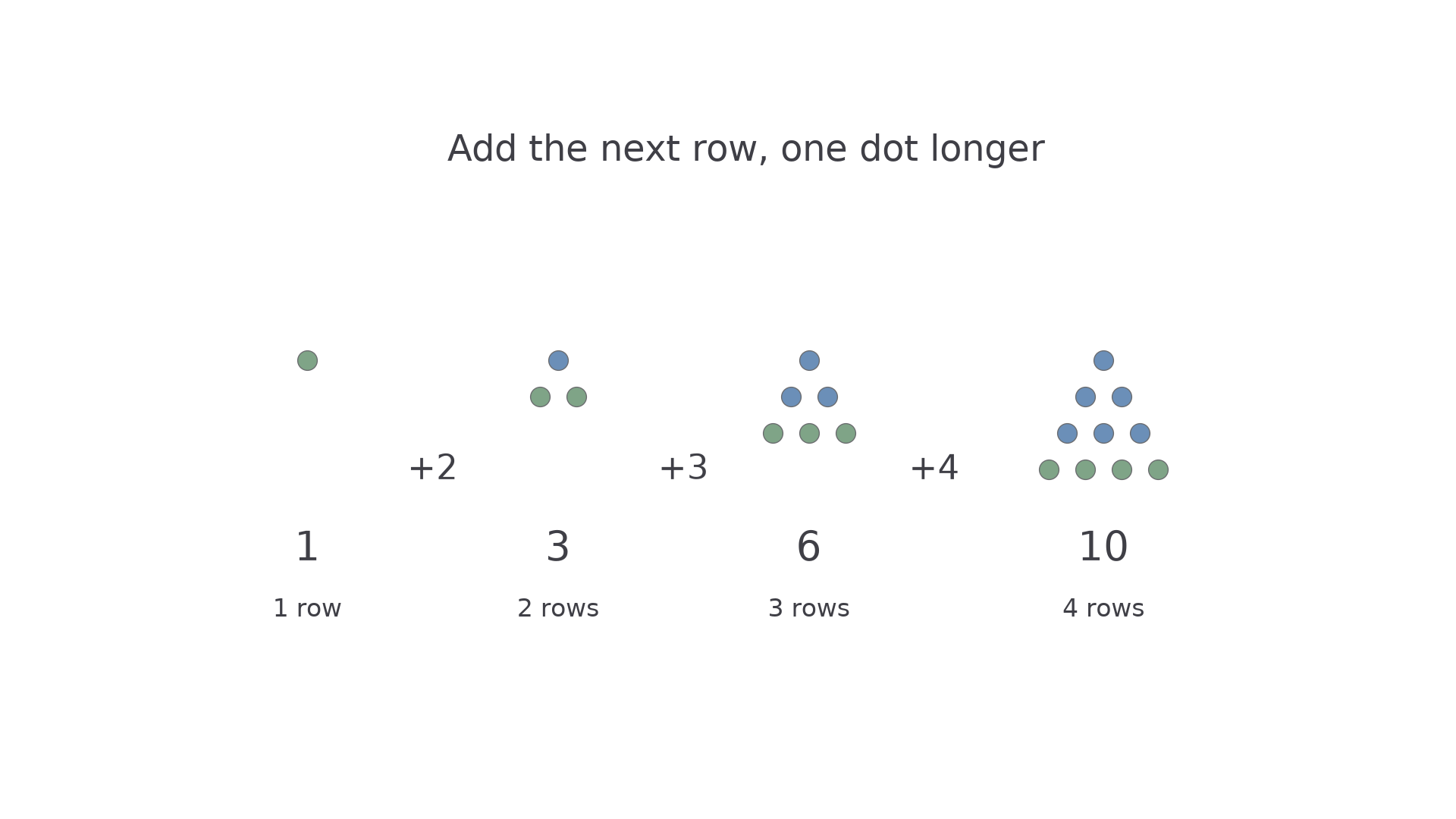
Rows containing 1 dot, then 2 dots, then 3 dots make a triangular arrangement. Each new row has one more dot than the previous row. The totals are triangle numbers, also called triangular numbers.
[DIAGRAM: asset_name: Growing triangle numbers; asset_slug: growing_triangle_numbers; caption: Consecutive rows give totals 1, 3, 6 and 10; each new row is one dot longer.; description: Four separate triangular dot arrays have one, two, three and four rows. Their totals are labelled 1, 3, 6 and 10. Previously present rows are blue and the newly added bottom row is sage. The additions shown are plus two, plus three and plus four.]
Triangle number
A triangle number is a sum of consecutive positive integers starting at 1. The first four are , , and . The triangle number in position has rows of lengths 1 through .
Look at the amount added, rather than expecting a constant gap. From 1 to 3 the gap is 2, then 3, then 4. The next gap is 5, because the next row contains 5 dots.
Worked example 7: the fifth triangle number
Question. Find the fifth triangle number.
Plan. Add a row of 5 to the fourth total, 10.
Answer. 15.
Check. Pairing terms in gives .
Extend the same pattern by one row. The added number changes as well as the total.
Worked example 8: the sixth triangle number
Question. Find the triangle number after 15, explaining the addition you use.
Plan. Since 15 has five rows, add a sixth row containing 6 dots.
Answer. 21, obtained by adding 6.
Check. , using all six row lengths once.
The opening 16 dots make a square, but the triangle totals pass from 15 straight to 21. So 16 is not a triangle number. A number may belong to more than one pattern: 1 is both a square and a triangle number.
Watch out
Do not keep adding the last gap. Triangle totals increase by , because each new row is longer than the previous one.
Continue the row lengths, rather than guessing the total.
Quick Recap
- A square uses two equal factors; a cube uses three.
- A root finds the repeated factor and reverses the corresponding power.
- Learn the squares from 1 to 15 and the cubes of 1, 2, 3, 4, 5 and 10, reading each fact backwards for roots.
- Triangle numbers add consecutive row lengths starting at 1.
Sixteen makes a square; triangular totals jump from 15 to 21, leaving 16 out.