E2.6 - Inequalities in two variables (Extended)
A point must lie to the right of , above and below . How can one picture communicate all three conditions, including which edges count? This part of E2.6 turns linear inequalities into regions and reads inequalities back from a diagram.
Boundary lines
An equation such as describes a line. An inequality such as describes a whole side of that line. First draw the boundary by replacing the inequality sign with an equals sign.
Strict and inclusive boundaries
A strict inequality, or , excludes its boundary: draw a broken line. An inclusive inequality, or , includes its boundary: draw a solid line.
The line's position comes from its equation; its style comes from the inequality. Use for a vertical boundary and for a horizontal one. For a sloping boundary, find two points and join them with a ruler.
[DIAGRAM: asset_name: Strict and inclusive versions of one boundary; asset_slug: regions_boundary_styles; caption: Both boundaries have equation x plus y equals 6; the inequality decides whether the line is broken or solid.; description: Two equal-scale grids show the line through zero comma six and six comma zero. The left is broken and labelled x plus y less than six, boundary excluded. The right is solid and labelled x plus y less than or equal to six, boundary included. Both points and axes are labelled. No region shading is used in this boundary-only comparison.]
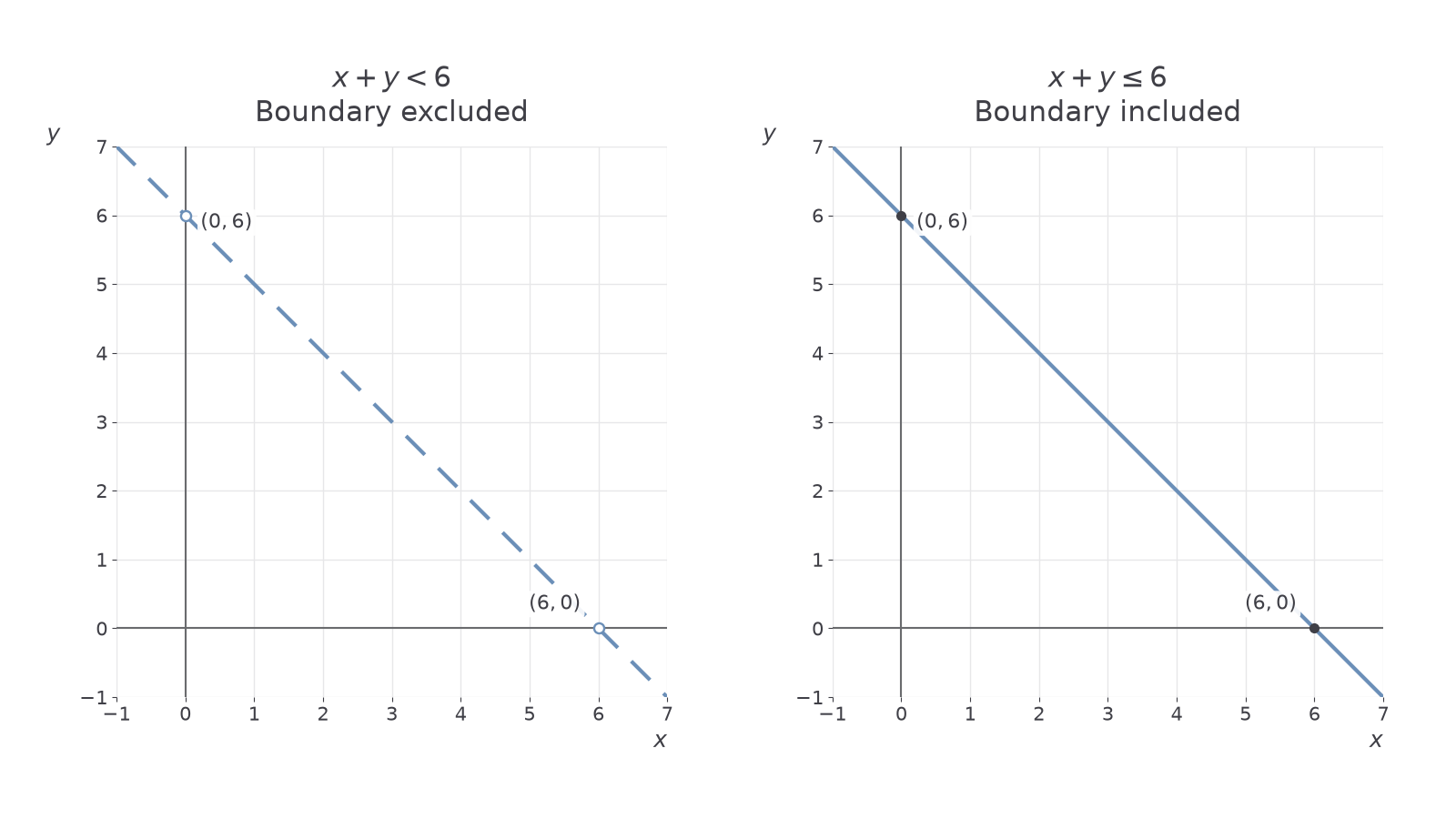
Worked example 1: a strict sloping boundary
Question. Describe how to draw the boundary for , giving two points on it and its line style.
Plan. Replace with , find intercepts, then use a broken line.
Answer. Draw a broken straight line through and .
Check. Each point has coordinate sum 6, which does not satisfy . Excluding the line is correct.
Change only the comparison to an inclusive one. The position stays exactly the same.
Worked example 2: an inclusive sloping boundary
Question. Describe the boundary for , giving two points on it and its line style.
Plan. Use the same equation and intercepts, but include equality.
Answer. Draw a solid straight line through and .
Check. At , , so a point on the boundary is allowed.
The line itself contains infinitely many points. Two correct points locate a straight boundary; they are not the only points that can be used.
Watch out
Do not use an open or closed circle instead of a boundary line. Circles mark endpoints on a number line; broken and solid lines show exclusion and inclusion on a two-dimensional region diagram.
Give enough information to locate and style the new boundary.
Unwanted regions
A boundary has two sides. Choose a test point on one side, substitute its coordinates into the inequality and decide whether it is allowed. The origin is convenient when it is not on the boundary. If your test point is on the boundary, choose another point: it cannot distinguish the two sides.
Unwanted region
The unwanted region contains points that fail a required inequality. Shade unwanted regions unless the question directs otherwise. With several inequalities, a solution must satisfy every condition, so the surviving unshaded region is their overlap.
For , for example, works and fails. The required side is above the line ; the unwanted side is below it.
Worked example 3: selecting a side
Question. Represent by describing the boundary and the region to shade.
Plan. Draw the solid boundary and test the origin.
The origin is below the boundary, so that side is wanted.
Answer. Draw solid and shade the region above it. Leave the lower side unshaded.
Check. lies above the boundary and gives , false. It belongs to the shaded side.
Now reverse only the inequality. The boundary remains solid but the wanted side swaps.
Worked example 4: selecting the opposite side
Question. Represent by describing the boundary and the region to shade.
Plan. Draw the same solid boundary and test the origin again.
Answer. Shade below the solid line , leaving the upper side unshaded.
Check. Boundary point satisfies equality and remains included in both examples; only the side has changed.
Continue this lesson.
You’re previewing NovaLearn without an account. Create a free account to read the rest.
Create free account