C6.3; E6.3 - Arcs and sectors
A circular cake is divided into six equal slices. How much curved edge and how much area belong to one slice, and why is its whole boundary longer than its curved edge? This lesson develops fractions of circles, arc length, sector area and sector perimeter in C6.3 and E6.3.
Fractions of a turn
Six equal slices share the cake's full turn of , so each slice has centre angle . One slice occupies one sixth of the whole circle. Equal centre angles divide both the circumference and the area equally.
Arc and sector
An arc is a part of a circle's circumference. A sector is the region bounded by two radii and their joining arc. The angle between the radii at the centre selects the fraction of the circle.
A sector is different from a segment: a segment is bounded by a chord and an arc. Here the straight boundaries always run to the centre.
Fraction of a circle
For a sector with centre angle measured in degrees,
The same fraction applies to its arc length and area. This fraction rule is not separately supplied on the formula lists: learn how it follows from one full turn.
For Core, sector calculations use angles that are factors of , so a whole number of equal copies completes the circle. Extended also uses other angles, taught in the next lesson. All calculations in this shared lesson use the Core angle range.
Worked example 1: six equal sectors
Question. What fraction of a circle is a sector of angle ? How many equal copies complete the circle?
Plan. Compare the angle with a full turn, then count equal angles in .
Answer. One sixth; six equal sectors complete the circle.
Check. , and six copies of add to 1.
Change the angle and the number of equal slices changes with it. The radius does not affect this fraction.
Worked example 2: five equal sectors
Question. What fraction of a circle is a sector of angle ? How many equal copies complete the circle?
Plan. Divide by the full-turn angle and simplify.
Answer. One fifth; five equal sectors complete the circle.
Check. Five lots of give .
For the same radius, increasing the centre angle increases both the arc length and sector area in the same proportion. It does not change either straight radius.
Watch out
The fraction is , not . A sector is of a circle; it cannot occupy six whole circles.
Match the angle to a fraction of one full turn.
Arc length
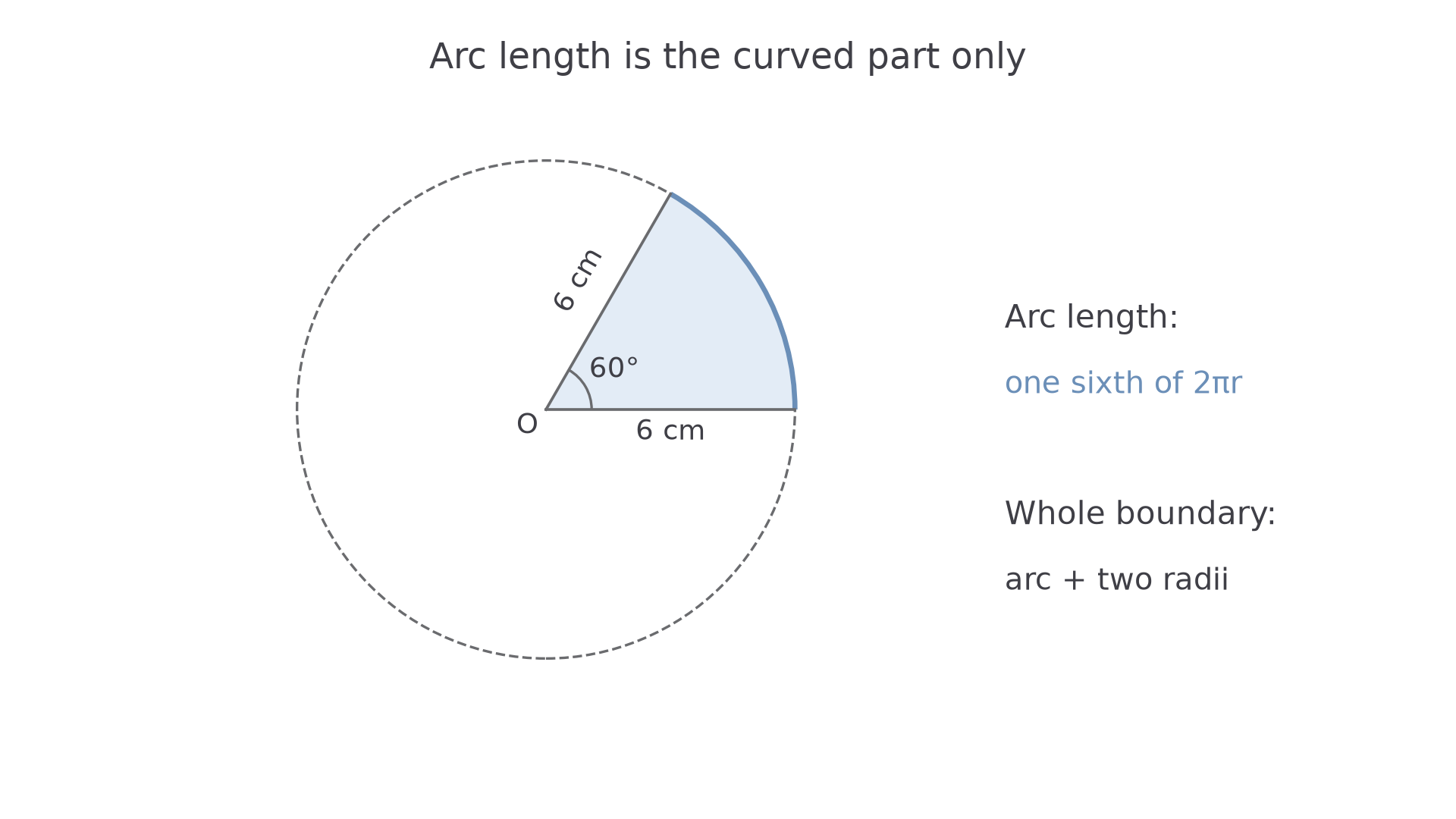
An arc is a length along the curved boundary. Find the full circumference, then take the sector's fraction. You do not need to approximate the curve by a straight line.
[DIAGRAM: asset_name: One sixth of a circumference; asset_slug: sector_arc_and_radii; caption: The highlighted arc is one sixth of the circumference; the two radii are separate straight boundaries.; description: An exact circle of radius six centimetres with a sixty degree sector shaded pale blue. The sixty degree angle is marked at O and both radii are labelled six centimetres. The selected circular arc is highlighted blue while the remaining circumference is grey and dashed. A side note identifies arc length as the curved part only.]
Arc length
Here is the centre angle in degrees and is the radius. The circle circumference formula is supplied on the formula lists; this fraction-of-circumference form is not separately listed.
When the angle divides 360 exactly, simplifying the fraction first often makes an exact answer quick. A diagram may give a diameter; halve it before using .
Worked example 3: a sixth-circle arc
Question. Find the length of the arc in a circle of radius . Give your answer in terms of .
Plan. Take one sixth of the full circumference.
Answer. .
Check. Six copies of this arc give , the complete circumference.
Keep the radius fixed and reduce the angle. This changes only the fraction of the circumference being used.
Continue this lesson.
You’re previewing NovaLearn without an account. Create a free account to read the rest.
Create free account