E5.3 - Explaining similar triangles (Extended)
A short line parallel to one side of a triangle cuts off a smaller triangle. Why must the smaller one have the same shape, and which side lengths can you compare? E5.3 combines geometric angle reasons with matched proportions, including triangles that share a corner or cross over one another.
Angle matching
Two triangles with two pairs of equal angles are similar. Their third angles must also be equal because each triangle's angles total . This is the angle-angle, or AA, similarity test.
AA similarity
If two angles of one triangle equal two angles of another, the triangles are similar. State which angles match and why they are equal. Write the triangles in corresponding vertex order.
Parallel lines often supply the equal angles. A shared angle or a pair of vertically opposite angles can supply another match.
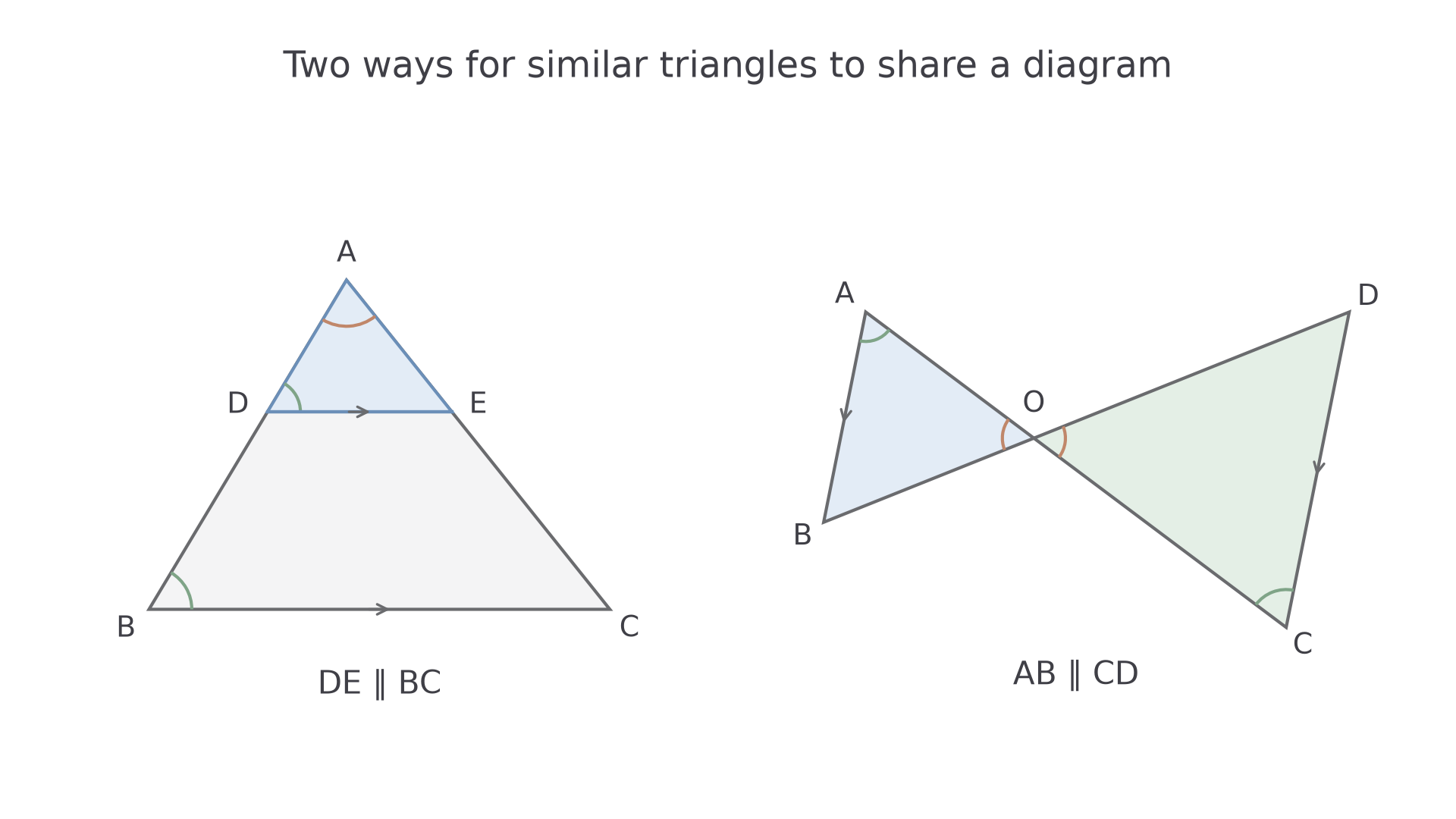
[DIAGRAM: asset_name: Nested and crossing similar triangles; asset_slug: similar_triangle_pairs; caption: Parallel sides give angle matches in both nested and crossing triangles.; description: Left panel shows triangle ABC with D on AB and E on AC, with DE parallel to BC and the smaller triangle ADE pale blue. Right panel shows A O C on one straight line and B O D on another, with AB parallel to CD; triangles AOB and COD lie on opposite sides of O. Matching-angle arcs are coloured consistently and parallel arrows identify the parallel sides. The diagrams have unequal side lengths and no accidental extra parallel lines.]
Worked example 1: a triangle inside another
Question. lies on , lies on , and . Show that triangles and are similar.
Plan. Use the shared angle at and an angle supplied by the parallel lines.
Answer. and are similar by AA, with , , .
Check. The remaining angles and are also equal by corresponding angles. This agrees with the vertex order.
The triangles now cross at a point instead of sharing an outer corner. Replace the shared angle by vertically opposite angles.
Worked example 2: crossing triangles
Question. lie on one straight line in that order, and lie on another. Given , show that triangles and are similar.
Plan. Match the angles at , then use alternate angles at the parallel sides.
Answer. The triangles are similar by AA, with , , .
Check. by alternate angles too. The side opposite , namely , therefore matches .
The opening smaller triangle is similar because the parallel cut gives corresponding angles, while the corner at the original vertex is shared.
Watch out
“Both triangles contain a right angle” would supply only one pair of equal angles. For AA you need a second pair, with a valid reason.
Give the angle reasons explicitly in this new configuration.
Length proportions
Once the angle matches establish similarity, translate the vertex order into side pairs. For similar to , the pairs are , , and .
Corresponding side proportions
With on , on , and ,
Each ratio uses the smaller triangle over the larger triangle. Not on the supplied formula list: form it from the vertex matches.
You may invert every ratio, but do not invert just one. Choose the pair containing the unknown and one fully known pair.
Continue this lesson.
You’re previewing NovaLearn without an account. Create a free account to read the rest.
Create free account