C5.4; E5.4 - Line and rotational symmetry
A sloping parallelogram fits its outline after a half-turn, yet it may have no mirror line at all. Why are these different kinds of symmetry? C5.4 and E5.4 connect folds, turns and familiar shape properties, so you can describe exactly how a shape matches itself.
Line symmetry
A mirror test compares the whole shape on one side of a line with the whole shape on the other side. Imagine folding the paper along that line: every boundary point must meet its partner.
Line symmetry
A line of symmetry, also called an axis of line symmetry, is a line in which reflection maps a two-dimensional shape exactly onto itself. Points on the line stay fixed; matching points lie equal perpendicular distances from it.
Try lines through matching vertices or side midpoints. Then check every side and corner, not just whether the line divides the area in half. An unmarked shape's outline is what matters; if a pattern includes colours or letters, those must match too.
[DIAGRAM: asset_name: Mirror lines and turns; asset_slug: mirror_lines_and_turns; caption: A rectangle has two mirror lines; a general parallelogram has none but still matches after a half-turn.; description: Exact non-square rectangle with its two midpoint axes drawn dashed and a contrasting failed diagonal fold, and a non-rectangular non-rhombic parallelogram with centre and a 180-degree rotation arrow. A regular pentagon panel shows five mirror lines and its 72-degree first matching turn.]
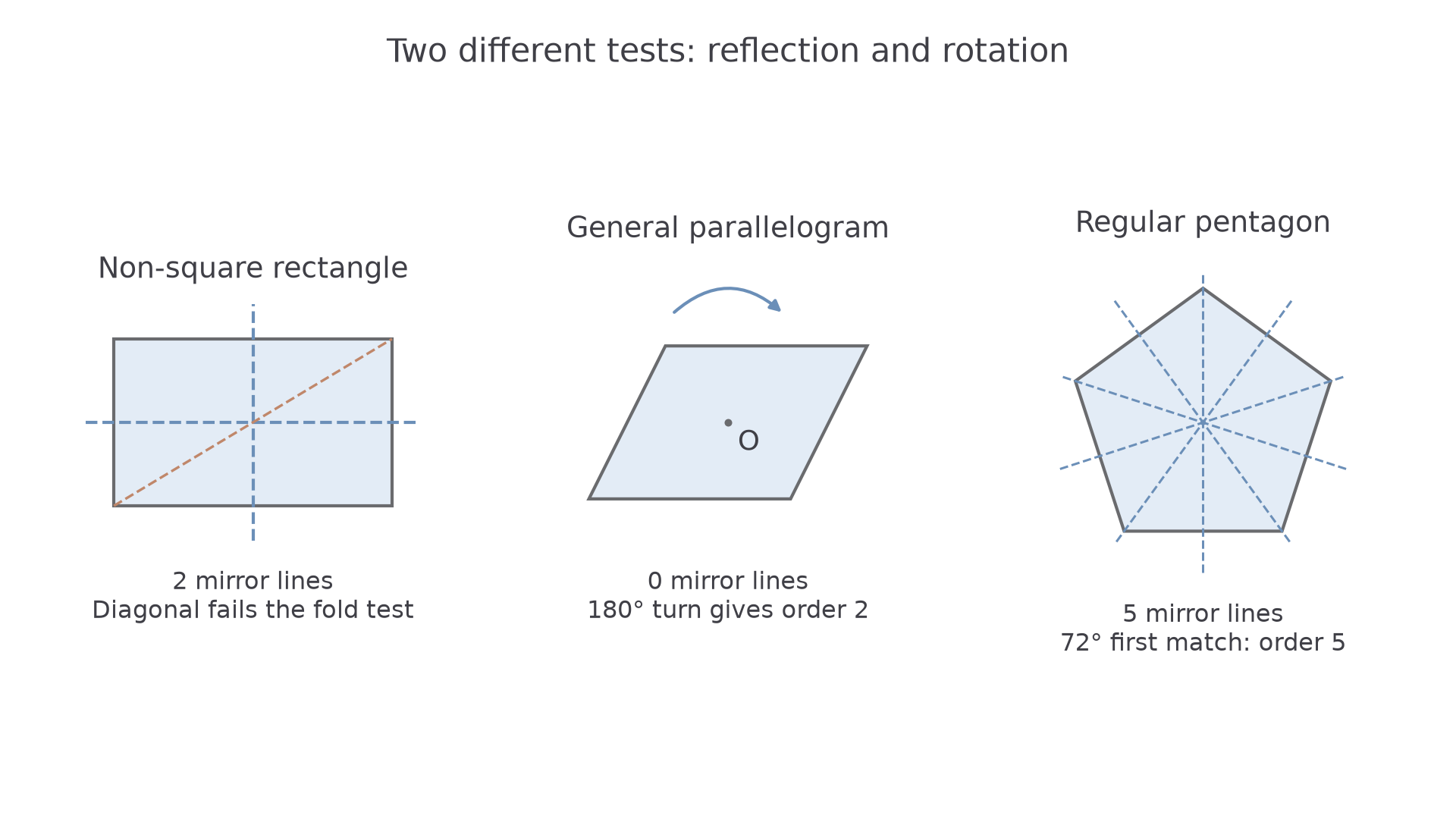
Worked example 1: testing a rectangle
Question. A rectangle is long and wide. Describe all its lines of symmetry.
Plan. Test folds through the centre, checking the lengths of corresponding sides.
- A line through the midpoints of the two sides exchanges the left and right halves exactly.
- A line through the midpoints of the two sides exchanges the top and bottom halves exactly.
- A diagonal would exchange an side with a side, so it fails.
Answer. Two lines: each joins the midpoints of a pair of opposite sides.
Check. Reflection in either stated line pairs all four vertices and preserves the long-side and short-side positions. No vertex-to-vertex line passes that test.
Make the adjacent sides equal and the diagonal test changes. The new symmetry comes from the changed property, not from the shape's orientation.
Worked example 2: the square boundary case
Question. A square has side . Describe all its lines of symmetry.
Plan. Retain the rectangle's successful folds, then retest its diagonals.
- Both lines joining opposite side midpoints still match the shape.
- Each diagonal now exchanges equal sides and equal right angles.
- These give two midpoint lines and two diagonals.
Answer. Four lines of symmetry.
Check. Folding along either diagonal places one triangular half exactly on the other. A line through a vertex must exchange that vertex's two sides, so only its diagonal can work; a line crossing sides must cross their midpoints.
Equal area is insufficient: each diagonal halves the non-square rectangle's area but does not reflect it onto itself.
Watch out
Do not count every diagonal as a mirror line. Test whether the two sides meeting at a vertex would actually coincide after reflection.
Use the stated side lengths to settle the next shape.
Rotational order
A turn can match a shape even when no fold works. Keep the centre of rotation fixed and turn the entire shape without moving it sideways.
Order of rotational symmetry
The order of rotational symmetry is the number of times a shape fits its original outline during one complete turn, including the final position. A shape with no earlier match has order 1.
For a shape with a finite rotational order, its matching positions are equally spaced. If the smallest positive matching turn is , then
Count matches rather than vertices. A shape with six vertices need not have order 6. A circle matches after any turn about its centre, so it has infinitely many rotational symmetries rather than a finite first positive angle.
Worked example 3: a half-turn without a mirror line
Question. A parallelogram has adjacent sides and , and one angle is . Find its rotational order.
Plan. Rotate about the intersection of its diagonals and see which vertices exchange.
- A turn exchanges each vertex with its opposite vertex and each side with the equal parallel opposite side.
- A smaller matching turn would have to exchange adjacent sides, but their lengths differ.
- Matching turns are therefore and .
Answer. Order .
Check. A quarter-turn would put a side into a side's position, so order 4 is impossible. The stated non-right angle also prevents rectangle mirror lines.
Continue this lesson.
You’re previewing NovaLearn without an account. Create a free account to read the rest.
Create free account