C8.1; E8.1 - Enlargements
Can an enlargement make a triangle smaller? C8.1 and E8.1 use a centre and a positive scale factor to place every image vertex, including factors between zero and one. You will draw accurate images and recover the centre and scale factor from a pair of shapes.
Centre rays
An enlargement with scale factor 2 doubles every length, but its position depends on the centre of enlargement. From that centre, each image is twice as far along the same ray as its original vertex. Doubling the coordinates works only when the centre is the origin.
Enlargement with a positive scale factor
An enlargement with centre S and positive scale factor sends a point P to P' on the same ray from S, with . The centre is fixed. Angles are unchanged and all lengths have the same multiplier, so the image is similar to the object.
Draw light rays from the centre through each vertex. Mark the required multiple of each distance along its ray, then join the image vertices in order with a ruler. For an offset centre, multiplying the horizontal and vertical moves from the centre by scales the whole ray in the same ratio.
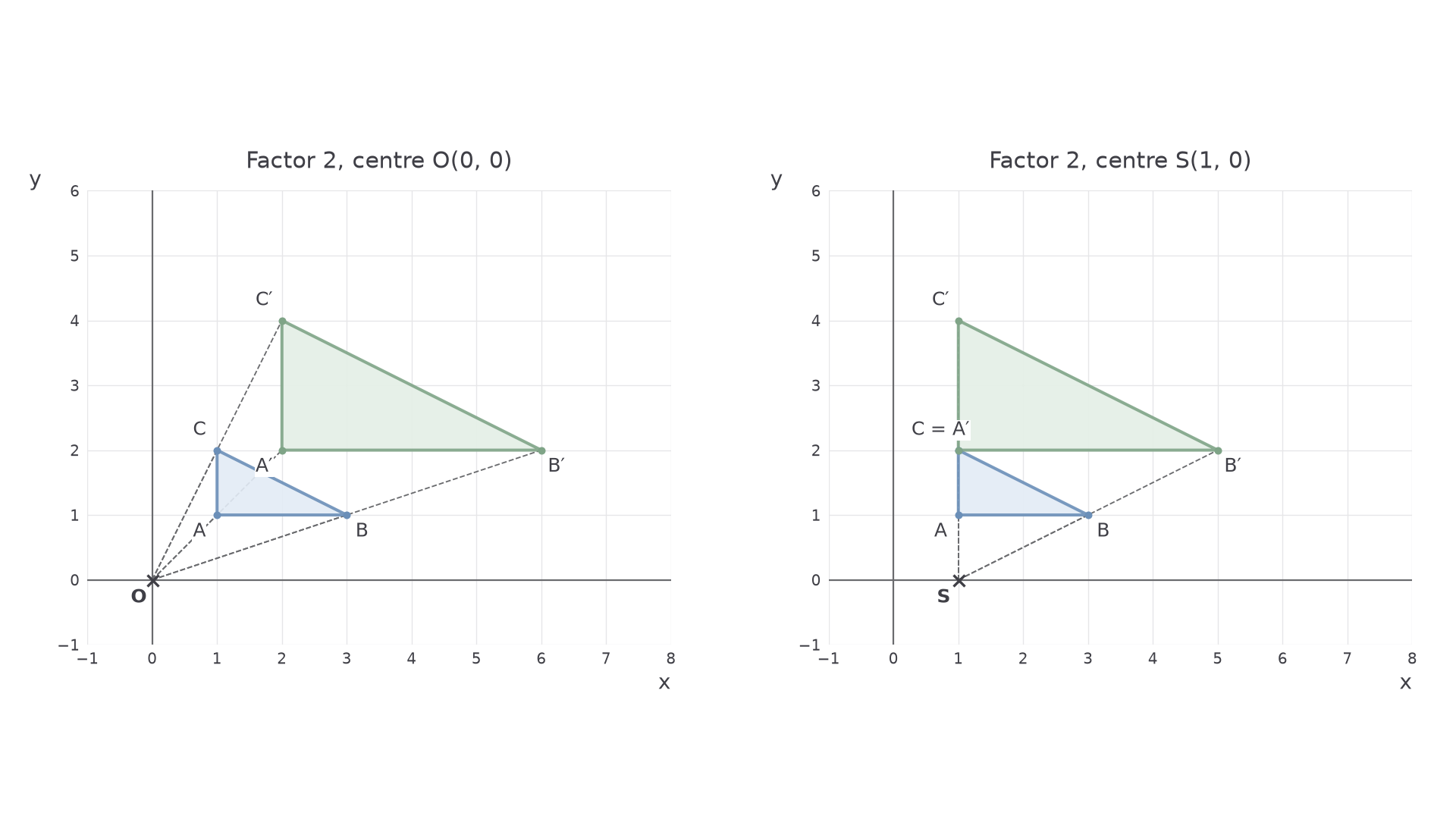
[DIAGRAM: asset_name: One enlargement factor with two different centres; asset_slug: enlargement_centres; caption: Both images have twice the side lengths, but changing the centre changes their positions.; description: Two accurate equal-scale grids use triangle A one comma one, B three comma one and C one comma two with factor two. Left centre is the origin and image vertices are two comma two, six comma two and two comma four. Right centre is S one comma zero and images are one comma two, five comma two and one comma four. Dashed rays connect each centre, vertex and image.]
Worked example 1: enlarging from the origin
Question. Enlarge by scale factor 2 about the origin.
Plan. Double each move from the origin and join the resulting vertices.
Answer. Join , as on the left grid.
Check. AB has length 2 and A'B' length 4; AC has length 1 and A'C' length 2. Every vertex lies on its original centre ray, with twice the distance from the origin.
Only the centre changes in the second example. The image retains the same size but occupies a different position.
Worked example 2: an offset centre
Question. Enlarge the same triangle by scale factor 2 about .
Plan. Double each displacement from S, then add it back to S.
Answer. , joined as on the right grid.
Check. The image side lengths are again 4 and 2. Along SB, moving from to and then repeating the same move reaches , so the required ray and factor agree.
The centre need not lie inside the shape, and it need not lie on an axis. A vertex at the centre stays there whatever the positive factor.
Watch out
Multiply distances from the centre, not distances from whichever axis is nearest. Doubling coordinates in the second example would incorrectly use the origin as the centre.
Work from the specified centre in this new triangle.
Fractional enlargement
The word enlargement names the transformation even when its scale factor makes a smaller image. For , each image vertex lies between the centre and its original vertex. The same positive centre ray is used; only the distance changes.
Positive fractional scale factor
A factor multiplies all lengths by a positive fraction. For example, halves each side and each distance from the centre. A factor greater than 1 increases lengths; leaves every point unchanged.
Use the axis scale carefully: an image coordinate can lie halfway between grid lines. Plot that position accurately, rather than rounding the coordinate to the nearest whole number.
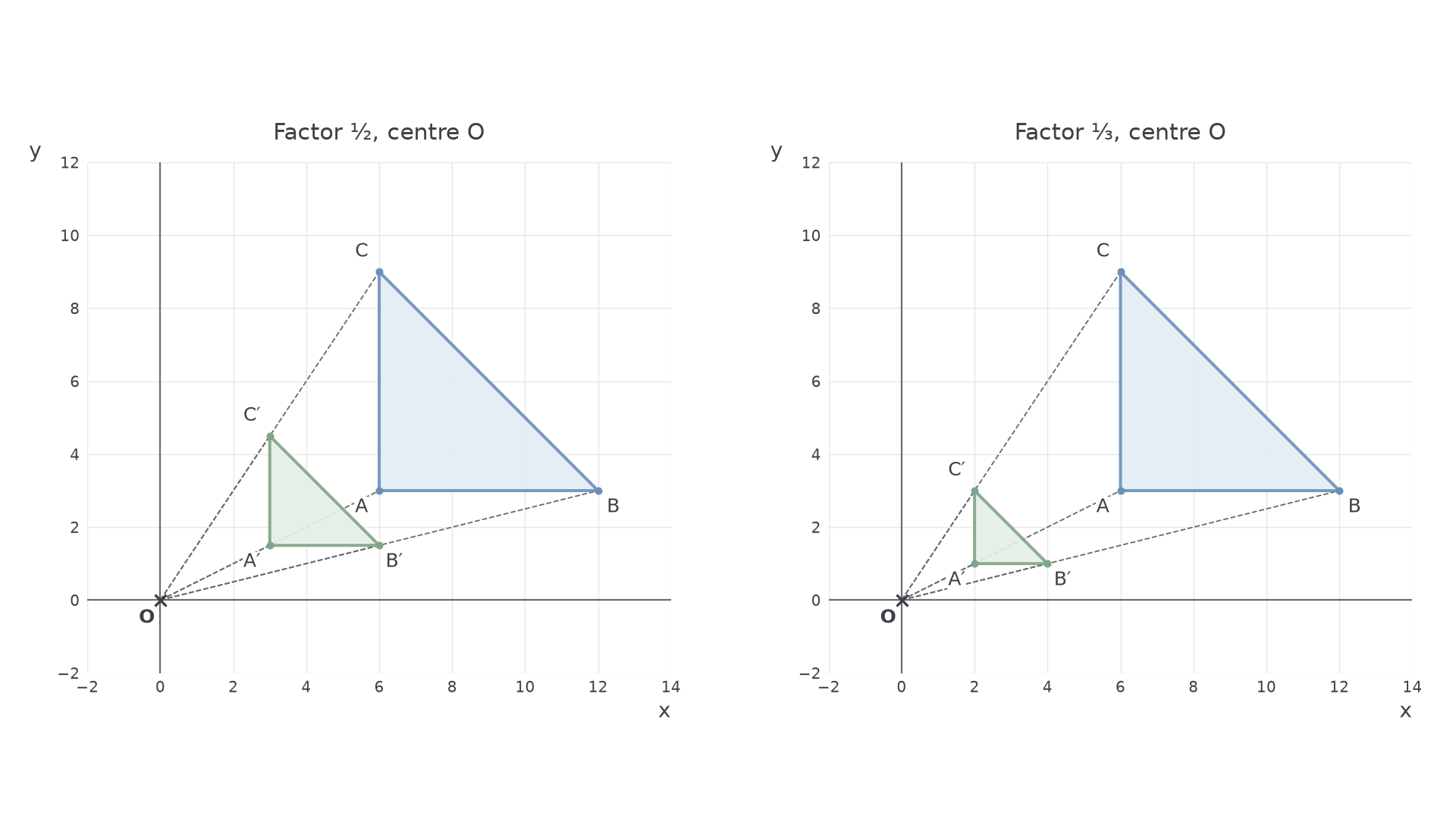
[DIAGRAM: asset_name: Positive fractional enlargements; asset_slug: fractional_enlargements; caption: The same triangle is reduced towards the origin by one half and one third.; description: Two accurate equal-scale grids show object vertices A six comma three, B twelve comma three and C six comma nine. The left image for factor one half has vertices three comma one point five, six comma one point five and three comma four point five. The right image for factor one third has vertices two comma one, four comma one and two comma three. Each image lies between its object and the centre at the origin along marked rays.]
Worked example 3: halving a shape
Question. Enlarge by factor about the origin.
Plan. Halve each displacement from the centre, keeping the same ray.
Answer. Join , as on the left grid.
Check. Original AB and AC each have length 6; the image lengths are each 3. Doubling every image coordinate recovers the object.
Continue this lesson.
You’re previewing NovaLearn without an account. Create a free account to read the rest.
Create free account