C6.4; E6.4 - Surface area of solids
A container needs enough material to cover its faces; leaving its top open saves material even when its side dimensions stay the same. C6.4 and E6.4 develop surface areas of prisms, pyramids, cylinders and cones. You will use nets, count exposed faces and select the height or sloping edge that each area calculation needs.
Nets and exposed faces
How much sheet material makes a closed box, and how much is saved by leaving its top open? Think of unfolding its surface into flat faces: calculate each face once, then add only the faces required.
Surface area and net
A solid's surface area is the total area of the specified surfaces. A net is an arrangement of flat faces that folds to form a solid. An exposed face is one on the outside, rather than hidden at a join or absent at an opening.
A closed cuboid has three pairs of matching rectangular faces. A right prism has two matching end faces and a rectangular side face for each straight edge of its cross-section. Multiplying the cross-section's perimeter by the prism length adds those side rectangles; it does not include the two ends.
[DIAGRAM: asset_name: Faces in two nets; asset_slug: cuboid_pyramid_nets; caption: Add each face once. A pyramid's triangular face height lies in its face.; description: A valid six-rectangle net of a cuboid with dimensions 6 cm, 4 cm and 3 cm is shown beside a square-based pyramid net. The pyramid has a 6 cm square base and four triangular faces each with perpendicular face height 5 cm. Paired cuboid faces share pale fill colours; dashed fold lines and the pyramid face-height right angle are shown.]
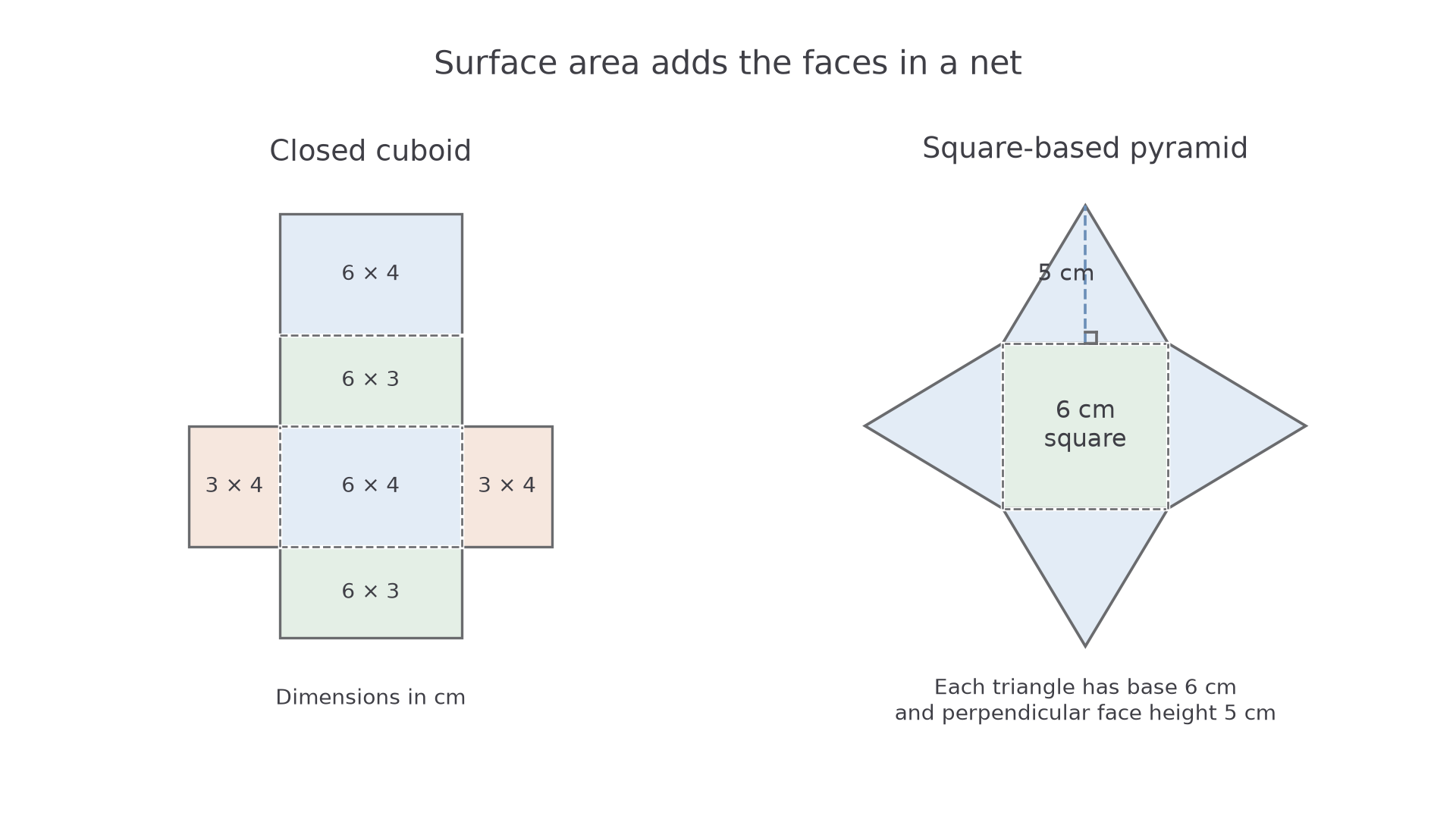
There is no supplied total-area formula for a cuboid, prism or pyramid: build the area from its faces. The triangle area formula is supplied on the Papers 1–4 lists. Required formulas are supplied within questions on Papers 5 and 6.
Worked example 1: six rectangular faces
Question. Calculate the total surface area of a closed cuboid measuring 6 cm by 4 cm by 3 cm.
Plan. Find the three different rectangular areas and count each twice.
Answer. .
Check. The six net faces have areas 24, 24, 18, 18, 12 and , totalling 108.
The next solid still has matching ends, but each end is triangular, so there are three side rectangles rather than four.
Worked example 2: five faces of a triangular prism
Question. A right triangular prism is 6 cm long. Its end is a right-angled triangle with perpendicular sides 3 cm and 4 cm and third side 5 cm. Calculate its total surface area.
Plan. Add two triangular ends and three rectangles running the full length.
Answer. .
Check. Listing the side areas separately gives 18, 24 and 30; adding the two ends gives .
A pyramid has no matching top face. Its triangular side faces meet at a vertex. To calculate a triangle's area, use its perpendicular height within that face, not the perpendicular height of the whole solid.
Worked example 3: a square-based pyramid
Question. A square-based pyramid has base side 6 cm. Each triangular face has perpendicular face height 5 cm. The perpendicular height of the solid is 4 cm. Calculate its total surface area.
Plan. Add the square base and four triangular faces, using face height 5 cm.
Answer. .
Check. The four triangles in the net cover ; the square covers 36. The solid height 4 cm is unused because this is an area calculation on the faces.
Removing a face subtracts its area. For example, the cuboid's 6 cm by 4 cm lid covers , so its open-top area is . A thin sheet is treated as having negligible thickness: count the sheet area once unless the question specifically asks for both sides to be painted.
Watch out
Do not calculate volume instead of area. In the pyramid, uses the solid height in the wrong plane; each side triangle needs face height 5 cm.
Decide which faces are present before adding their areas.
Cylinder surface
Cutting a cylinder's curved surface along its height and unrolling it gives a rectangle. The rectangle's width is the circumference , and its height is , so its area is .
Curved surface area of a cylinder
For a closed cylinder, add two circular ends, each of area . For an open-top container, add just its circular base. The curved-area and circle-area formulas are on the supplied lists for Papers 1–4; required formulas are supplied within questions on Papers 5 and 6.
Continue this lesson.
You’re previewing NovaLearn without an account. Create a free account to read the rest.
Create free account