E7.3 - Exact trigonometric values (Extended)
A calculator displays a decimal for the height of a triangle, but can you give the height without rounding at all? Special triangles give exact sine, cosine and tangent values. You will derive the values, recognise their patterns and use them in calculations that keep square roots exact.
Special triangles
A right triangle has hypotenuse 2 and an angle of . Its height is , rather than a rounded decimal. Two familiar shapes explain where this number comes from.
You already know
In a right triangle, , and . Pythagoras gives the third side. A surd such as keeps an irrational length exact.
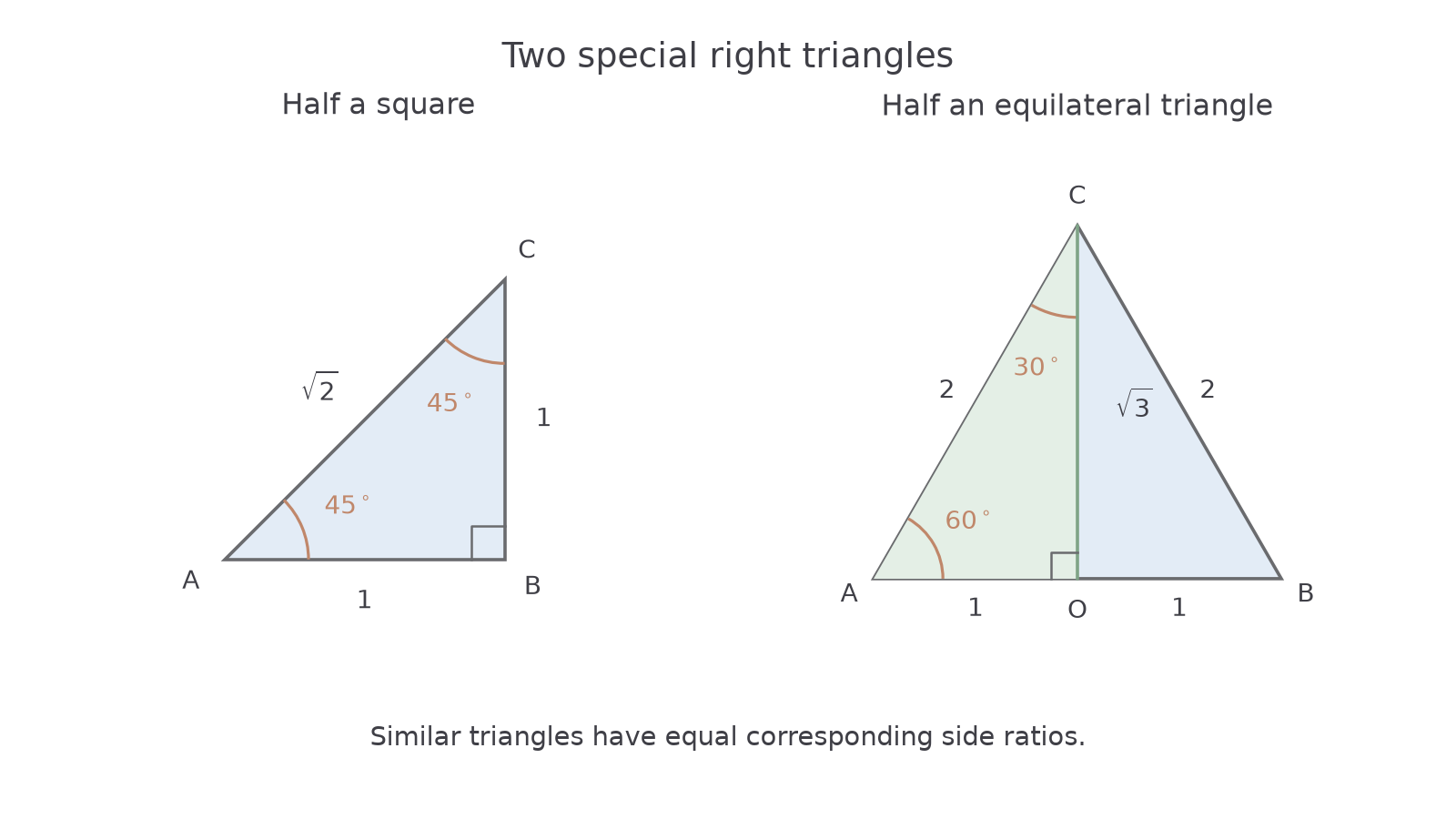
Cut a square along a diagonal to make two equal angles of . Cut an equilateral triangle down its line of symmetry to make angles of , and . Similar triangles have the same side ratios, whatever their size.
[DIAGRAM: asset_name: Two special right triangles; asset_slug: special_right_triangles; caption: A square diagonal gives 45 degrees; half an equilateral triangle gives 30 and 60 degrees.; description: Left, an exact right isosceles triangle has perpendicular sides 1 and 1 and hypotenuse square root 2, with both acute angles 45 degrees. Right, an equilateral triangle of side 2 is bisected perpendicularly into two right triangles with short side 1, height square root 3 and hypotenuse 2; angles 30 and 60 degrees are labelled.]
To remove a square root from a denominator, multiply both numerator and denominator by that root. For example, ; multiplying by preserves the value.
Worked example 1: a square diagonal
Question. Derive the exact sine and cosine of from a right triangle with two sides of length 1 meeting at the right angle.
Plan. Find the hypotenuse, then divide each equal leg by it.
Answer. Both values are .
Check. Symmetry makes the opposite and adjacent sides equal. Also , agreeing with the squared side ratios in Pythagoras.
The second shape changes the equal-sided triangle before the cut: start with three equal sides, so the resulting right triangle has unequal legs.
Worked example 2: half an equilateral triangle
Question. An equilateral triangle has side 2. Derive , , and .
Plan. Bisect the triangle through its top vertex, then use the resulting right triangle.
The cut halves the base and the top angle. The new triangle has hypotenuse 2, short leg 1 and height .
For , the side of length 1 is opposite. For , it is adjacent: changing the reference angle swaps the roles of the legs.
Answer. The four exact values are , in the order asked.
Check. The angles add to . The longer leg is opposite , so , as the results show.
Scaling changes the lengths but leaves these ratios unchanged.
Watch out
is exact; 0.866 is an approximation. Keep the surd when an exact value is required.
Use the same construction at a different scale.
Sine and cosine values
The two triangles give the interior values in the table. To include and , imagine a line of length 1 rotating from horizontal to vertical. Its horizontal distance is ; its vertical height is . At the horizontal position these are 1 and 0; at the vertical position they are 0 and 1. The endpoint positions are not ordinary right triangles, so we use this interpretation there.
Continue this lesson.
You’re previewing NovaLearn without an account. Create a free account to read the rest.
Create free account