E4.6 - Perpendicular lines and bisectors (Extended)
A line rises 2 units for every 3 units to the right. What direction would cross it at a right angle? E4.6 develops perpendicular gradients and equations, then combines them with a midpoint to find a perpendicular bisector.
Perpendicular gradient
Turn a right-angled gradient triangle through . A movement 3 right and 2 up becomes 2 left and 3 up. The first direction has gradient ; the turned direction has gradient .
[DIAGRAM: asset_name: Turning a gradient direction through a right angle; asset_slug: perpendicular_gradient_turn; caption: A quarter-turn exchanges horizontal and vertical changes and reverses one sign.; description: Equal-scale coordinate axes show two lines through the origin with gradients two thirds and minus three halves. A blue direction triangle has run three and rise two, and a sage triangle has run minus two and rise three. A right-angle marker at the origin confirms the perpendicular directions.]
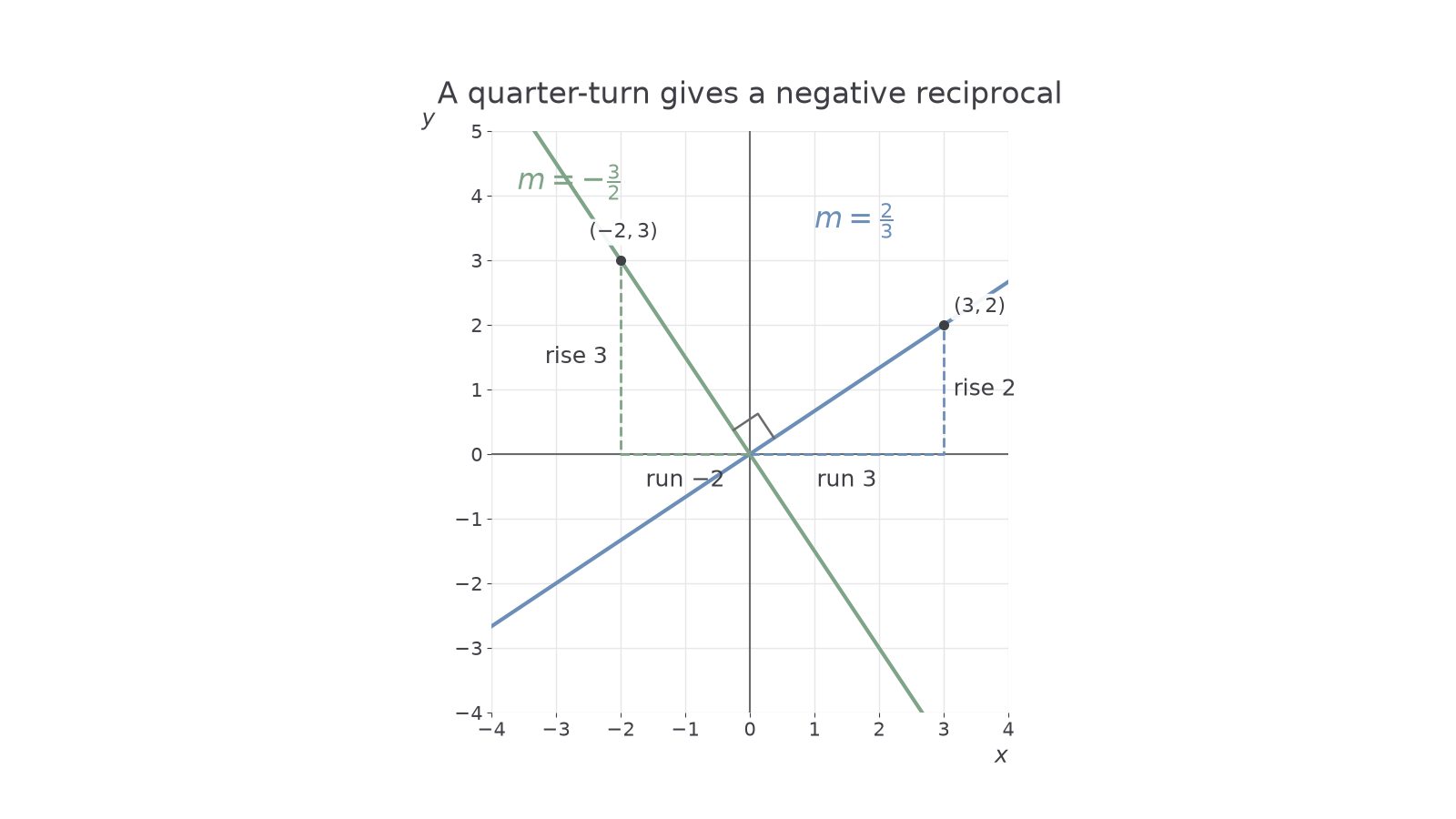
Perpendicular gradients
For two non-vertical lines with non-zero gradients,
The second gradient is the negative reciprocal of the first. A horizontal line and a vertical line are perpendicular; their gradients do not fit the product rule because the vertical gradient is undefined.
Not in the supplied formula list: learn it.
The quarter-turn explains both parts of the rule: exchange numerator and denominator, then change the sign.
Worked example 1: a positive fractional gradient
Question. Find the gradient of a line perpendicular to .
Plan. Take the negative reciprocal of .
Answer. .
Check. , as required.
Now the original gradient is negative. Its negative reciprocal is positive.
Worked example 2: first revealing the gradient
Question. Find the gradient of a line perpendicular to .
Plan. Divide the whole equation by 3, then take the negative reciprocal.
Answer. .
Check. . A negative slope and a positive slope can cross at a right angle.
For , the gradient is zero. A perpendicular is vertical, such as ; do not attempt to evaluate . Conversely, every perpendicular to is horizontal and has gradient zero.
Watch out
Changing only the sign is insufficient: a perpendicular to gradient 5 has gradient , not . Taking only the reciprocal is also insufficient.
Separate the ordinary case from the vertical case.
Equation through a point
The perpendicular gradient sets the direction. Substituting a specified point into locates the required perpendicular line.
Worked example 3: a positive original gradient
Question. Find the equation of the line perpendicular to through .
Plan. Find the negative reciprocal of 2, then use the point to find .
Answer. .
Check. , and at the proposed line gives . Both the direction and the point are correct.
Change only the sign of the original gradient next. The perpendicular direction reverses its sign too.
Worked example 4: a negative original gradient
Question. Find the equation of the line perpendicular to through .
Plan. Use perpendicular gradient , then substitute the point.
Answer. .
Check. and .
A perpendicular to the horizontal line through is . A perpendicular to the vertical line through that point is . In these cases the relevant coordinate gives the equation immediately.
Exam tip
Show the perpendicular gradient and the point substitution. They are separate decisions: a correct gradient alone does not locate the line.
Simplify the given equation before finding its perpendicular.
Continue this lesson.
You’re previewing NovaLearn without an account. Create a free account to read the rest.
Create free account