C9.3; E9.3 - Probability tree diagrams
A bag contains 6 red and 4 blue counters. If you draw twice with replacement, is “one of each colour” the same event as “red then blue”? C9.3 and E9.3 organise the stages in a tree, calculate one path and combine all paths belonging to an event.
Branch conventions
A tree separates the first-stage choices, then starts a fresh set of branches after each first result. A complete path from left to right records one ordered combined outcome.
Probability tree
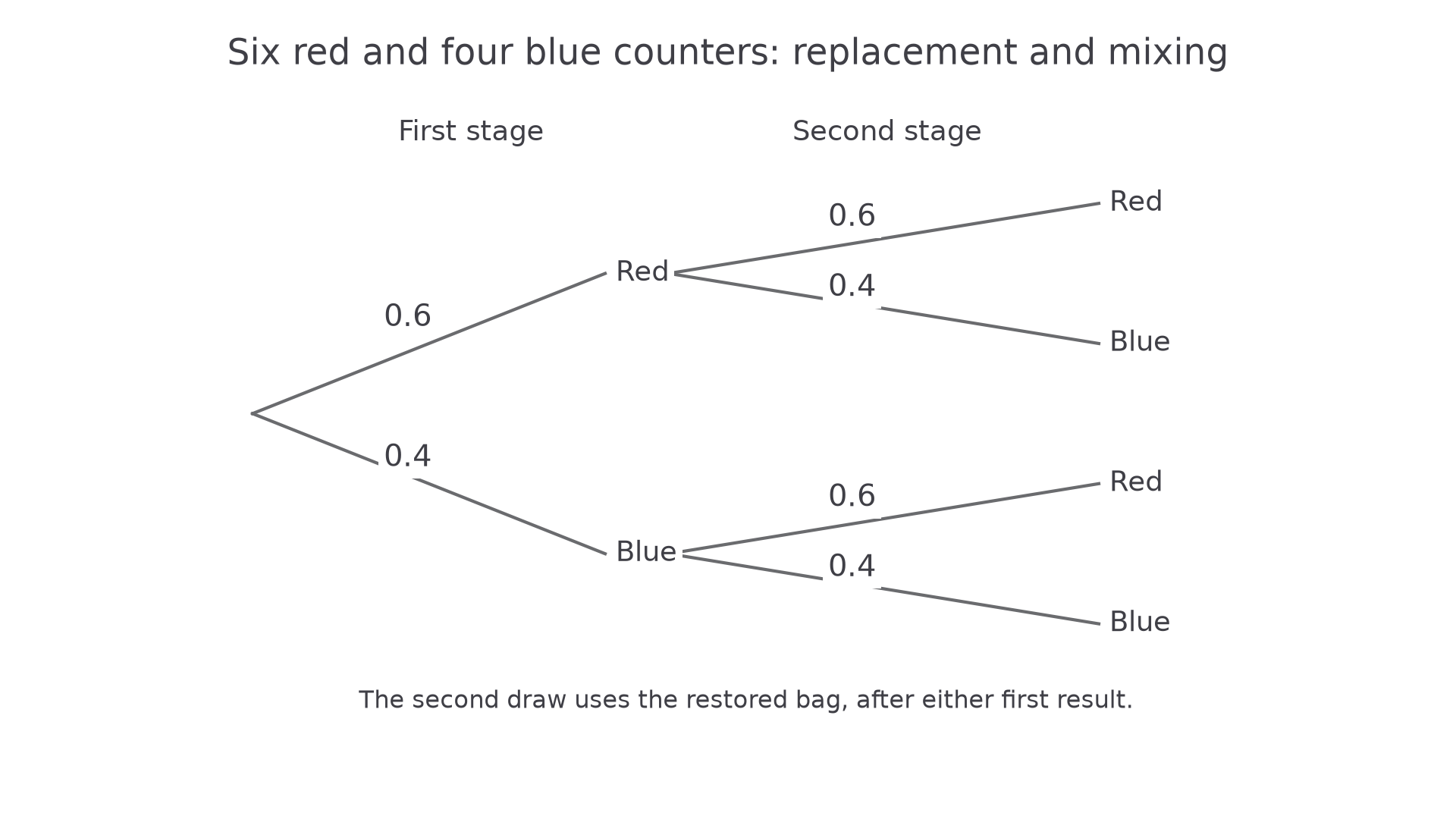
In a probability tree, write outcomes at the ends of branches and probabilities beside branches. Branches leaving the same point describe all the possible next outcomes, so their probabilities add to 1.
For with-replacement draws, put the counter back and mix before drawing again. The second-stage branches therefore show the original probabilities after either first colour.
[DIAGRAM: asset_name: Two draws with replacement; asset_slug: replacement_tree; caption: Each split totals one, and replacement preserves the second-draw probabilities.; description: A complete two-stage probability tree for a bag of six red and four blue counters drawn at random with replacement and mixing. The first red and blue branches have probabilities zero point six and zero point four. After each first colour, the second red and blue branches again have probabilities zero point six and zero point four. Red and blue outcomes are labelled at branch ends.]
Worked example 1: repeat the restored probabilities
Question. A bag contains 6 red and 4 blue counters. Two random draws are made with replacement and mixing. State the probabilities on every branch of the tree.
Plan. Find the original colour probabilities, then use them again at each second-stage split.
Answer. At all three splits, the red branch is and the blue branch is .
Check. Each split totals . The bag returns to ten counters with its original colour counts before the second draw.
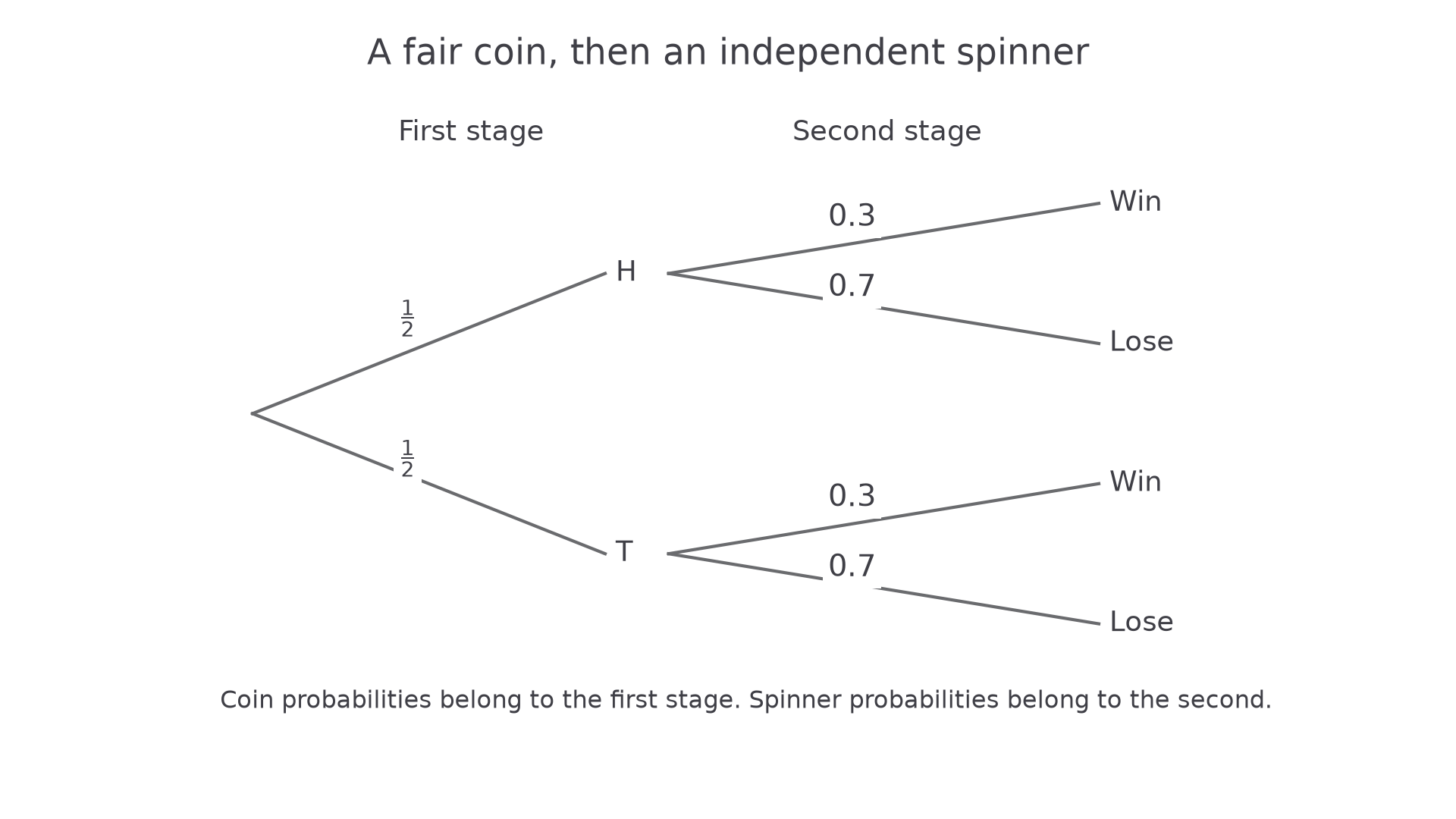
Now the two stages use different devices. Independent does not mean that the two devices have matching probabilities; it means the first result does not alter the second device's probabilities.
[DIAGRAM: asset_name: A coin followed by an independent spinner; asset_slug: coin_spinner_tree; caption: The spinner probabilities repeat after both coin results, while the coin has its own probabilities.; description: A complete tree starts with fair coin branches H and T of probability one half each. After H and after T, an independent spinner gives win with probability zero point three and lose with probability zero point seven. Outcomes are written at the ends and probabilities beside all six branches.]
Worked example 2: two different stages
Question. A fair coin is tossed. Independently, a spinner gives win with probability , otherwise lose. State all branch probabilities for a tree with coin first and spinner second.
Plan. Use the fair-coin probabilities at the first split and complement the spinner's win probability at each second split.
Answer. First-stage branches are each; both second-stage splits have win and lose .
Check. The three split totals are , and . The independent spinner keeps the same probabilities after H and T.
The branch probability describes the next result from that branch's starting point. It is not yet the probability of the whole path.
Watch out
Only add branches leaving the same point to check a total of 1. Adding all six branch labels of a two-stage tree gives 3, because it mixes three different splits.
Use a complement at each second-stage split.
Following a path
Following one path means getting its first result and then its second result. The second probability selects a fraction of the outcomes already on the first branch.
Continue this lesson.
You’re previewing NovaLearn without an account. Create a free account to read the rest.
Create free account