C1.1; E1.1 - Factors, multiples and primes
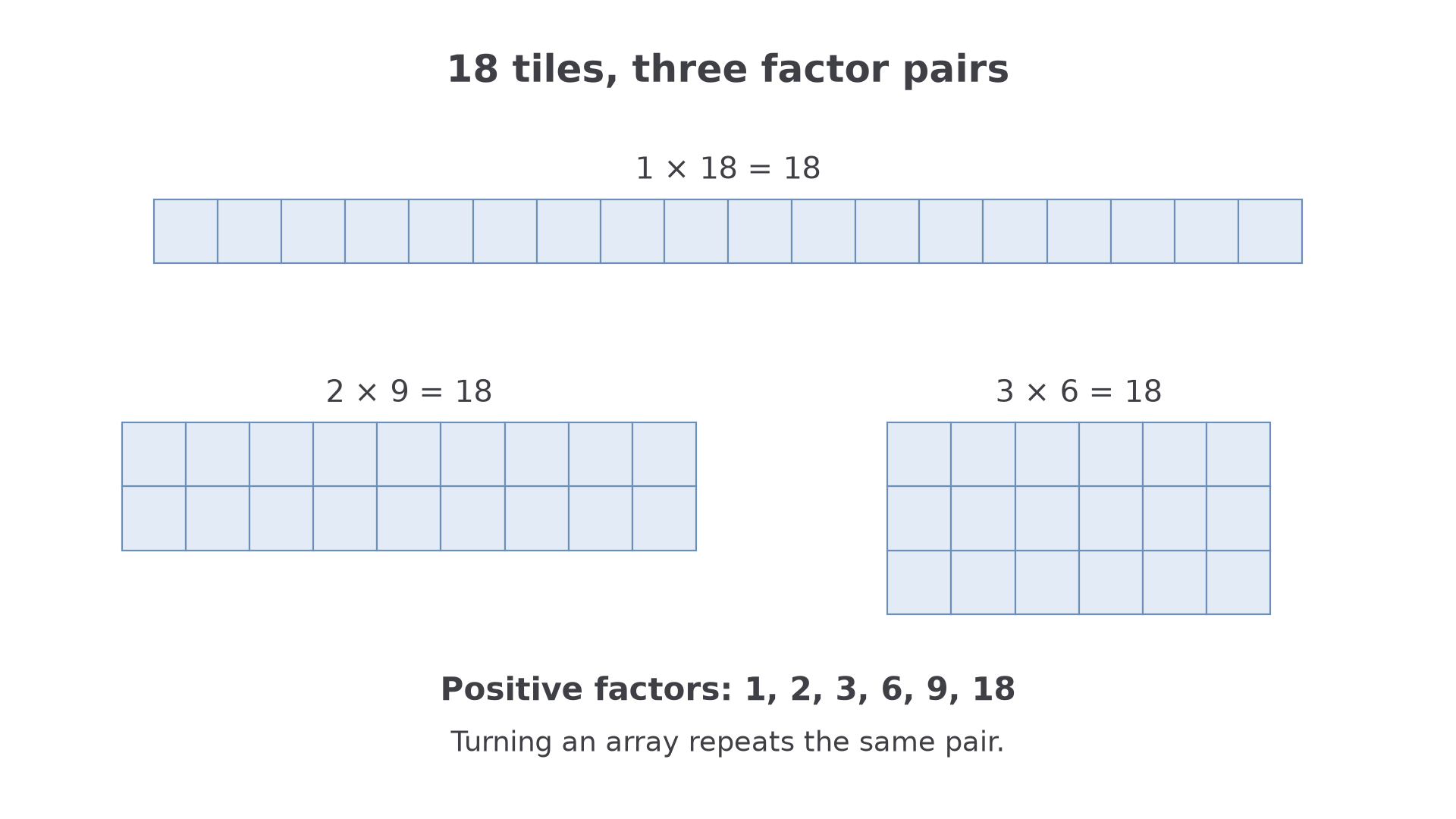
You can arrange 18 tiles in three different rectangles, counting a turned rectangle as the same arrangement. Why does 17 allow only one? This lesson develops the factors, multiples and prime factors in C1.1 and E1.1, so you can recognise the structure hidden inside a whole number.
Factor pairs
An exact rectangle gives you a multiplication statement: 3 rows of 6 tiles use tiles. Both 3 and 6 divide 18 exactly, so they are factors of 18.
Factor
A factor of a positive whole number divides it exactly, leaving no remainder. A factor pair is a pair of positive whole numbers whose product is that number.
The rectangles show every factor pair of 18. Turning the rectangle gives , so it does not produce a new pair.
[DIAGRAM: asset_name: Factor pairs of eighteen; asset_slug: factor_pairs_eighteen; caption: The three rectangles give every positive factor of 18.; description: Three exact arrays of eighteen unit squares arranged as one by eighteen, two by nine and three by six. Each is labelled with its dimensions and product. Turning a rectangle does not make a new factor pair.]
Worked example 1: finding every factor
Question. Write down all the positive factors of 18.
Plan. Test whole numbers in order, recording both members of each factor pair.
4 does not divide 18 exactly. By 5, the paired number would be smaller than 5; the factor pairs would then repeat in reverse.
Answer. .
Check. Dividing 18 by each listed number gives a whole number. The factors pair from the ends: , , .
The next number has an extra pair. Test possible divisors rather than guessing from the size of the number.
Worked example 2: a longer factor list
Question. Write down all the positive factors of 24.
Plan. Start at 1 and stop when the pairs begin to reverse.
5 does not divide 24 exactly. The next pair, , reverses a pair already recorded.
Answer. .
Check. Each pair multiplies to 24, and testing every whole number from 1 to 5 leaves no missing pair.
A factor list finishes: a positive factor cannot be larger than the number it divides.
Watch out
Include both 1 and the number itself. A factor must divide exactly: 5 is not a factor of 24 because .
Use pairs to keep your next list complete.
Multiples
A multiple comes from multiplying, rather than dividing. In , 24 is a multiple of 6 and 6 is a factor of 24: the same multiplication gives both relationships.
Multiple
A multiple of a number is the result of multiplying it by an integer. Its positive multiples use the multipliers . For example, the positive multiples of 6 begin .
Here “positive” tells you to start above zero. Zero is a multiple too, because , but it is not a positive multiple.
Worked example 3: generating multiples
Question. Write down the first four positive multiples of 6.
Plan. Multiply 6 by 1, 2, 3 and 4.
Answer. .
Check. The list increases by 6 each time, beginning with 6.
A range changes where the list starts and stops; it does not change the step size.
Worked example 4: multiples within a range
Question. Write down all the multiples of 9 between 20 and 60.
Plan. Find the first multiple above 20, then add 9 until the next would exceed 60.
Answer. .
Check. Each answer divides by 9 exactly. The neighbouring multiples, 18 and 63, lie outside the range.
Positive multiples keep going because you can always add the number once more.
Watch out
“Factor of 9” and “multiple of 9” ask for different lists. The factors are ; the positive multiples begin .
Check both ends of the requested range.
Prime numbers
Some positive whole numbers have only one rectangle: a single row. These are the prime numbers, which cannot be split into a product of two smaller positive whole numbers.
Prime number
A prime number is an integer greater than 1 with exactly two positive factors: 1 and itself. A composite number is an integer greater than 1 with more than two positive factors.
The number 1 has just one positive factor, so it is neither prime nor composite. The number 2 has exactly two positive factors, 1 and 2, so it is prime. Every larger even number has 2 as an extra factor, making 2 the only even prime.
Worked example 5: a prime number
Question. Is 17 prime? Give a reason.
Plan. Look for a factor pair other than .
17 is not divisible by 2, 3 or 4. Any pair with both factors at least 5 would have product at least , already larger than 17.
Answer. Yes. The only positive factors of 17 are 1 and 17.
Check. There is no possible pair left to test: a pair with a smaller factor from 2 to 4 has been ruled out, and two larger factors are too large.
For a composite number, one extra factor pair is enough to settle the question.
Worked example 6: a composite number
Question. Is 21 prime? Give a reason.
Plan. Test for an extra factor pair.
Answer. No. Its positive factors include 1, 3, 7 and 21, so it has more than two.
Check. exactly: the extra pair is genuine.
Odd numbers can be composite: being odd rules out 2 as a factor, but does not rule out 3, 5 or another factor.
Key idea
A factor pair explains the opening puzzle. The number 18 has several pairs; 17 is prime, so its only rectangle is .
Use the definition to make the next decision.
Prime factorisation
A composite factor can be split again. Keep splitting until every final factor is prime: these primes are the number’s multiplicative building blocks.
Prime factorisation
A prime factorisation expresses a positive integer greater than 1 as a product of prime numbers. Repeated prime factors must all be included.
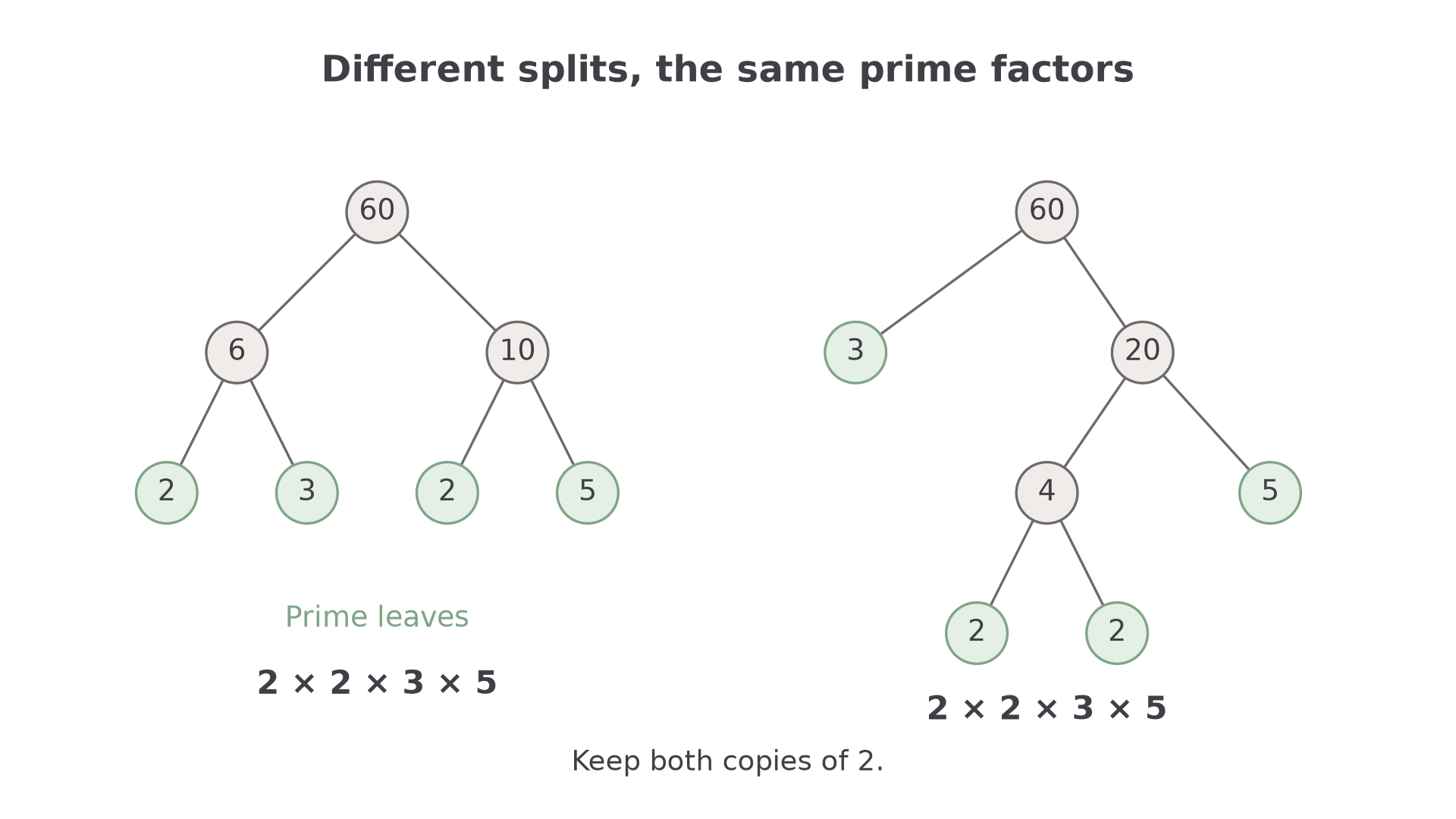
For example, has two copies of 2. You can write , where means , not .
[DIAGRAM: asset_name: Two factor trees for sixty; asset_slug: prime_trees_sixty; caption: Different first splits give the same prime factors, including two copies of 2.; description: Two exact factor trees start from sixty. The first splits into six and ten, then two and three from six and two and five from ten. The second splits into three and twenty, then four and five from twenty and two and two from four. Prime leaves are highlighted, and both give two times two times three times five.]
Worked example 7: a product of primes
Question. Write 60 as a product of its prime factors.
Plan. Split 60 into convenient factors, then split each composite factor.
Answer. , or .
Check. . All final factors are prime.
The second example repeats a different prime. Keep every leaf of the tree, including repeats.
Worked example 8: repeated prime factors
Question. Write 90 as a product of its prime factors.
Plan. Use and split both composite factors.
Answer. .
Check. . The two copies of 3 are both needed.
The two trees for 60 reveal a useful surprise: the first split can change, while the final prime factors stay the same, apart from their order. You will use this structure to find common factors and common multiples later.
Watch out
A list of distinct primes is not always a prime factorisation. For 90, loses one copy of 3. Also, stop at prime leaves: a final factor such as 9 still needs splitting.
Finish by checking both the product and the final factors.
Quick Recap
- Factors divide exactly; use pairs to find a complete positive factor list.
- Positive multiples come from multiplying by .
- A prime has exactly two positive factors. The number 1 is neither prime nor composite.
- Prime factorisation keeps every repeated prime factor; multiply back to check.
The opening rectangles show the distinction: 18 is composite, while 17 has only the pair .