E2.2 - Factorising quadratics (Extended)
Which two brackets expand to ? The middle coefficient and the constant give two clues, and both must fit. This Extended E2.2 lesson develops quadratic factorisation, then combines it with extracting a common factor to factorise cubic expressions fully.
Monic quadratics
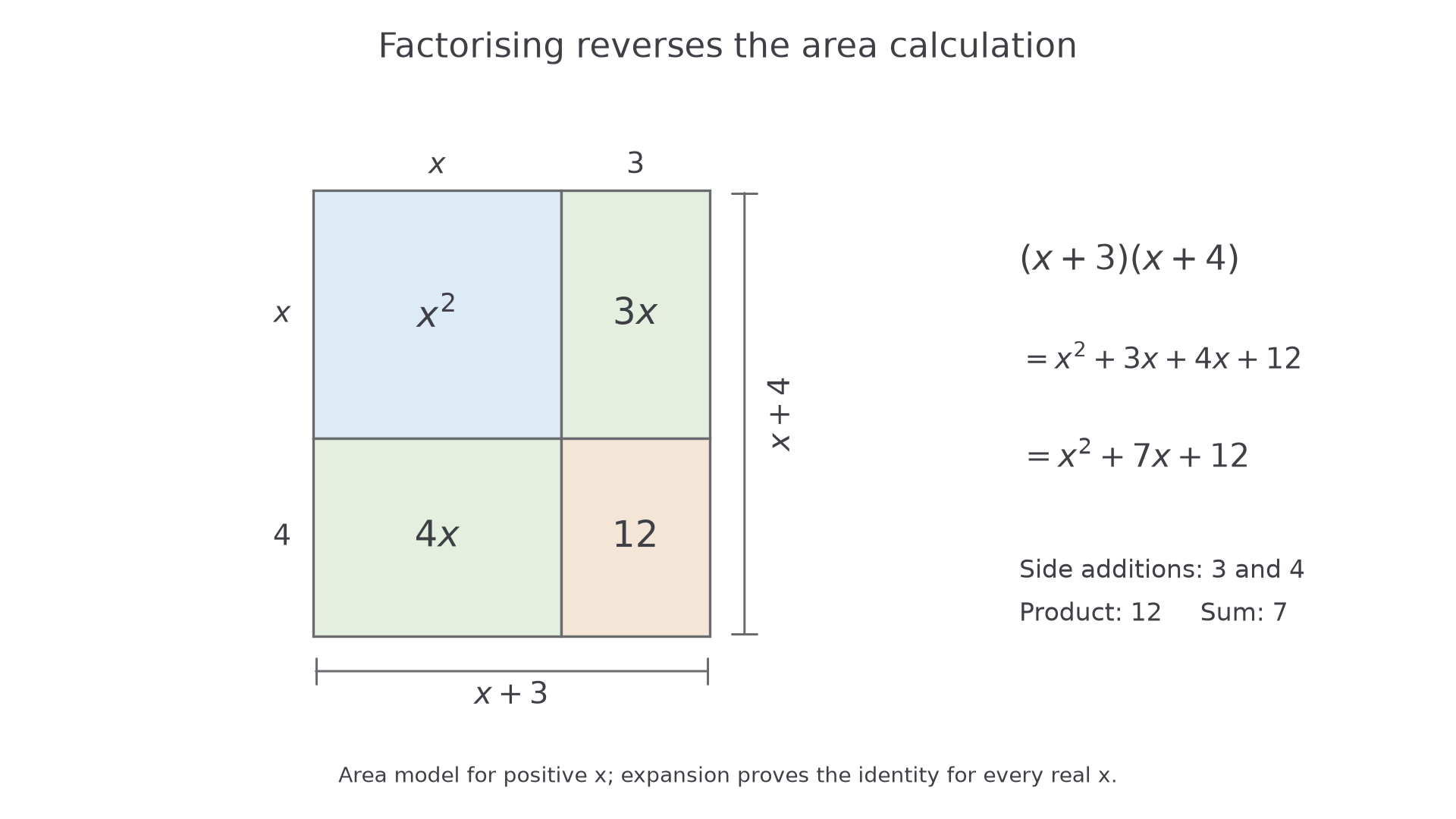
A rectangle with sides and has area . Splitting each side shows four areas: , , and 12. The two middle areas combine to give .
[DIAGRAM: asset_name: Quadratic area model; asset_slug: quadratic_area_model; caption: The two side additions multiply to 12 and add to 7.; description: A rectangle partitioned into four regions with side segments x and 3 horizontally, and x and 4 vertically. The four regions are labelled x squared, 3x, 4x and 12. Full sides are x plus 3 and x plus 4. The illustration uses positive x; the resulting algebraic identity holds for every real x.]
Monic quadratic
A quadratic expression has highest power 2 and a non-zero coefficient of that power. It is monic when the coefficient of is 1, as in .
Expanding two brackets explains the clues:
To reverse this expansion, find numbers whose product is the constant and whose sum is the coefficient of . A positive product needs equal signs; a negative product needs opposite signs. The area picture uses positive lengths, but expansion proves the identity for negative values of too.
Worked example 1: two positive constants
Question. Factorise .
Plan. Find a factor pair of 12 that adds to 7.
Answer. .
Check. Expansion gives , checking every coefficient.
The next expression keeps the middle coefficient 7 but changes the constant to a negative value. The two bracket constants must now have opposite signs, while their sum is still positive.
Worked example 2: opposite signs
Question. Factorise .
Plan. Find a signed pair with product and sum 7.
Answer. .
Check. .
For , both constants would be negative: and . Check the sum as well as the product. Some quadratics, such as , have no factorisation into brackets with integer constants; do not force an unsuitable pair.
Watch out
has constant 12, but its middle term is , not . Matching only the constant does not establish a factorisation.
Use the two clues together.
Non-monic quadratics
When the coefficient of is not 1, a simple pair of constants is no longer enough. Splitting the middle term lets you recover the four terms that came from expanding two brackets.
For , look for numbers and with and . Replace by , then factorise the two pairs. The condition makes the same bracket appear in both pairs. You may instead find the brackets directly, provided their expansion matches all three terms.
Worked example 3: splitting a positive middle term
Question. Factorise .
Plan. Split 11 into two numbers with product , then extract common brackets.
Answer. .
Check. Expanding gives .
Change only the sign of the middle term. The product of the splitting numbers stays positive, so both splitting numbers must now be negative.
Worked example 4: splitting a negative middle term
Question. Factorise .
Plan. Use and , whose product is 18 and sum is .
Answer. .
Check. .
The final line uses the same distributive law as . Treat as one shared factor, even though it contains two terms.
Watch out
The splitting product is , not just . Also, : taking out changes both signs inside the bracket.
Write the split before grouping if you need to keep the signs visible.
Common factors first
A cubic expression can hide a quadratic. If every term contains , extract it before looking for two brackets. Include any numerical common factor at the same time: “factorise” means factorise fully.
For example, . The outside remains part of the answer. Extracting it is an identity, not division of an equation: no value, including , is lost.
Worked example 5: a cubic with a shared letter
Question. Factorise .
Plan. Extract , then factorise the remaining monic quadratic.
Answer. .
Check. ; multiplying by returns . At , both forms are also zero.
The next expression changes only by an overall factor of 2. Remove that numerical factor together with the letter so that the same quadratic appears.
Worked example 6: a numerical factor as well
Question. Factorise .
Plan. Extract the full common factor , then reuse the quadratic pattern.
Answer. .
Check. Re-expansion gives . The leading term is , so the outside factor has been kept.
If the remaining quadratic is non-monic, apply the splitting method from the preceding part. The order is still common factor first, quadratic second, expansion check last.
Watch out
is correct but unfinished. loses the factor . The full answer needs all three factors and the numerical multiplier.
Finish every factorisation you can see.
Quick Recap
- For a monic quadratic, bracket constants have the required sum and product.
- For a non-monic quadratic, split the middle coefficient using product , then group.
- Remove a full common factor before factorising a remaining quadratic.
- Expand the proposed factors to check every original term.
The opening expression is : 3 and 4 multiply to 12 and add to 7.