AO2 - Explaining an investigation
A border around a square gets longer as the central square grows. How can you explain its area without drawing every stage? AO2 brings together choosing mathematics, reasoning beyond examples and communicating a conclusion whose certainty matches the evidence.
Selecting a strategy
Choose mathematics that matches what the question asks you to find. If a region is described as an outer shape with a hole, subtraction may be simpler than counting individual squares. If a relationship is unclear, a small table or a labelled GDC plot can help you decide what to investigate next.
Problem-solving
Identify the unknown, select the relevant information and connect a representation to a calculation. A diagram can reveal lengths, a table can reveal changes and algebra can express the same calculation for any allowed input.
For a square border, area and perimeter answer different questions. Here we want the amount of material, so use area. On Papers 5 and 6, required formulas are supplied within the questions. You still need to choose the relevant one, identify its dimensions and apply it to the correct regions.
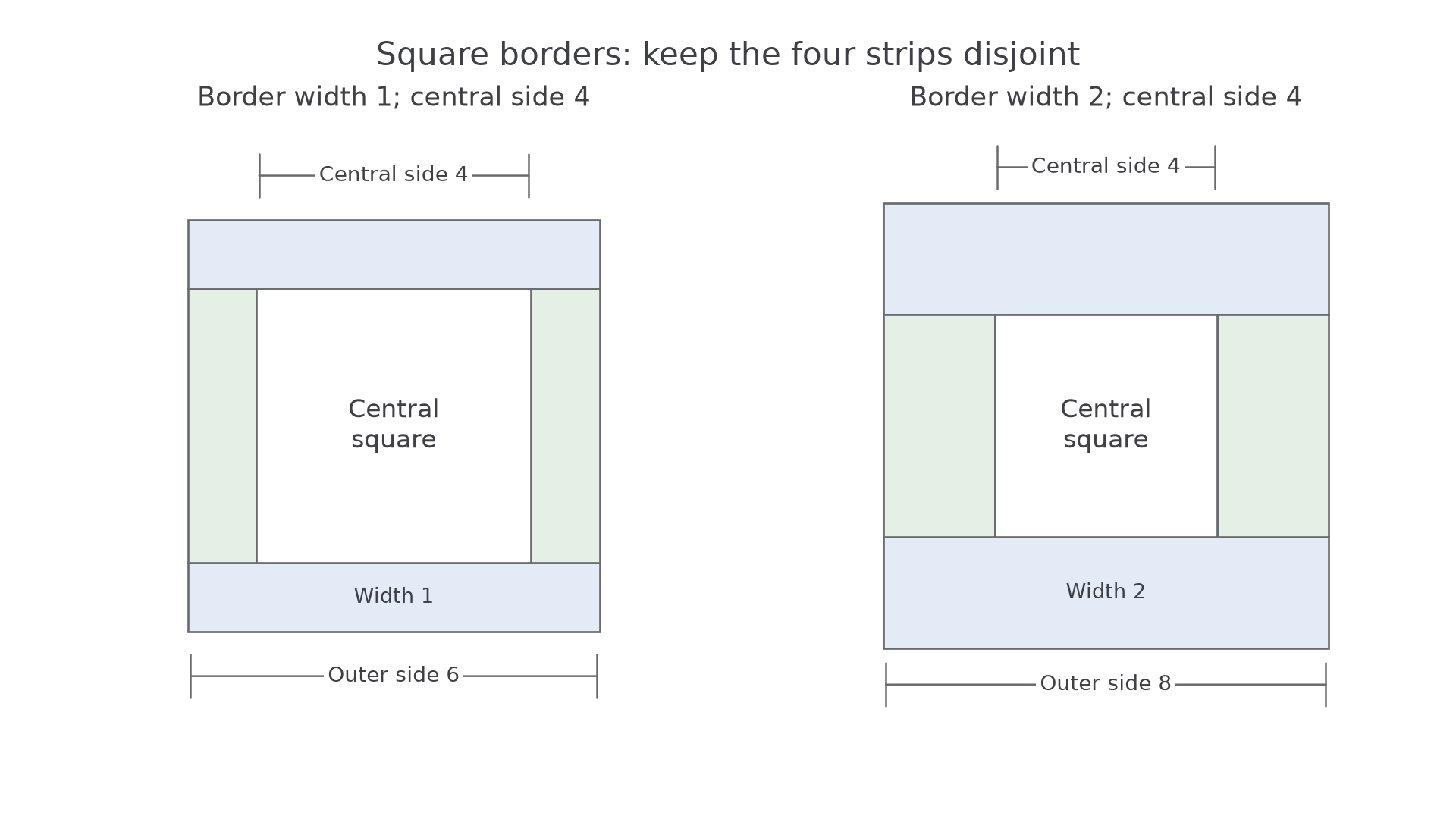
[DIAGRAM: asset_name: Two widths of square border; asset_slug: investigation_square_borders; caption: Subtract the hole, or partition the border into non-overlapping strips.; description: Two exact square borders have a central square of side four units. Left border has width one unit and outer side six, partitioned into two full-width horizontal strips and two shorter vertical strips. Right border has width two units and outer side eight, partitioned in the same way. The two horizontal strips are blue and vertical strips sage. Dimensions and non-overlapping boundaries are labelled.]
Worked example 1: subtracting a central square
Question. A square of side cm has a border 1 cm wide all around it. Use the rectangle area formula to express the border area in terms of , and find it when .
Plan. Find the outer side, then subtract the central square's area.
There is 1 cm of border at both ends of each side, so the outer side is , not .
Answer. , giving at .
Check. Partition into two horizontal strips and two vertical strips: . Their interiors do not overlap.
Double the border width while leaving the central side variable unchanged. This changes both the long strips and the corner contributions.
Worked example 2: a wider border
Question. A square of side cm has a border 2 cm wide. Use to find the border area and evaluate it at .
Plan. Add two border widths to the central side before subtracting areas.
Answer. , giving at .
Check. Two full-width strips and two inner-height strips give . This also explains why doubling the border width did not merely double the original 28.
The two strategies give the same formula: . Agreement between different representations is a useful check on a chosen method.
Watch out
Adding the areas of four full-length border strips counts each corner twice. Use a non-overlapping partition or subtract the hole from the outside square.
Use either valid strategy and make the dimensions clear.
Reasoning beyond examples
A calculation for one case answers that case. To explain a pattern for every permitted starting value, keep the starting value as a letter and show why the expression simplifies in the same way each time.
General mathematical reason
A general reason uses the conditions of the construction to establish the claimed result for every allowed case. Algebraic identities, complete case divisions and exact geometric partitions can provide such reasons. A finite list of matching calculations cannot alone prove an unrestricted claim.
Consider three equally spaced positive integers. Compare the square of the middle number with the product of the outside numbers. With , the difference is . The issue is whether 1 comes from this particular start or from the spacing.
Worked example 3: consecutive integers
Question. Show algebraically that the square of the middle of three consecutive positive integers is 1 more than the product of the outside integers.
Plan. Write the integers as , then subtract the two complete products.
The terms involving cancel, so the result does not depend on the starting positive integer.
Answer. The middle square exceeds the outside product by 1 for every such triple.
Check. A new triple gives . This checks the calculation; the algebra, rather than the new example, supplies the general reason.
Change the gap from 1 to 3. Retain the same comparison so you can see precisely which part of the earlier cancellation changes.
Continue this lesson.
You’re previewing NovaLearn without an account. Create a free account to read the rest.
Create free account