C1.14; E1.14 - Time, clocks and timetables
A journey can finish on a different day even though it lasts less than two hours. Learn to convert time units, read clocks and timetables, and compare local times using C1.14 and E1.14. Keeping the date beside the time makes overnight journeys much easier to follow.
Time units
Is hours the same as 2 hours 50 minutes? The decimal measures a fraction of an hour: half of 60 minutes is 30 minutes, so the two durations are different.
Duration
A duration measures how long something lasts. A clock time, such as 14 20, identifies a point in the day.
Use the size of the unit to decide whether to multiply or divide. There are more minutes than hours in the same duration, because minutes are smaller.
| Relationship | Conversion |
|---|---|
| 1 minute | 60 seconds |
| 1 hour | 60 minutes, or 3600 seconds |
| 1 day | 24 hours |
| 1 week | 7 days |
| 1 year | 12 months; use 365 days in these calculations |
Months have different numbers of days: there is no single exact “days per month” conversion. For example, 18 months is years. Using 365 days per year gives days as a year-based conversion, rather than the length of every possible 18-calendar-month period. Also, , so one year is 52 weeks and 1 day, not exactly 52 weeks.
Worked example 1: mixed units to seconds and hours
Question. Express 2 hours 18 minutes in seconds and in decimal hours.
Plan. Convert both parts to the same unit before adding.
Answer. 8280 seconds; hours.
Check. . Also, minutes, recovering the original duration.
Now reverse the direction: turn a decimal part of an hour into minutes.
Worked example 2: decimal hours to mixed units
Question. Express hours in hours and minutes, and in seconds.
Plan. Keep the 3 whole hours and multiply the remaining hour by 60.
Answer. 3 hours 24 minutes; 12 240 seconds.
Check. seconds.
Decimal place value still applies, but the units change by 60 rather than 100.
Watch out
. The correct decimal is hours. Divide minutes by 60, not 100.
Try the reverse conversion with a different decimal fraction.
Clocks
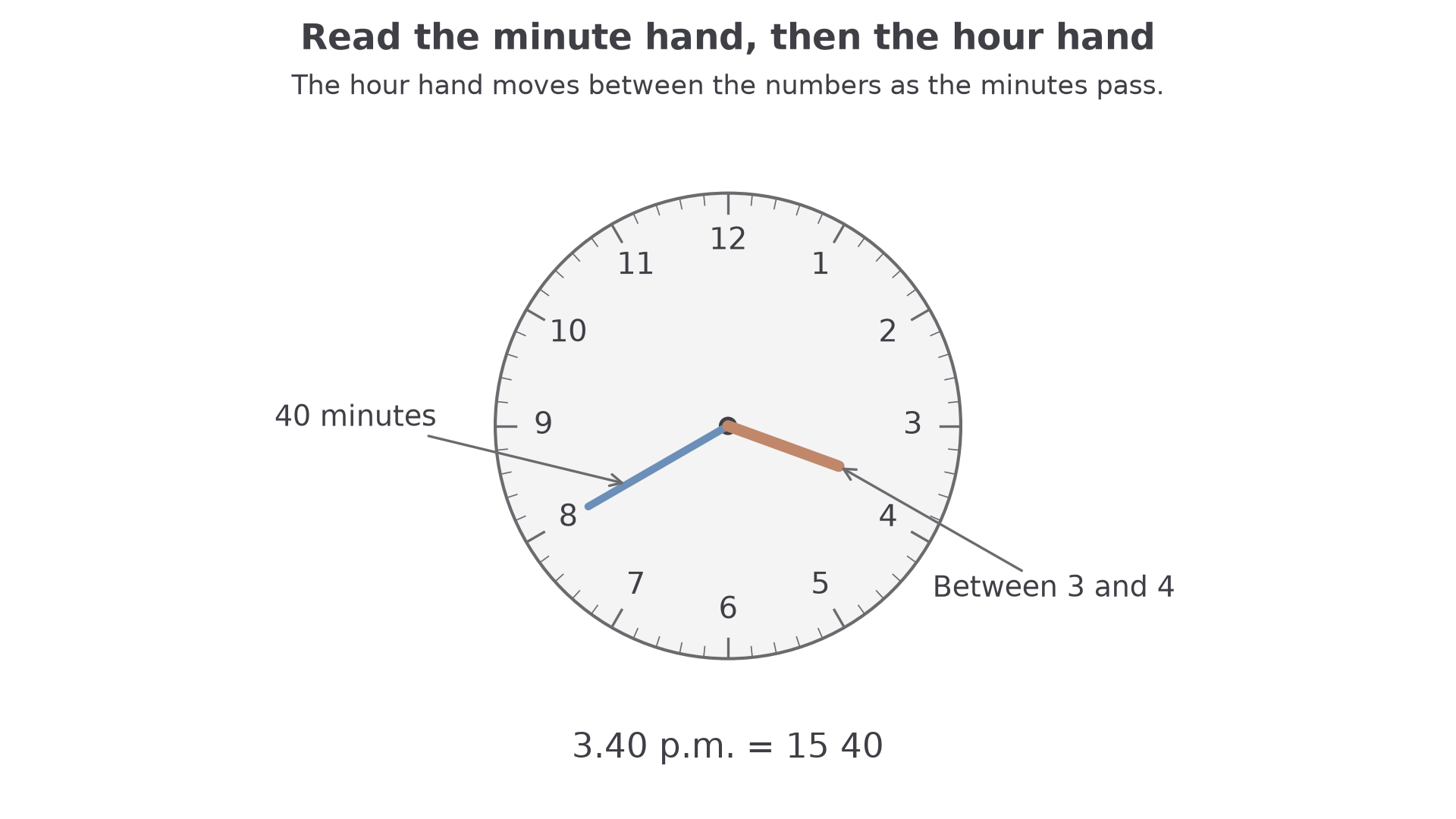
An analogue clock repeats every 12 hours, so its hands alone do not tell you whether it is morning or afternoon. The long minute hand points through 60 minutes in one turn; the short hour hand moves gradually between hour numbers.
[DIAGRAM: asset_name: Reading an analogue clock; asset_slug: clock_three_forty; caption: The minute hand shows 40 minutes and the hour hand is between 3 and 4.; description: An analogue clock with the long hand pointing to 8 and the shorter hand two thirds of the way from 3 to 4. Labels identify 40 minutes and the hour between 3 and 4. The time is 3.40, which is 15 40 if it is afternoon.]
12-hour and 24-hour time
In the 12-hour clock, a.m. means before noon and p.m. means from noon until midnight. In the 24-hour clock, hours run from 00 to 23, written with two minute digits: for example, 07 05.
The first two digits give hours; the last two give minutes. Use this table at the two boundaries.
| Event | 12-hour form | 24-hour form |
|---|---|---|
| Midnight, start of a day | 12.00 a.m. | 00 00 |
| Half an hour after midnight | 12.30 a.m. | 00 30 |
| Noon | 12.00 p.m. | 12 00 |
| Half an hour after noon | 12.30 p.m. | 12 30 |
For a.m. times from 1 to 11, keep the hour and add a leading zero if needed. For p.m. times from 1 to 11, add 12. Handle the hour 12 separately using the table.
Worked example 3: an afternoon clock
Question. A clock shows 3.40 in the afternoon. Write the time using the 24-hour clock.
Plan. Convert the afternoon hour, leaving the minutes unchanged.
Answer. 15 40.
Check. , and the 40 minute digits have not changed.
The next time lies just after midnight, where subtracting 12 mechanically would give the wrong hour.
Worked example 4: just after midnight
Question. Write 00 25 using the 12-hour clock.
Plan. Recognise hour 00 as the first hour after midnight.
Answer. 12.25 a.m.
Check. This is 25 minutes after midnight in both formats; 12.25 p.m. would be after noon.
The label is part of a complete 12-hour time.
Exam tip
Write a.m. or p.m. when giving a 12-hour time. “6.20” alone could mean morning or evening. Keep two minute digits: 6.05 a.m., not 6.5 a.m.
Use the midnight boundary to convert this time.
Time differences
A timetable gives clock times; a journey calculation asks for a duration. Count forward through convenient whole hours or midnight, rather than subtracting times as decimal numbers.
Time-zone difference
If town B is 3 hours ahead of town A, its clock reads 3 hours later at the same instant. Add 3 hours to change A's local time to B's; subtract 3 hours to reverse the conversion.
Time-zone differences here are supplied in the question. Keep the stated offset fixed throughout the journey, and change the date when crossing midnight.
Worked example 5: an overnight timetable
Question. This train timetable uses the same local time throughout. How long does the journey from West to East take?
| Station | Time |
|---|---|
| West, departure | Monday 23 35 |
| East, arrival | Tuesday 01 10 |
Plan. Split the journey at midnight.
Answer. 1 hour 35 minutes.
Check. Adding 1 hour 35 minutes to Monday 23 35 gives Tuesday 01 10.
For a flight, the arrival clock may also use a different time zone. First calculate the arrival instant in the departure time zone, then change zones.
Worked example 6: arrival in another time zone
Question. A flight leaves A at 22 50 on Monday and lasts 3 hours 25 minutes. B is 4 hours ahead of A. Find the arrival day and local time in B.
Plan. Add the duration using A's clock, then add the 4-hour offset.
Answer. Tuesday, 06 15 local time in B.
Check. Subtracting 4 hours from Tuesday 06 15 gives Tuesday 02 15 in A. Counting back 3 hours 25 minutes gives Monday 22 50.
Both journeys answer the opening question: crossing midnight changes the date even when a journey is short.
Watch out
For elapsed time, 14 10 minus 13 45 is 25 minutes, not 65 minutes. One hour contains 60 minutes. For time zones, “ahead” means add when converting to that place's local clock.
Work with one clock until the flight duration has been added.
Quick Recap
- Convert minutes and hours using 60; decimal hours are not hour-and-minute notation.
- Use 7 days per week, 12 months per year and 365 days per year where appropriate.
- Midnight is 00 00; noon is 12 00. Include a.m. or p.m. in 12-hour answers.
- Find elapsed time on one clock, then apply a supplied time-zone difference and check the date.
A journey from 23 35 to 01 10 lasts only 1 hour 35 minutes, but finishes on the next day.